


Cognitive impairment, depressive symptoms, and functional decline in older people
- PMID: 12110064
- PMCID: PMC2939718
- DOI: 10.1046/j.1532-5415.2002.50259.x
Cognitive impairment, depressive symptoms, and functional decline in older people
Abstract
Objectives: Although cognitive impairment and depressive symptoms are associated with functional decline, it is not understood how these risk factors act together to affect the risk of functional decline. The purpose of this study is to determine the relative contributions of cognitive impairment and depressive symptoms on decline in activity of daily living (ADL) function over 2 years in an older cohort.
Design: Prospective cohort study.
Setting: A U.S. national prospective cohort study of older people, Asset and Health Dynamics in the Oldest Old.
Participants: Five thousand six hundred ninety-seven participants (mean age 77, 64% women, 86% white) followed from 1993 to 1995.
Measurements: Cognitive impairment and depressive symptoms were defined as the poorest scores: 1.5 standard deviations below the mean on a cognitive scale or 1.5 standard deviations above the mean on validated depression scales. Risk of functional decline in participants with depressive symptoms, cognitive impairment, and both, compared with neither risk factor, were calculated and stratified by baseline dependence. Analyses were adjusted for demographics and comorbidity.
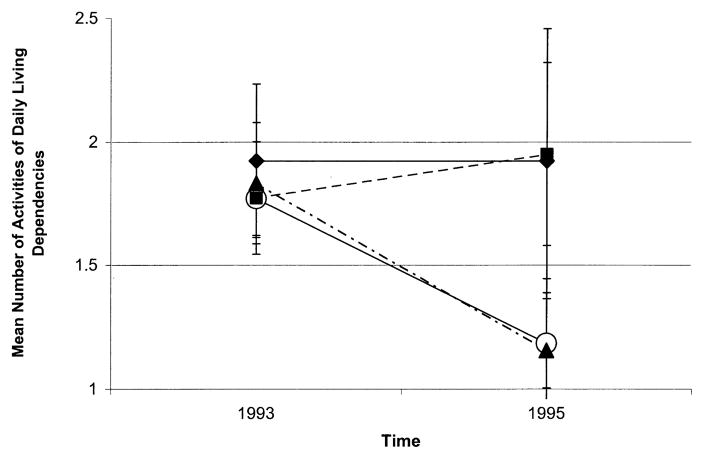
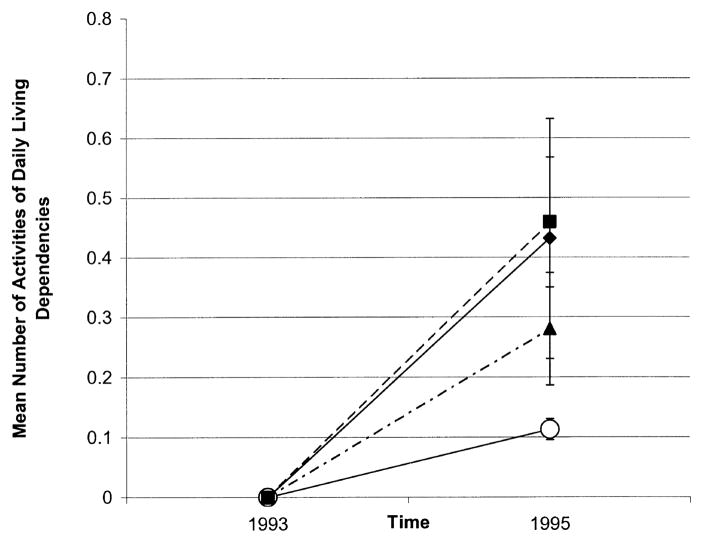
Results: Eight percent (n = 450) of subjects declined in ADL function. In participants who were independent in all ADLs at baseline, the relative risk (RR) of 2-year functional decline was 2.3 (95% confidence interval (CI) = 1.7-3.1) for participants with cognitive impairment, 1.9 (95% CI = 1.3-2.6) for participants with depressive symptoms, and 2.4 (95% CI = 1.4-3.7) for participants with cognitive impairment and depressive symptoms. In participants who were dependent in one or more ADLs at baseline, RR of 2-year functional decline was 1.9 (95% CI = 1.2-2.8) for participants with cognitive impairment, 0.6 (95% CI = 0.3-1.3) for participants with depressive symptoms, and 1.5 (95% CI = 0.8-2.6) for participants with cognitive impairment and depressive symptoms.
Conclusions: In participants with no ADL dependence at baseline, cognitive impairment and depressive symptoms are risk factors for decline, but that, in participants with dependence in ADL at baseline, cognitive impairment, but not depressive symptoms, is a risk factor for additional decline.
Figures
References
-
- Kramarow E, Rooks R, Weeks J, et al. Health, United States, 1999. Hyattsville, MD: National Center for Health Statistics; 1999. Health and Aging Chartbook.
-
- Yaffe K, Blackwell T, Gore R, et al. Depressive symptoms and cognitive decline in nondemented elderly women: A prospective study. Arch Gen Psychiatry. 1999;56:425–430. - PubMed
-
- Parmelee PA, Kleban MH, Lawton MP, et al. Depression and cognitive change among institutionalized aged. Psychol Aging. 1991;6:504–511. - PubMed
-
- Gallo JJ, Rabins PV. Depression without sadness: Alternative presentations of depression in late life. Am Fam Physician. 1999;60:820–826. - PubMed
-
- Cronin-Stubbs D, de Leon CF, Beckett LA, et al. Six-year effect of depressive symptoms on the course of physical disability in community-living older adults. Arch Intern Med. 2000;160:3074–3080. - PubMed
Publication types
MeSH terms
Grants and funding
LinkOut - more resources
Full Text Sources
Medical
