


P2Y(1) and P2Y(2) receptors are coupled to the NO/cGMP pathway to vasodilate the rat arterial mesenteric bed
- PMID: 12110609
- PMCID: PMC1573418
- DOI: 10.1038/sj.bjp.0704789
P2Y(1) and P2Y(2) receptors are coupled to the NO/cGMP pathway to vasodilate the rat arterial mesenteric bed
Abstract
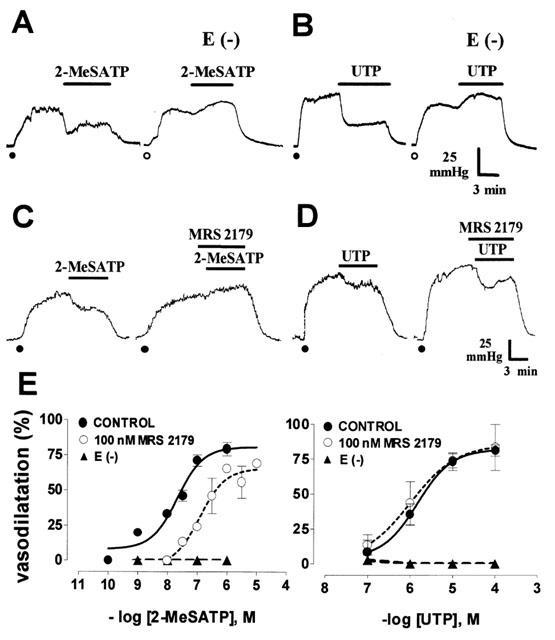
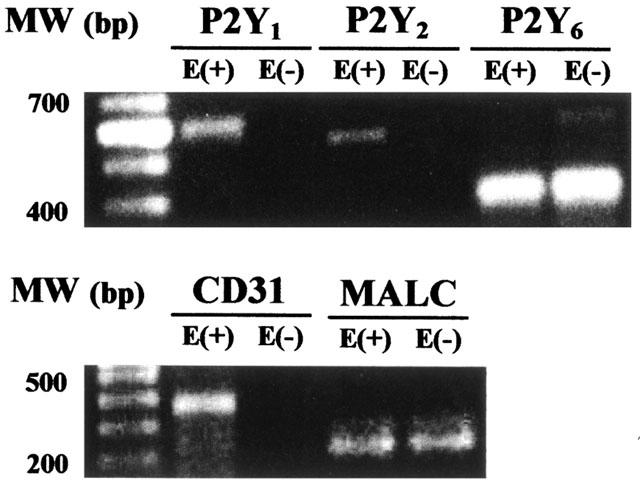
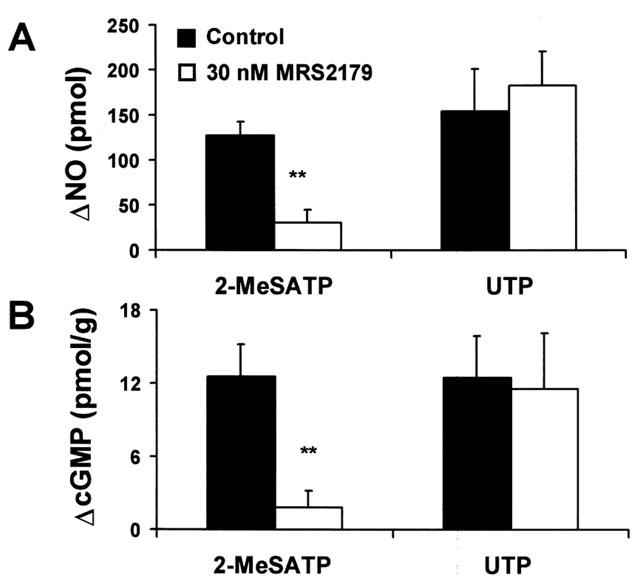
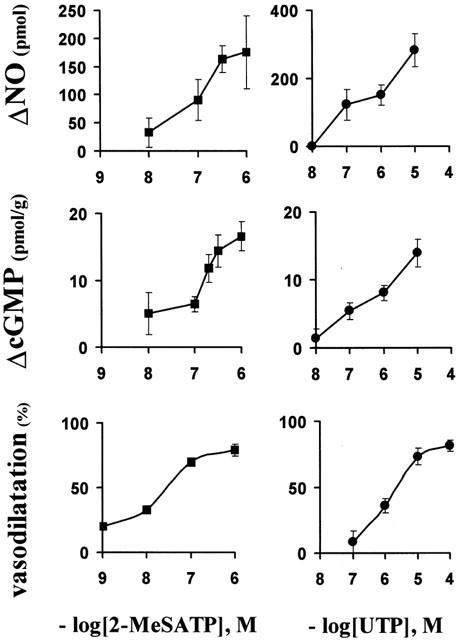
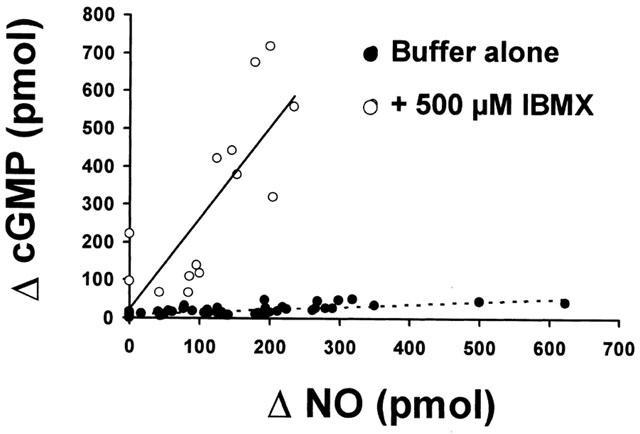
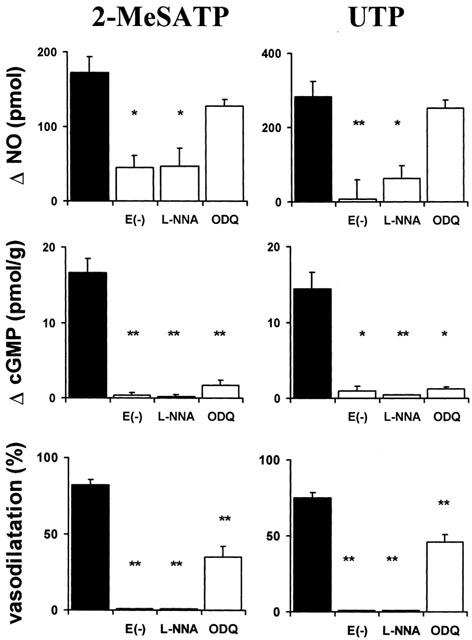
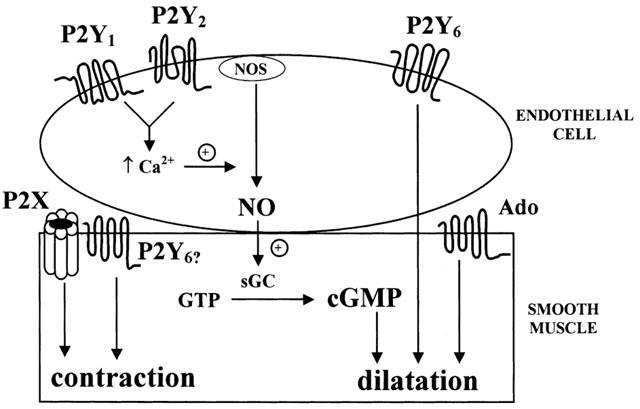
1. To assess the role of nucleotide receptors in endothelial-smooth muscle signalling, changes in perfusion pressure of the rat arterial mesenteric bed, the luminal output of nitric oxide (NO) and guanosine 3',5' cyclic monophosphate (cGMP) accumulation were measured after the perfusion of nucleotides. 2. The rank order of potency of ATP and analogues in causing relaxation of precontracted mesenteries was: 2-MeSADP=2-MeSATP>ADP>ATP=UDP=UTP>adenosine. The vasodilatation was coupled to a concentration-dependent rise in NO and cGMP production. MRS 2179 selectively blocked the 2-MeSATP-induced vasodilatation, the NO surge and the cGMP accumulation, but not the UTP or ATP vasorelaxation. 3. mRNA encoding for P2Y(1), P2Y(2) and P2Y(6) receptors, but not the P2Y(4) receptor, was detected in intact mesenteries by RT-PCR. After endothelium removal, only P2Y(6) mRNA was found. 4. Endothelium removal or blockade of NO synthase obliterated the nucleotides-induced dilatation, the NO rise and cGMP accumulation. Furthermore, 2-MeSATP, ATP, UTP and UDP contracted endothelium-denuded mesenteries, revealing additional muscular P2Y and P2X receptors. 5. Blockade of soluble guanylyl cyclase reduced the 2-MeSATP and UTP-induced vasodilatation and the accumulation of cGMP without interfering with NO production. 6. Blockade of phosphodiesterases with IBMX increased 15-20 fold the 2-MeSATP and UTP-induced rise in cGMP; sildenafil only doubled the cGMP accumulation. A linear correlation between the rise in NO and cGMP was found. 7. Endothelial P2Y(1) and P2Y(2) receptors coupled to the NO/cGMP cascade suggest that extracellular nucleotides are involved in endothelial-smooth muscle signalling. Additional muscular P2Y and P2X receptors highlight the physiology of nucleotides in vascular regulation.
British Journal of Pharmacology (2002) 136, 847-856
Figures
References
-
- ADRIAN K., BERNHARD M.K., BREITINGER H., OGILVIE A. Expression of purinergic receptors (ionotropic P2X1-7 and metabotropic P2Y1-11) during myeloid differentiation of HL60 cells. Biochim. Biophys. Acta. 2000;1492:127–138. - PubMed
-
- ANDERSON C.M., PARKINSON F.E. Potential signalling roles for UTP and UDP: sources, regulation and release of uracil nucleotides. TiPS. 1997;18:387–392. - PubMed
-
- BALLARD S.A., GINGELL C.J., TANG K., TURNER L.A., PRICE M.E., NAYLOR A.M. Effects of sildenafil on the relaxation of human corpus cavernosum tissue in vitro and on the activities of cyclic nucleotide phosphodiesterase isozyme. J. Urol. 1998;159:2164–2171. - PubMed
-
- BOARDER M.R., HOURANI S.M. The regulation of vascular function by P2 receptors: multiple sites and multiple receptors. Trends. Pharmacol. Sci. 1998;19:99–107. - PubMed
-
- BORIC M.P., FIGUEROA X.F., DONOSO M.V., PAREDES A., POBLETE I., HUIDOBRO-TORO J.P. Rise in endothelium-derived NO after stimulation of rat perivascular sympathetic mesenteric nerves. Am. J. Physiol. 1999;277:H1027–1035. - PubMed
Publication types
MeSH terms
Substances
LinkOut - more resources
Full Text Sources
Molecular Biology Databases
