. 2002 Aug 6;99(16):10599-604.
doi: 10.1073/pnas.152327599. Epub 2002 Jul 11.

Monoallelic expression and methylation of imprinted genes in human and mouse embryonic germ cell lineages

Affiliations

Monoallelic expression and methylation of imprinted genes in human and mouse embryonic germ cell lineages

Patrick Onyango et al. Proc Natl Acad Sci U S A. .

Erratum in

  • Proc Natl Acad Sci U S A. 2006 Sep 19;103(38):14255

Abstract

Imprinting is an epigenetic modification leading to monoallelic expression of some genes, and disrupted imprinting is believed to be a barrier to human stem cell transplantation, based on studies that suggest that epigenetic marks are unstable in mouse embryonic germ (EG) and embryonic stem (ES) cells. However, stem cell imprinting has not previously been examined directly in humans. We found that three imprinted genes, TSSC5, H19, and SNRPN, show monoallelic expression in in vitro differentiated human EG-derived cells, and a fourth gene, IGF2, shows partially relaxed imprinting at a ratio from 4:1 to 5:1, comparable to that found in normal somatic cells. In addition, we found normal methylation of an imprinting control region (ICR) that regulates H19 and IGF2 imprinting, suggesting that imprinting may not be a significant epigenetic barrier to human EG cell transplantation. Finally, we were able to construct an in vitro mouse model of genomic imprinting, by generating EG cells from 8.5-day embryos of an interspecific cross, in which undifferentiated cells show biallelic expression and acquire preferential parental allele expression after differentiation. This model should allow experimental manipulation of epigenetic modifications of cultured EG cells that may not be possible in human stem cell studies.


Figures
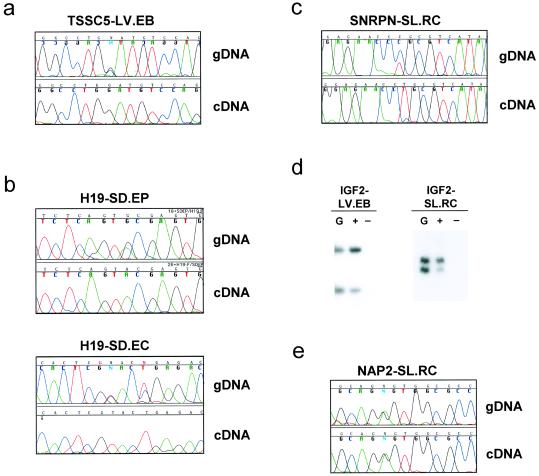
Fig 1.
Fig 1.
Expression analysis of four imprinted genes and one nonimprinted gene in differentiated human EG cell derivatives. (a) Chromatogram showing the polymorphism in genomic DNA (gDNA) and monoallelic expression of the imprinted gene TSSC5 as shown by the cDNA from line LV.EB. (b) Chromatogram showing monoallelic expression of H19 in lines SD.EC and SD.EP. The reverse complement is displayed for line SD.EC. (c) Chromatogram showing monoallelic expression of SNRPN in line SL.RC. (d) Preferential allele expression of IGF2 in the EG lines LV.EB and SL.RC. Genomic DNA lane is denoted by the letter G, The lane marked + indicates that the RT reaction was performed in the presence of reverse transcriptase, and the lane marked − represents reactions performed in the absence of the enzyme. Analysis of IGF2 in line LV.EB was performed with the ApaI polymorphism, and in line SL.RC with the dinucleotide repeat polymorphism. Both polymorphisms are found in exon 9 (ref. 17). Allele ratio quantitation was performed with a PhosphorImager. (e) Chromatogram showing biallelic expression of the nonimprinted gene NAP2 in line SL.RC.
Fig 2.
Fig 2.
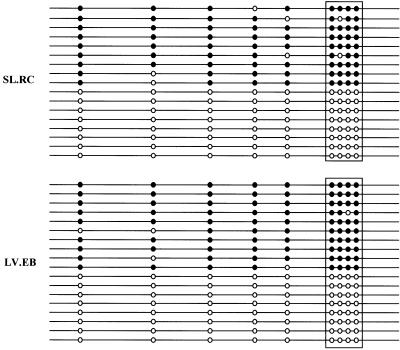
Normal half-methylation of a CTCF binding site in the H19 ICR, analyzed by bisulfite DNA sequencing. PCR products were cloned and 20 randomly selected clones were sequenced for each EG line. Methylated CpG sites are depicted by filled circles, and the unmethylated CpG sites as open circles. The boxed area represents the CTCF core binding site 1 (ref. 10). (Upper) Line SL.RC. (Lower) Line LV.EB.
Fig 3.
Fig 3.
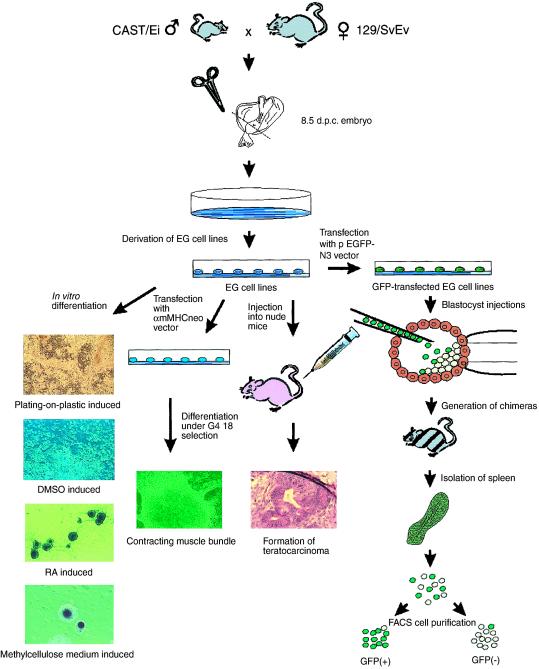
Experimental design for generating mouse EG cells from an interspecific cross. Day 8.5 (129/SvEv × CAST/Ei)F1 embryos were dissected near the base of the allantois to initiate primordial GC cultures from which EG cell lines were established, which was confirmed by s.c. injection into athymic nude mice to form teratocarcinomas, and by blastocyst injection to generate chimeric mice capable of germ-line transmission. The EG cell lines could be induced to differentiate in vitro by any of several methods, including transfection with a vector selectable after cardiomyocyte differentiation. RA, retinoic acid. In addition, cells differentiated in vivo in chimeric mice could be flow-sorted by prior transfection with a GFP-containing vector.
Fig 4.
Fig 4.
Partial imprinting after differentiation induced by the following: DMSO, Snrpn analyzed by SSCP-PCR (a); culture in methylcellulose, Snrpn analyzed by SSCP-PCR (b); or transfection with αmMHCneo and selection for cardiac myocytes, Kvlqt1 analyzed by SSCP-PCR (c). In each case there is equal biallelic expression before differentiation and preferential expression of the paternal (Snrpn) or maternal (Kvlqt1) allele after differentiation.
Fig 5.
Fig 5.
Nearly complete imprinting of EG cells after differentiation in vivo in mouse chimeras. EG cells were transfected with the pEGFP-N3 vector and injected into blastocysts of C57BL/6 mice, and spleen cells from the chimeras were purified by fluorescence-activated cell sorting. (a) Kvlqt1 analyzed by SSCP-PCR. (b) Snrpn analyzed by SNuPE. (c) Igf2 analyzed by SSCP-PCR; the upper band is a nonspecific product of SSCP as indicated in the parental genomic DNA lanes.

Comment in

References

    1. Lee J., Inoue, K., Ono, R., Ogonuki, N., Kohda, T., Kaneko-Ishino, T., Ogura, A. & Ishino, F. (2002) Development (Cambridge, U.K.) 129, 1807-1817. - PubMed
    1. Labosky P. A., Barlow, D. P. & Hogan, B. L. (1994) Development (Cambridge, U.K.) 120, 3197-3204. - PubMed
    1. Tada T., Tada, M., Hilton, K., Barton, S. C., Sado, T., Takagi, N. & Surani, M. A. (1998) Dev. Genes Evol. 207, 551-561. - PubMed
    1. Dean W., Bowden, L., Aitchison, A., Klose, J., Moore, T., Meneses, J. J., Reik, W. & Feil, R. (1998) Development (Cambridge, U.K.) 125, 2273-2282. - PubMed
    1. Humpherys D., Eggan, K., Akutsu, H., Hochedlinger, K., Rideout, W. M., 3rd, Biniszkiewicz, D., Yanagimachi, R. & Jaenisch, R. (2001) Science 293, 95-97. - PubMed

Publication types

Substances

LinkOut - more resources