Advancing donor liver age and rapid fibrosis progression following transplantation for hepatitis C
- PMID: 12117889
- PMCID: PMC1773334
- DOI: 10.1136/gut.51.2.248
Advancing donor liver age and rapid fibrosis progression following transplantation for hepatitis C
Abstract
Background and aim: Cirrhosis with liver failure due to hepatitis C virus (HCV) infection is the most common indication for liver transplantation (LT). Reinfection of the transplanted liver by HCV is inevitable, and aggressive hepatitis with accelerated progression to graft cirrhosis may be observed. Of concern, recent reports suggest that the outcome of LT for HCV may have deteriorated in recent years. Determinants of rate of progression to cirrhosis in the immunocompetent non-transplant patient are well defined, and the most powerful determinant is patient age at the time of infection. Following LT for HCV, recipient age does not affect outcome of HCV reinfection. However, the impact of donor age on graft fibrosis progression rate following LT has not been examined.
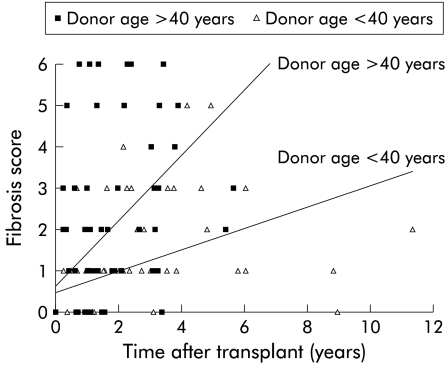
Methods: We have examined post-transplant biopsies to assess histological activity, including fibrosis stage (scored 0-6 units, 6 representing established cirrhosis), and to calculate fibrosis progression rates in 101 post-transplant specimens from 56 HCV infected LT patients. Univariate and multivariate analyses examined the impact of parameters including recipient and donor age and sex on fibrosis progression rate, and on predicted time to cirrhosis.
Results: For the cohort, median fibrosis progression rate was 0.78 units/year, and median interval from transplantation to development of cirrhosis was 7.7 years. In multivariate analysis, donor age (not recipient age) was a powerful determinant (p=0.02) of fibrosis progression rate. When the liver donor was younger than 40 years, median progression rate was 0.6 units/year and interval to cirrhosis was 10 years. When the donor was aged 50 years or more, median progression rate was 2.7 units/year and interval to cirrhosis only 2.2 years. During the observation period there has been a significant increase in donor age (p=0.01) but date of transplantation per se is not a determinant of progression rate when included in multivariate analyses.
Conclusions: Donor age has a major influence on graft outcome following transplantation for HCV. The changing organ donor profile will affect the long term results of LT for HCV. These observations have important implications for donor liver allocation.
Figures
Comment in
-
The impact of advancing donor age on histologic recurrence of hepatitis C infection: the perils of ignored maternal advice.Liver Transpl. 2003 May;9(5):535-7. doi: 10.1002/lt.500090516. Liver Transpl. 2003. PMID: 12740801 Review. No abstract available.
References
-
- Gane EJ, Portmann BC, Naoumov NV, et al. Long-term outcome of hepatitis C infection after liver transplantation. N Engl J Med 1996;334:815–20. - PubMed
-
- Feray C, Caccamo L, Alexander GJ, et al. European collaborative study on factors influencing outcome after liver transplantation for hepatitis C. European Concerted Action on Viral Hepatitis (EUROHEP) Group. Gastroenterology 1999;117:619–25. - PubMed
-
- Schluger LK, Sheiner PA, Thung SN, et al. Severe recurrent cholestatic hepatitis C following orthotopic liver transplantation. Hepatology 1996;23:971–6. - PubMed
-
- Taga SA, Washington MK, Terrault N, et al. Cholestatic hepatitis C in liver allografts. Liver Transpl Surg 1998;4:304–10. - PubMed
-
- Rosen HR, Gretch DR, Oehlke M, et al. Timing and severity of initial hepatitis C recurrence as predictors of long-term liver allograft injury. Transplantation 1998;65:1178–82. - PubMed
MeSH terms
LinkOut - more resources
Full Text Sources
Medical