. 2002 Aug;70(8):4539-46.
doi: 10.1128/IAI.70.8.4539-4546.2002.

Sat, the secreted autotransporter toxin of uropathogenic Escherichia coli, is a vacuolating cytotoxin for bladder and kidney epithelial cells

Affiliations

Sat, the secreted autotransporter toxin of uropathogenic Escherichia coli, is a vacuolating cytotoxin for bladder and kidney epithelial cells

Debra M Guyer et al. Infect Immun. 2002 Aug.

Abstract

The secreted autotransporter toxin (Sat) of uropathogenic Escherichia coli exhibits cytopathic activity upon incubation with HEp-2 cells. We further investigated the effects of Sat on cell lines more relevant to the urinary tract, namely, those derived from bladder and kidney epithelium. Sat elicited elongation of cells and apparent loosening of cellular junctions upon incubation with Vero kidney cells. Additionally, incubation with Sat triggered significant vacuolation within the cytoplasm of both human bladder (CRL-1749) and kidney (CRL-1573) cell lines. This activity has been associated with only a few other known toxins. Following transurethral infection of CBA mice with a sat mutant, no reduction of CFU in urine, bladder, or kidney tissue was seen compared to that in mice infected with wild-type E. coli CFT073. However, significant histological changes were observed within the kidneys of mice infected with wild-type E. coli CFT073, including dissolution of the glomerular membrane and vacuolation of proximal tubule cells. Such damage was not observed in kidney sections of mice infected with a Sat-deficient mutant. These results indicate that Sat, a vacuolating cytotoxin expressed by uropathogenic E. coli CFT073, elicits defined damage to kidney epithelium during upper urinary tract infection and thus contributes to pathogenesis of urinary tract infection.


Figures
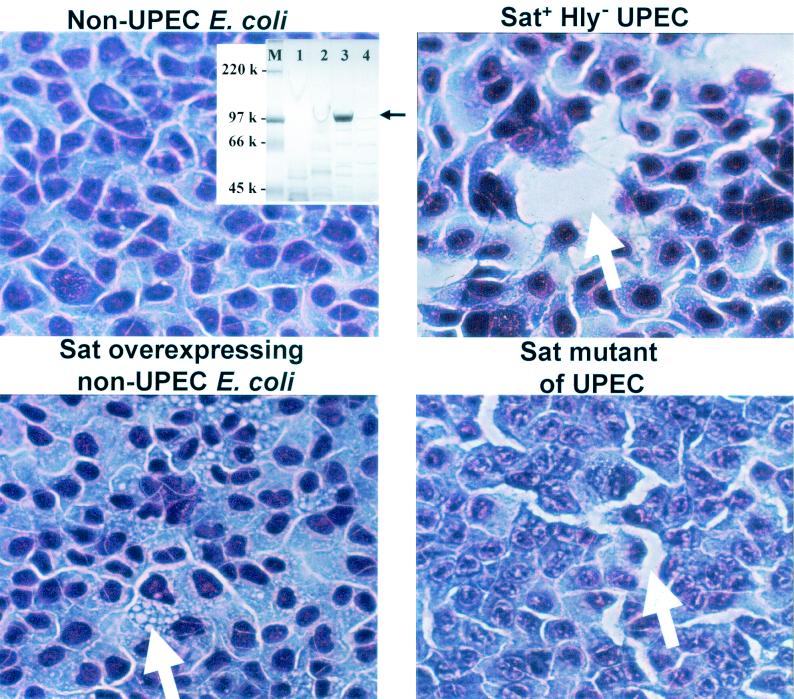
FIG. 1.
FIG. 1.
Cytopathic activity of Sat on human bladder cells. Concentrated culture supernatants (electrophoresed on sodium dodecyl sulfate-polyacrylamide gels [inset]) of E. coli HB101[pBluescript SK(−)] (lane 4, inset) (nonuropathogenic E. coli [non-UPEC]), E. coli CFT073 hlyD::TnphoA (lane 1, inset) (Sat+ Hly UPEC), E. coli HB101(pDG4) (lane 3, inset) (Sat-overexpressing non-UPEC), and E. coli CFT073 sat::pGP704 (lane 2, inset) (Sat mutant of UPEC) were incubated with monolayers of human bladder cells for 2 h at 37°C. Supernatant was concentrated 100-fold and added in 20-μl volumes to 250-μl cell monolayers. The monolayers were washed, fixed, stained with Giemsa stain, and photographed at a magnification of ×100. Vacuolation (bottom left panel) and loosening of cellular junctions are indicated by arrows.
FIG. 2.
FIG. 2.
Cytopathic activity of Sat on human kidney cells. Concentrated culture supernatants of E. coli HB101(pDG4) overexpressing Sat were incubated with monolayers of human kidney cells for 1 h at 37°C. Supernatant was concentrated 100-fold and added in 20-μl volumes to 250-μl cell monolayers. The monolayers were washed, fixed, stained with Giemsa stain, and photographed at a magnification of ×100. Vacuolation is indicated by arrows. No cytopathic effects were noted for supernatants from E. coli HB101[pBluescript SK(−)] and E. coli CFT073 sat::pGP704 (Sat mutant) (data not shown).
FIG. 3.
FIG. 3.
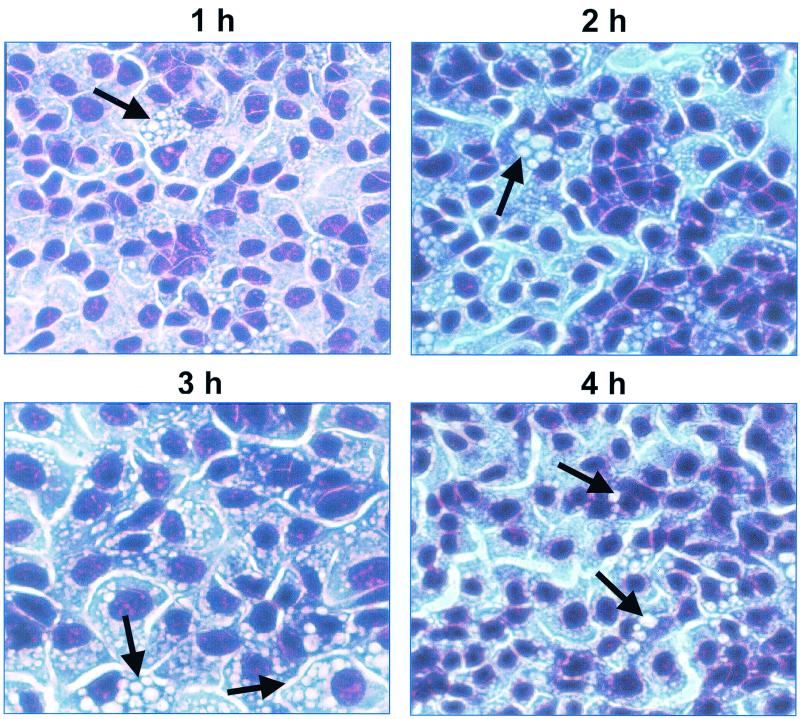
Time course of cytopathic effects of Sat on human bladder cells. Concentrated culture supernatants of E. coli HB101(pDG4) were incubated with monolayers of human bladder cells for 1 to 4 h at 37°C. The supernatant was concentrated 100-fold and added in 20-μl volumes to 250-μl cell monolayers. The monolayers were washed, fixed, stained with Giemsa stain, and photographed at a magnification of ×100. Arrows indicate areas of prominent vacuolation.
FIG. 4.
FIG. 4.
Histological damage attributed to Sat following a 4-day infection of CBA mice with wild-type E. coli CFT073 and a sat::pGP704 mutant. Kidney tissue sections were prepared from mice following a 4-day infection with E. coli CFT073 or a sat mutant. normal, tissue isolated from uninfected mice. Sat mutant, kidney tissue from mice infected with a sat::pGP704 mutant. CFT073, kidney tissue from mice infected with E. coli CFT073. The glomerular membrane (G) is present in normal uninfected control mice (upper left panel) and mice infected with the sat mutant (upper right panel). Proximal tubules (PT) show a loss of epithelial cells in tissue from mice infected with CFT073 (lower right panel) but not in normal tissue or tissue from mice infected with the sat mutant (upper panels). Vacuolation (V) is faintly visible in kidney sections of mice infected with CFT073 (lower right panel).

References

    1. Abrami, L., M. Fivaz, P. E. Glauser, R. G. Parton, and F. G. van der Goot. 1998. A pore-forming toxin interacts with a GPI-anchored protein and causes vacuolation of the endoplasmic reticulum. J. Cell Biol. 140:525-540. - PMC - PubMed
    1. Al Hasani, K., I. R. Henderson, H. Sakellaris, K. Rajakumar, T. Grant, J. P. Nataro, R. Robins-Browne, and B. Adler. 2000. The sigA gene which is borne on the pathogenicity island of Shigella flexneri 2a encodes an exported cytopathic protease involved in intestinal fluid accumulation. Infect. Immun. 68:2457-2463. - PMC - PubMed
    1. Benjelloun-Touimi, Z., P. J. Sansonetti, and C. Parsot. 1995. SepA, the major extracellular protein of Shigella flexneri: autonomous secretion and involvement in tissue invasion. Mol. Microbiol. 17:123-135. - PubMed
    1. Benz, I., and M. A. Schmidt. 1989. Cloning and expression of an adhesin (AIDA-I) involved in diffuse adherence of enteropathogenic Escherichia coli. Infect. Immun. 57:1506-1511. - PMC - PubMed
    1. Blanco, J. E., M. Blanco, A. Mora, and J. Blanco. 1997. Production of toxins (enterotoxins, verotoxins, and necrotoxins) and colicins by Escherichia coli strains isolated from septicemic and healthy chickens: relationship with in vivo pathogenicity. J. Clin. Microbiol. 35:2953-2957. - PMC - PubMed

Publication types

MeSH terms

LinkOut - more resources