. 2002 Aug;70(8):4581-90.
doi: 10.1128/IAI.70.8.4581-4590.2002.

Helicobacter pylori-induced activation of human endothelial cells

Affiliations

Helicobacter pylori-induced activation of human endothelial cells

M Innocenti et al. Infect Immun. 2002 Aug.

Abstract

Helicobacter pylori infection causes active chronic inflammation with a continuous recruitment of neutrophils to the inflamed gastric mucosa. To evaluate the role of endothelial cells in this process, we have examined adhesion molecule expression and chemokine and cytokine production from human umbilical vein endothelial cells stimulated with well-characterized H. pylori strains as well as purified proteins. Our results indicate that endothelial cells actively contribute to neutrophil recruitment, since stimulation with H. pylori bacteria induced upregulation of the adhesion molecules VCAM-1, ICAM-1, and E-selectin as well as the chemokines interleukin 8 (IL-8) and growth-related oncogene alpha (GRO-alpha) and the cytokine IL-6. However, there were large variations in the ability of the different H. pylori strains to stimulate endothelial cells. These interstrain variations were seen irrespective of whether the strains had been isolated from patients with duodenal ulcer disease or asymptomatic carriers and were not solely related to the expression of known virulence factors, such as the cytotoxin-associated gene pathogenicity island, vacuolating toxin A, and Lewis blood group antigens. In addition, one or several unidentified proteins which act via NF-kappaB activation seem to induce endothelial cell activation. In conclusion, human endothelial cells produce neutrophil-recruiting factors and show increased adhesion molecule expression after stimulation with certain H. pylori strains. These effects probably contribute to the continuous recruitment of neutrophils to H. pylori-infected gastric mucosa and may also contribute to tissue damage and ulcer formation.


Figures
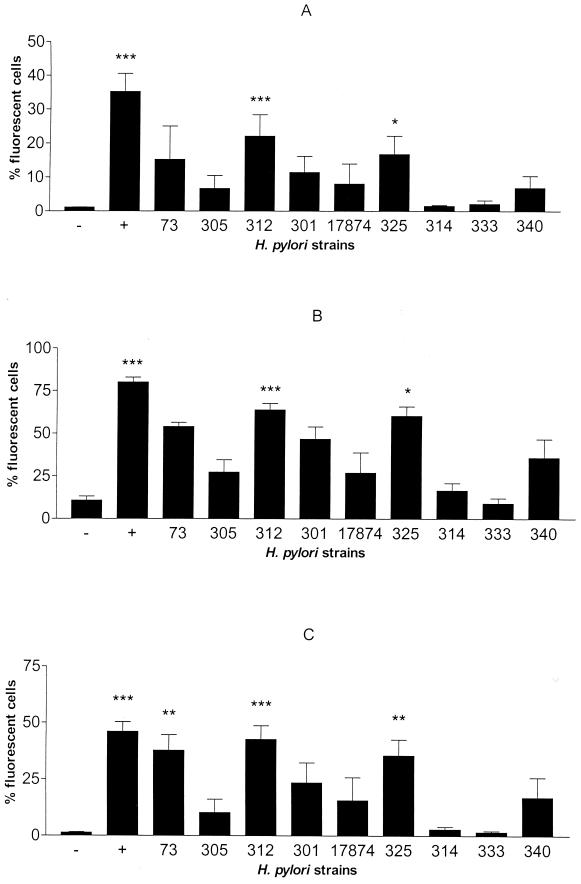
FIG. 1.
FIG. 1.
Graphic representation of adhesion molecule expression by HUVEC after stimulation with H. pylori bacteria. VCAM-1 (A), ICAM-1 (B), and E-selectin (C) expression by HUVEC was determined by using flow cytometry after 6.5 h of stimulation with a 100-μl suspension (OD, 1.0) of H. pylori strain Hel 73, 305, 312, 301, 325, 314, 333, or 340 or CCUG 17874. −, medium alone; +, positive control, TNF-α (100 ng/ml). Bars represent the geometric mean and standard error of the mean. Statistical evaluation of control and stimulated samples was performed by one-way analysis of variance (Kruskal-Wallis test) followed by Dunn's multiple-comparison tests. P values were <0.001 (three asterisks), <0.01 (two asterisks), and <0.05 (one asterisk) (n ≥ 4).
FIG. 2.
FIG. 2.
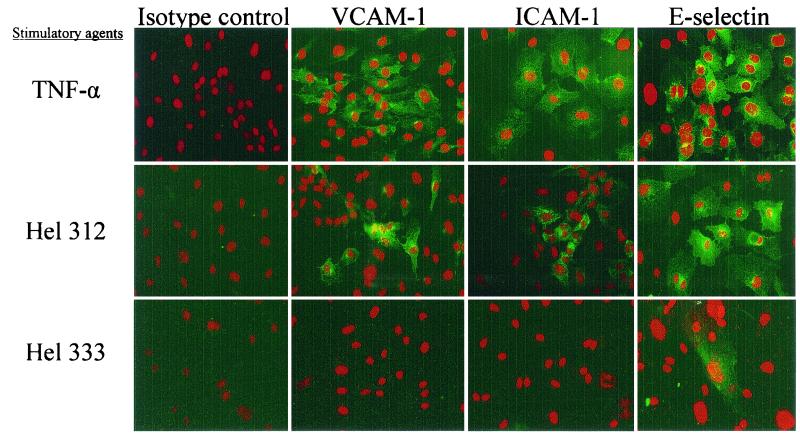
Adhesion molecule expression by HUVEC after stimulation with H. pylori bacteria. VCAM-1, ICAM-1, and E-selectin expression by HUVEC cultured on slides was determined after 6.5 h of stimulation with a 100-μl suspension (OD, 1.0) of H. pylori strain Hel 312 or 333 or with 100 ng of TNF-α/ml. Sections were stained with an MAb against each adhesion molecule and developed with FITC-conjugated F(ab′)2 fragments of a rat anti-mouse MAb (green). Propidium iodide was used for contrast nuclear staining (red). Each field is representative of the whole slide, and the figure shows one representative experiment out of two. Magnification, ×138.
FIG. 3.
FIG. 3.
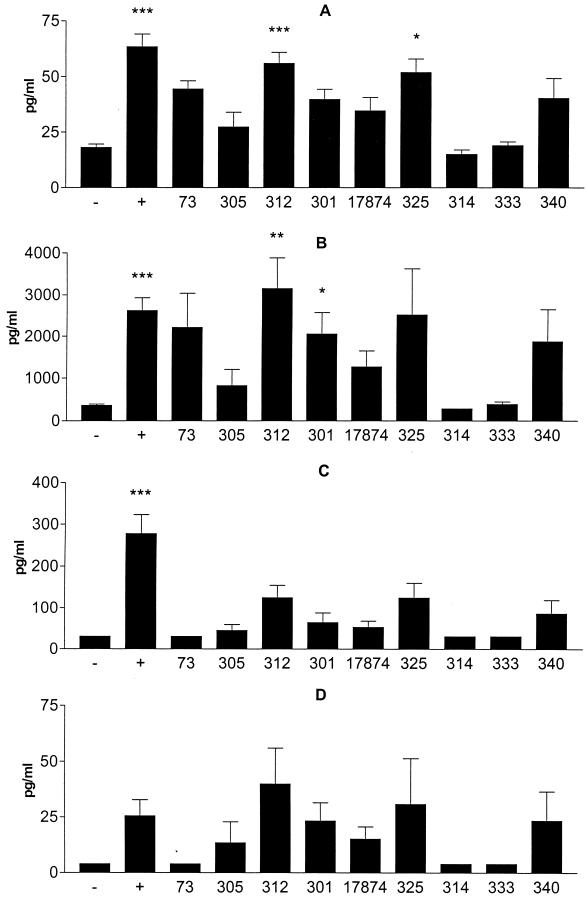
Chemokine and cytokine production by HUVEC after stimulation with H. pylori bacteria. IL-6 (A), IL-8 (B), GRO-α (C), and GM-CSF (D) levels were determined by using an ELISA and culture medium from HUVEC stimulated for 24 h with a 10-μl suspension (OD, 1.0) of H. pylori strain Hel 73, 305, 312, 301, 325, 314, 333, or 340 or CCUG 17874. −, medium alone; +, positive control, TNF-α (100 μg/ml). Bars represent the geometric mean and standard error of the mean. Statistical evaluation of control and stimulated samples was performed by a one-way analysis of variance (Kruskal-Wallis test) followed by Dunn's multiple-comparison tests. P values were <0.001 (three asterisks), <0.01 (two asterisks), and <0.05 (one asterisk) (n ≥ 4).
FIG. 4.
FIG. 4.
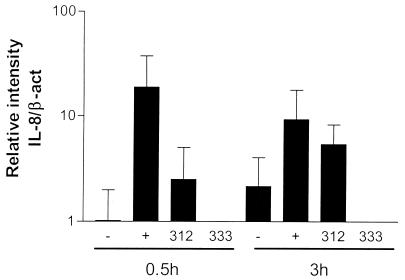
IL-8 mRNA expression in HUVEC after H. pylori stimulation. HUVEC were stimulated with H. pylori Hel 312 or 333 for 0.5 or 3 h, and IL-8 mRNA expression was measured by using RT-PCR. −, medium alone; +, positive control, TNF-α (100 ng/ml). Bars represent the geometric mean and standard error of the mean. Relative IL-8 mRNA expression was calculated as the intensity of IL-8 bands divided by the intensity of corresponding β-actin (β-act) bands (n = 3).
FIG. 5.
FIG. 5.
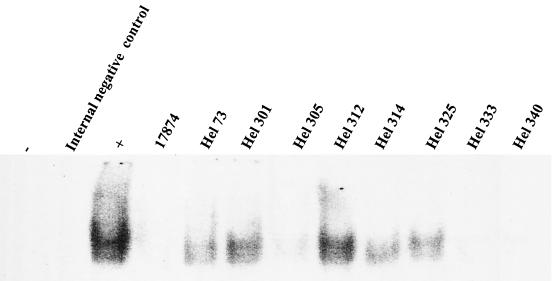
NF-κB activation in HUVEC after H. pylori stimulation. HUVEC were stimulated with H. pylori bacteria for 6 h, and NF-κB activation was assessed by an EMSA. −, unstimulated cells; +, positive control, TNF-α (100 ng/ml). The figure shows one representative experiment out of three.

Comment in

References

    1. Aihara, M., D. Tsuchimoto, H. Takizawa, A. Azuma, H. Wakebe, Y. Ohmoto, K. Imagawa, M. Kikuchi, N. Mukaida, and K. Matsushima. 1997. Mechanisms involved in Helicobacter pylori-induced interleukin-8 production by a gastric cancer cell line, MKN45. Infect. Immun. 65:3218-3224. - PMC - PubMed
    1. Albelda, S. M., C. W. Smith, and P. A. Ward. 1994. Adhesion molecules and inflammatory injury. FASEB J. 8:504-512. - PubMed
    1. Atherton, J. C., T. L. Cover, R. J. Twells, M. R. Morales, C. J. Hawkey, and M. J. Blaser. 1999. Simple and accurate PCR-based system for typing vacuolating cytotoxin alleles of Helicobacter pylori. J. Clin. Microbiol. 37:2979-2982. - PMC - PubMed
    1. Baeuerle, P. A., and V. R. Baichwal. 1997. NF-kappa B as a frequent target for immunosuppressive and anti-inflammatory molecules. Adv. Immunol. 65:111-137. - PubMed
    1. Baggiolini, M. 1998. Chemokines and leukocyte traffic. Nature 392:565-568. - PubMed

Publication types

MeSH terms

LinkOut - more resources