


Synergism between trematode infection and pesticide exposure: a link to amphibian limb deformities in nature?
- PMID: 12118118
- PMCID: PMC126596
- DOI: 10.1073/pnas.152098899
Synergism between trematode infection and pesticide exposure: a link to amphibian limb deformities in nature?
Abstract
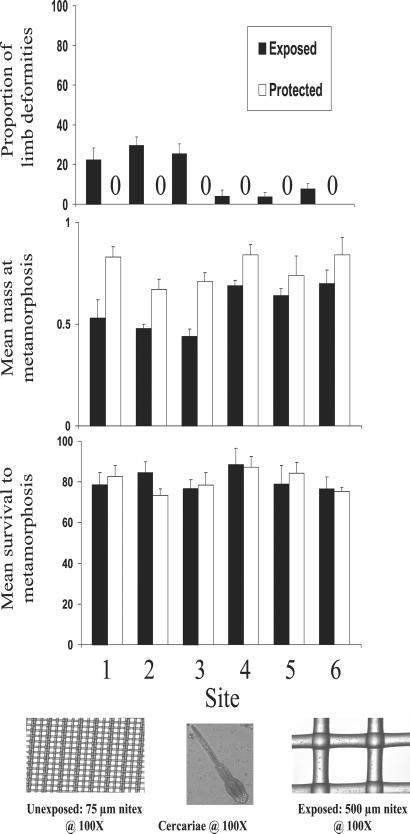
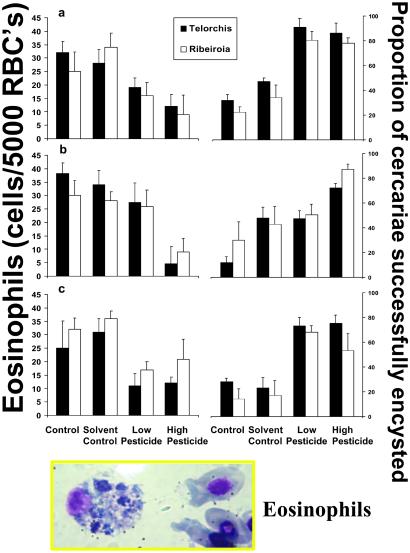
The apparently rapid increase in the prevalence of amphibian limb deformities has led to substantial interest from ecologists and public health professionals. Hypotheses proposed to explain the deformities fall into two broad categories: chemical contaminants and trematode infection. Although there are convincing experimental demonstrations that certain factors can lead to some deformities, the causes for recent increases in amphibian malformation remain controversial. Moreover, no experimental studies on amphibian deformities have been conducted in the field, and no studies have attempted to examine the synergistic effects of trematode infection and exposure to chemical contaminants. Here, I present the results of field and laboratory experiments that link increased trematode infection, and increased limb deformities, to pesticide exposure. Field experiments conclusively demonstrated that exposure to trematode infection was required for the development of limb deformities in wood frogs, Rana sylvatica. However, deformities were more common at sites adjacent to agricultural runoff. Laboratory experiments corroborated the association between pesticide exposure and increased infection with pesticide-mediated immunocompetency as the apparent mechanism. Given the conservative contaminant exposure levels used [Environmental Protection Agency (EPA) drinking water standards] and the widespread use of many pesticides, these negative impacts may help to explain pathogen-mediated amphibian declines in many regions.
Figures
References
-
- Wake D B. Science. 1991;253:860. - PubMed
-
- Blaustein A R, Wake D B, Sousa W P. Cons Biol. 1994;8:60–71.
-
- Wake D B. Trends Ecol Evol. 1998;13:379–380. - PubMed
-
- Alford R A, Richards S J. Annu Rev Ecol Syst. 1999;30:133–165.
-
- Houlahan J E, Findlay C S, Schmidt B R, Meyer A H, Kuzmin S L. Nature (London) 2000;404:752–755. - PubMed
Publication types
MeSH terms
Substances
Grants and funding
LinkOut - more resources
Full Text Sources
Medical
Research Materials
