Autotaxin has lysophospholipase D activity leading to tumor cell growth and motility by lysophosphatidic acid production
- PMID: 12119361
- PMCID: PMC2173129
- DOI: 10.1083/jcb.200204026
Autotaxin has lysophospholipase D activity leading to tumor cell growth and motility by lysophosphatidic acid production
Abstract
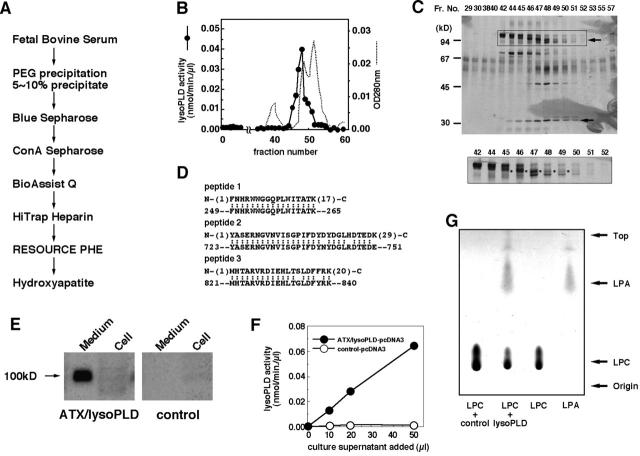
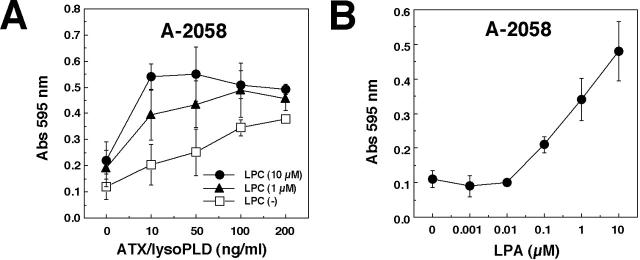
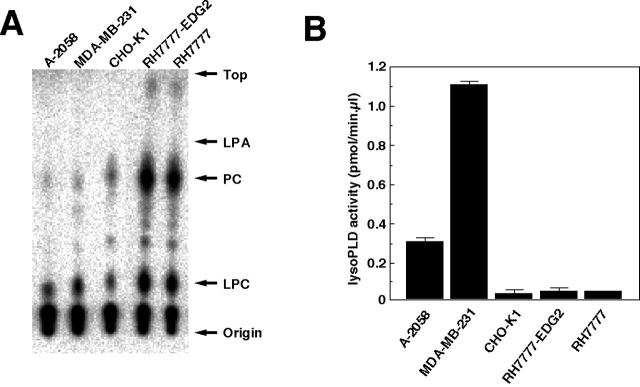
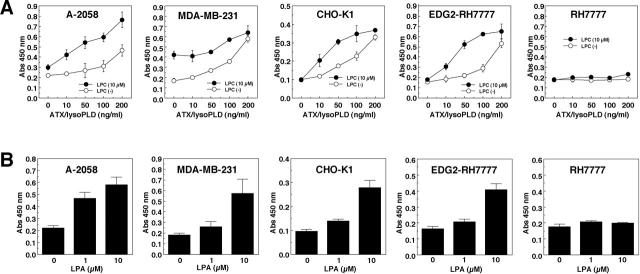
Autotaxin (ATX) is a tumor cell motility-stimulating factor, originally isolated from melanoma cell supernatants. ATX had been proposed to mediate its effects through 5'-nucleotide pyrophosphatase and phosphodiesterase activities. However, the ATX substrate mediating the increase in cellular motility remains to be identified. Here, we demonstrated that lysophospholipase D (lysoPLD) purified from fetal bovine serum, which catalyzes the production of the bioactive phospholipid mediator, lysophosphatidic acid (LPA), from lysophosphatidylcholine (LPC), is identical to ATX. The Km value of ATX for LPC was 25-fold lower than that for the synthetic nucleoside substrate, p-nitrophenyl-tri-monophosphate. LPA mediates multiple biological functions including cytoskeletal reorganization, chemotaxis, and cell growth through activation of specific G protein-coupled receptors. Recombinant ATX, particularly in the presence of LPC, dramatically increased chemotaxis and proliferation of multiple different cell lines. Moreover, we demonstrate that several cancer cell lines release significant amounts of LPC, a substrate for ATX, into the culture medium. The demonstration that ATX and lysoPLD are identical suggests that autocrine or paracrine production of LPA contributes to tumor cell motility, survival, and proliferation. It also provides potential novel targets for therapy of pathophysiological states including cancer.
Figures
Comment in
-
Lysophospholipids in the limelight: autotaxin takes center stage.J Cell Biol. 2002 Jul 22;158(2):197-9. doi: 10.1083/jcb.200206094. Epub 2002 Jul 22. J Cell Biol. 2002. PMID: 12135981 Free PMC article.
References
-
- An, S., T. Bleu, O.G. Hallmark, and E.J. Goetzl. 1998. Characterization of a novel subtype of human G protein-coupled receptor for lysophosphatidic acid. J. Biol. Chem. 273:7906–7910. - PubMed
-
- Bandoh, K., J. Aoki, H. Hosono, S. Kobayashi, T. Kobayashi, M.K. Murakami, M. Tsujimoto, H. Arai, and K. Inoue. 1999. Molecular cloning and characterization of a novel human G-protein-coupled receptor, EDG7, for lysophosphatidic acid. J. Biol. Chem. 274:27776–27785. - PubMed
-
- Bligh, E.C., and W.F. Dyer. 1959. A rapid method for total lipid extraction and purification. Can. J. Biochem. Physiol. 37:911–917. - PubMed
-
- Bollen, M., R. Gijsbers, H. Ceulemans, W. Stalmans, and C. Stefan. 2000. Nucleotide pyrophosphatases/phosphodiesterases on the move. Crit. Rev. Biochem. Mol. Biol. 35:393–432. - PubMed
-
- Clair, T., H.Y. Lee, L.A. Liotta, and M.L. Stracke. 1997. Autotaxin is an exoenzyme possessing 5′-nucleotide phosphodiesterase/ATP pyrophosphatase and ATPase activities. J. Biol. Chem. 272:996–1001. - PubMed
Publication types
MeSH terms
Substances
LinkOut - more resources
Full Text Sources
Other Literature Sources
Molecular Biology Databases
Miscellaneous