. 2002 Jul 23;99(15):10203-8.
doi: 10.1073/pnas.152318599. Epub 2002 Jul 15.

Transcripts of Vp-1 homeologues are misspliced in modern wheat and ancestral species

Affiliations

Transcripts of Vp-1 homeologues are misspliced in modern wheat and ancestral species

Rowan S McKibbin et al. Proc Natl Acad Sci U S A. .

Abstract

The maize (Zea mays) Viviparous 1 (Vp1) transcription factor has been shown previously to be a major regulator of seed development, simultaneously activating embryo maturation and repressing germination. Hexaploid bread wheat (Triticum aestivum) caryopses are characterized by relatively weak embryo dormancy and are susceptible to preharvest sprouting (PHS), a phenomenon that is phenotypically similar to the maize vp1 mutation. Analysis of Vp-1 transcript structure in wheat embryos during grain development showed that each homeologue produces cytoplasmic mRNAs of different sizes. The majority of transcripts are spliced incorrectly, contain insertions of intron sequences or deletions of coding region, and do not have the capacity to encode full-length proteins. Several VP-1-related lower molecular weight protein species were present in wheat embryo nuclei. Embryos of a closely related tetraploid species (Triticum turgidum) and ancestral diploids also contained misspliced Vp-1 transcripts that were structurally similar or identical to those found in modern hexaploid wheat, which suggests that compromised structure and expression of Vp-1 transcripts in modern wheat are inherited from ancestral species. Developing embryos from transgenic wheat grains expressing the Avena fatua Vp1 gene showed enhanced responsiveness to applied abscisic acid compared with the control. In addition, ripening ears of transgenic plants were less susceptible to PHS. Our results suggest that missplicing of wheat Vp-1 genes contributes to susceptibility to PHS in modern hexaploid wheat varieties and identifies a possible route to increase resistance to this environmentally triggered disorder.


Figures
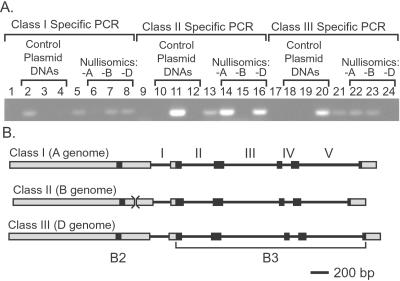
Figure 1
Figure 1
Allocation of wheat TaVp1 genomic clones to specific genomes. (A) Lanes 1–8 show class I genomic clone-specific PCR. 1, no template DNA; 2–4 class I, II, and III template DNAs, respectively; 5, Soleil genomic DNA; 6–8, CS euploid; 6, CS nullisomic 3A–tetrasomic 3D; 7, CSN3B–T3A; 8, CSN3D–T3A. Lanes 9–16 show class II genomic clone-specific PCR. 9, no template DNA; 10–12, as described for lanes 2–4; 13, as described for lane 5; 14–16, as described for lanes 6–8. Lanes 17–24 show class III genomic clone-specific PCR. 17, no template DNA; 18–20, as described for lanes 2–4; 21, as described for lane 5; 22–24, as described for lanes 6–8. (B) Schematic representation of Vp-1 homeologues (to scale). Exons (boxed) and introns (lines, numbered) are shown, as are the positions of the B2 and B3 domains within the coding regions (black boxes). The position of a 12-bp deletion in Vp-B1 is indicated (><).
Figure 2
Figure 2
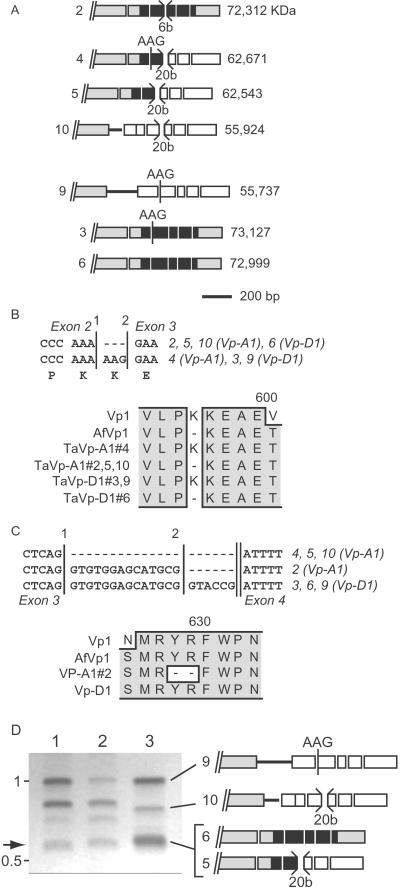
Structures of TaVp1 RNAs. (A) Structure of misspliced cDNAs derived from wheat Vp-1 homeologues [to scale; clone numbers are indicated (Left)]. Exons are indicated as boxes, and intron sequences are shown as horizontal lines. The positions of intron sequence, alternatively spliced AAG codons, and short deletions (b, bases) are shown. Where missplicing leads to incorporation of a stop codon in the ORF is indicated as open boxes following the stop codon, and the sizes of presumptive resulting proteins are indicated next to each transcript (Right). (B) Alternative splicing (either at position 1 or 2 at the junction of intron 2 and exon 3) leads to deletion of an AAG codon in several RNAs from both homeologues. Also shown is the predicted protein sequence compared with maize (Vp1) and A. fatua (AfVp1). (C) Premature splicing of exon 3 in Vp-A1 leads to termination of the ORF (position 1) or deletion of two residues (position 2) within the highly conserved B3 domain. Also shown is the predicted protein sequence compared with Vp1 and AfVp1. (D) Agarose gel electrophoresis analysis of RT-PCR amplification products. Comparison of products from polysomal (lane 1) and poly(A) RNA (lane 2) sources from mature embryos, with combined products from cDNA clones (lane 3), is shown (clones are indicated diagrammatically). The arrow indicates the position of correctly spliced transcript product. The positions of molecular weight markers are indicated (in kb).
Figure 3
Figure 3
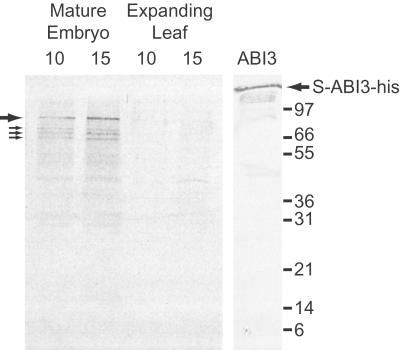
Western analysis of nuclear-localized VP-1 proteins. Western analysis was carried out with a B2-specific antibody by using nuclear proteins derived from mature wheat embryos or young, expanding leaves (with 10 or 15 μg of protein). Whole Escherichia coli extracts containing the ABI3 derivative protein, S-ABI3-his, were used to show the specificity of the antibody. The positions of proteins detected in embryo extracts are shown, the thick arrow indicates the major immunoreactive protein, and the thin arrows indicate three lower molecular weight proteins (83, 74, 70, and 64 kDa, respectively). Positions of molecular weight markers are indicated (in kDa).
Figure 4
Figure 4
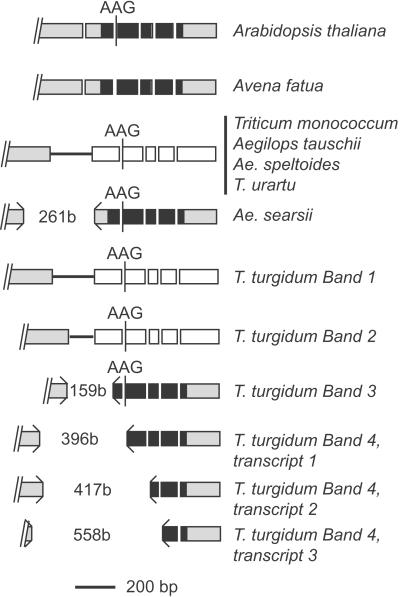
Structure of Vp-1 RNAs in diploid and tetraploid wheat ancestors and related species. Exons are indicated as boxes, and intron sequences are indicated as horizontal lines. The positions of intron sequence, alternatively spliced AAG codons, and short deletions (b, bases) are shown (to scale). Where missplicing leads to incorporation of a stop codon in the ORF is indicated as open boxes following the stop codon. The positions of deletions are indicated (><).

References

    1. McCarty D R, Hattori T, Carson C B, Vasil V, Lazar M, Vasil I K. Cell. 1991;66:895–905. - PubMed
    1. Hoecker U, Vasil I K, McCarty D R. Genes Dev. 1995;9:2459–2469. - PubMed
    1. Wilson G F, Rhodes A M, Dickinson D B. Plant Physiol. 1973;52:350–356. - PMC - PubMed
    1. Hattori T, Terada T, Hamasuna S T. Plant Mol Biol. 1994;24:805–810. - PubMed
    1. Jones H D, Peters N C B, Holdsworth M J. Plant J. 1997;12:911–920. - PubMed

Publication types

Associated data

LinkOut - more resources