


Comparative stability studies of antipseudomonal beta-lactams for potential administration through portable elastomeric pumps (home therapy for cystic fibrosis patients) and motor-operated syringes (intensive care units)
- PMID: 12121900
- PMCID: PMC127357
- DOI: 10.1128/AAC.46.8.2327-2332.2002
Comparative stability studies of antipseudomonal beta-lactams for potential administration through portable elastomeric pumps (home therapy for cystic fibrosis patients) and motor-operated syringes (intensive care units)
Abstract
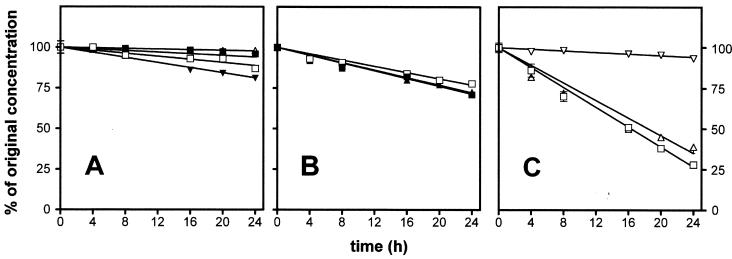
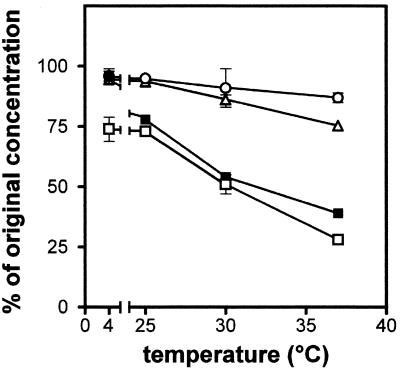
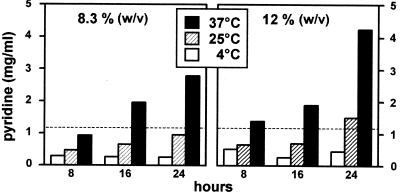
The stability of antipseudomonal beta-lactams in concentrated solutions was examined in view of their potential administration by continuous infusion with external pumps (for intensive care patients) or with portable pumps carried under clothing (for cystic fibrosis patients). Aztreonam (100 g/liter), piperacillin (128 g/liter, with tazobactam), and azlocillin (128 g/liter) remained 90% stable for up to more than 24 h at 37 degrees C (mezlocillin [128 g/liter] was stable at 25 degrees C but not at 37 degrees C). Ceftazidime (120 g/liter), cefpirome (32 g/liter), and cefepime (50 g/liter) remained 90% stable for up to 24, 23.7, and 20.5 h at 25 degrees C but only for 8, 7.25, and 13 h at 37 degrees C, respectively. The control of temperature therefore appears to be critical for all three cephalosporins that cannot be recommended for use in portable pumps carried under clothes for prolonged periods for reasons of stability. Cefpirome and cefepime solutions developed an important color change (from light yellow to dark red) upon exposure when stored at 30 degrees C or higher. Degradation of ceftazidime was accompanied by the liberation of pyridine which, at 37 degrees C, was in excess of what is allowed by the U.S. Pharmacopeia, i.e., 1.1 mg/liter, after 8 and 12 h for drug concentrations of 12 and 8.3%, respectively. Imipenem and meropenem are too unstable (10% degradation at 25 degrees C after 3.5 and 5.15 h, respectively) to be recommended for use by continuous infusion. Faropenem, examined in comparison with imipenem and meropenem, proved as stable as aztreonam or piperacillin.
Figures
References
-
- Angus, B. J., M. D. Smith, Y. Suputtamongkol, H. Mattie, A. L. Walsh, V. Wuthiekanun, W. Chaowagul, and N. J. White. 2000. Pharmacokinetic-pharmacodynamic evaluation of ceftazidime continuous infusion versus intermittent bolus injection in septicaemic melioidosis. Br. J. Clin. Pharmacol. 50:184-191. - PMC - PubMed
-
- Augey, V., P. Y. Grosse, G. Albert, M. Audran, and F. Bressolle. 1996. High-performance liquid chromatographic determination of tazobactam and piperacillin in human plasma and urine. J. Chromatogr. B Biomed. Appl. 682:125-136. - PubMed
-
- Boyd, D. B. 1984. Electronic structures of cephalosporins and penicillins. 15. Inductive effect of the three-position side chain in cephalosporins. J. Med. Chem. 27:63-66. - PubMed
-
- Boyd, D. B. 1985. Elucidating the leaving group effect in the beta-lactam ring opening mechanism of cephalosporins. J. Organ. Chem. 50:886-888.
Publication types
MeSH terms
Substances
LinkOut - more resources
Full Text Sources
Medical
