


doi: 10.1128/AAC.46.8.2668-2670.2002.
Chemiosmotic mechanism of antimicrobial activity of Ag(+) in Vibrio cholerae
Affiliations
- PMID: 12121953
- PMCID: PMC127333
- DOI: 10.1128/AAC.46.8.2668-2670.2002
Item in Clipboard
Chemiosmotic mechanism of antimicrobial activity of Ag(+) in Vibrio cholerae
Antimicrob Agents Chemother.
2002 Aug.
Abstract
Although the antimicrobial effects of silver salts were noticed long ago, the molecular mechanism of the bactericidal action of Ag(+) in low concentrations has not been elucidated. Here, we show that low concentrations of Ag(+) induce a massive proton leakage through the Vibrio cholerae membrane, which results in complete deenergization and, with a high degree of probability, cell death.
Figures
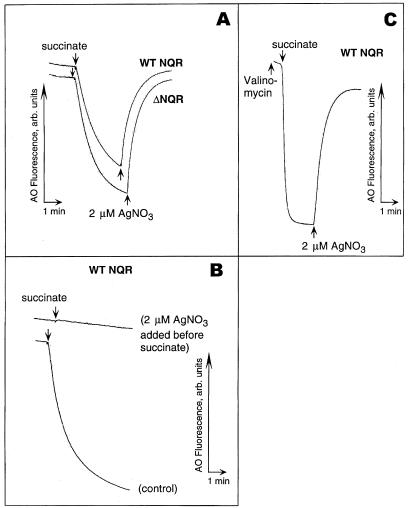
Effects of Ag+ on the H+ permeability of the membrane measured in the inside-out membrane vesicles prepared from V. cholerae. Respiration-dependent formation of ΔpH was initiated by the addition of 10 mM Tris-succinate (down arrows). Where indicated, 2.0 μM AgNO3 was added to the vesicles (up arrows). (A) Addition of Ag+ after succinate collapses ΔpH generated in wild-type (WT) NQR (upper trek) as well as ΔNQR (lower trek) membranes. (B) Ag+ prevents the formation of the respiration-dependent ΔpH. (C) Ag+-induced ΔpH collapse is very fast in the presence of 0.2 μM valinomycin. In each case, typical treks from five independent experiments are shown.
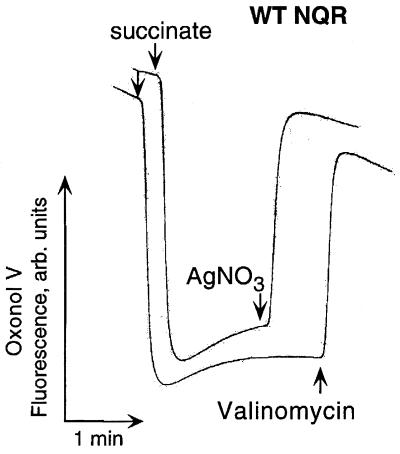
Effects of Ag+ on Δψ in subbacterial vesicles of V. cholerae. The Δψ-sensitive dye Oxonol V (1.0 μM) was used instead of AO. Ag+ (4.0 μM) completely dissipates Δψ generated by respiration in vesicles derived from the strain possessing the wild-type (WT) NQR (upper trek). Nearly identical results were obtained with ΔNQR vesicles (data not shown). In the control experiment (lower trek), 0.2 μM valinomycin was added instead of AgNO3. Shown are typical treks from five independent experiments.
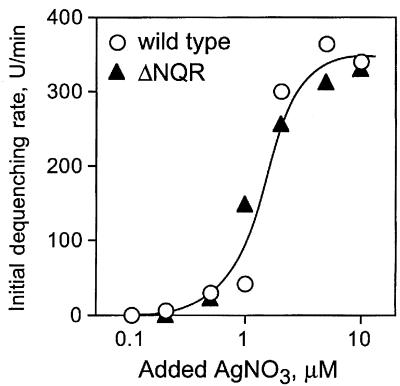
The initial rate of ΔpH dissipation in the wild-type and ΔNQR membrane vesicles as a function of the AgNO3 added. A transmembrane pH gradient was generated by the addition of 10 mM Tris-succinate to the vesicles at pH 7.5, and varying concentrations of AgNO3 were added after a steady-state ΔpH was reached. In each case, changes in AO fluorescence were monitored for 20 s after Ag+ addition. Initial dequenching rates are expressed in arbitrary fluorescence units per minute.
References
-
- Barquera, B., P. Hellwig, W. Zhou, J. E. Morgan, C. C. Häse, K. K. Gosink, M. Nilges, P. J. Bruesehoff, A. Roth, C. R. D. Lancaster, and R. B. Gennis. 2002. Purification and characterization of the recombinant Na+-translocating NADH:quinone oxidoreductase from Vibrio cholerae. Biochemistry 41:3781-3791. - PubMed
-
- Chappell, J. B., and G. D. Greville. 1954. Effect of silver ions on mitochondrial adenosine triphosphatase. Nature 174:930-931. - PubMed
-
- Hayashi, M., T. Miyoshi, M. Sato, and T. Unemoto. 1992. Properties of respiratory chain-linked Na+-independent NADH-quinone reductase in a marine Vibrio alginolyticus. Biochim. Biophys. Acta 1099:145-151. - PubMed
-
- Klasen, H. J. 2000. A historical review of the use of silver in the treatment of burns. II. Renewed interest for silver. Burns 26:131-138. - PubMed
Publication types
MeSH terms
Substances
Grants and funding
LinkOut - more resources
Full Text Sources
Other Literature Sources
Medical
