


TonEBP/NFAT5 stimulates transcription of HSP70 in response to hypertonicity
- PMID: 12138186
- PMCID: PMC133967
- DOI: 10.1128/MCB.22.16.5753-5760.2002
TonEBP/NFAT5 stimulates transcription of HSP70 in response to hypertonicity
Abstract
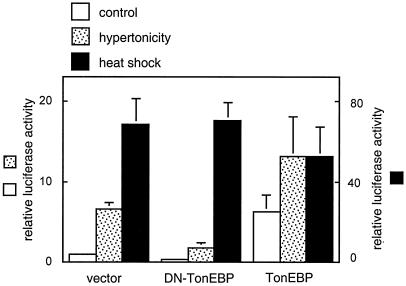
While hyperosmolality of the kidney medulla is essential for urinary concentration, it imposes a great deal of stress. Cells in the renal medulla adapt to the stress of hypertonicity (hyperosmotic salt) by accumulating organic osmolytes. Tonicity-responsive enhancer (TonE) binding protein (TonEBP) (or NFAT5) stimulates transcription of transporters and a synthetic enzyme for the cellular accumulation of organic osmolytes. We found that dominant-negative TonEBP reduced expression of HSP70 as well as the transporters and enzyme. Near the major histocompatibility complex class III locus, there are three HSP70 genes named HSP70-1, HSP70-2, and HSC70t. While HSP70-1 and HSP70-2 were heat inducible, only HSP70-2 was induced by hypertonicity. In the 5' flanking region of the HSP70-2 gene, there are three sites for TonEBP binding. In cells transfected with a reporter plasmid containing this region, expression of luciferase was markedly stimulated in response to hypertonicity. Coexpression of the dominant-negative TonEBP reduced the luciferase expression. Mutating all three sites in the reporter plasmid led to a complete loss of induction by hypertonicity. Thus, TonEBP rather than heat shock factor stimulates transcription of the HSP70-2 gene in response to hypertonicity. We conclude that TonEBP is a master regulator of the renal medulla for cellular protection against high osmolality via organic osmolytes and molecular chaperones.
Figures



References
-
- Beck, F. X., A. Burger-Kentischer, and E. Müller. 1988. Cellular response to osmotic stress in the renal medulla. Pflügers Arch. 436:814-827. - PubMed
-
- Beere, H. M., B. B. Wolf, K. Cain, D. D. Mosser, A. Mahboubi, T. Kuwana, P. Tailor, R. I. Morimoto, G. M. Cohen, and D. R. Green. 2000. Heat-shock protein 70 inhibits apoptosis by preventing recruitment of procaspase-9 to the Apaf-1 apoptosome. Nat. Cell Biol. 2:469-475. - PubMed
-
- Cha, J. H., S. K. Woo, K. H. Han, Y. H. Kim, J. S. Handler, J. Kim, J., and H. M. Kwon. 2001. Hydration status affects nuclear distribution of transcription factor tonicity responsive enhancer binding protein in rat kidney. J. Am. Soc. Nephrol. 12:2221-2230. - PubMed
-
- Dasgupta, S., T. C. Hohman, and D. Carper. 1992. Hypertonic stress induces αB-crystallin expression. Exp. Eye Res. 54:461-470. - PubMed
-
- Dmitrieva, N., D. Kultz, L. Michea, J. Ferraris, and M. Burg. 2000. Protection of renal inner medullary epithelial cells from apoptosis by hypertonic stress-induced p53 activation. J. Biol. Chem. 275:18243-18247. - PubMed
Publication types
MeSH terms
Substances
Grants and funding
LinkOut - more resources
Full Text Sources
Other Literature Sources
