


Clustered DNA damage induced by gamma radiation in human fibroblasts (HF19), hamster (V79-4) cells and plasmid DNA is revealed as Fpg and Nth sensitive sites
- PMID: 12140332
- PMCID: PMC137090
- DOI: 10.1093/nar/gkf467
Clustered DNA damage induced by gamma radiation in human fibroblasts (HF19), hamster (V79-4) cells and plasmid DNA is revealed as Fpg and Nth sensitive sites
Abstract
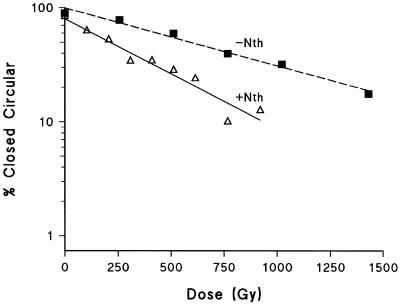
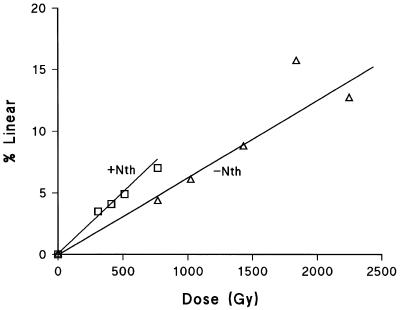
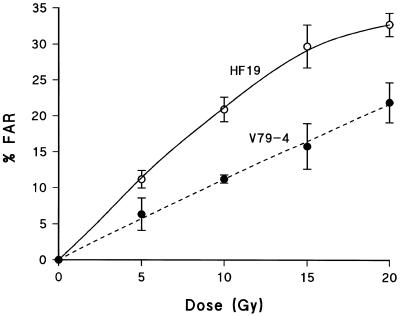
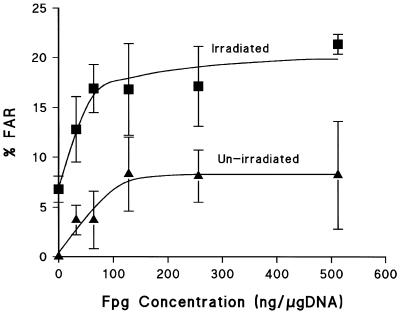
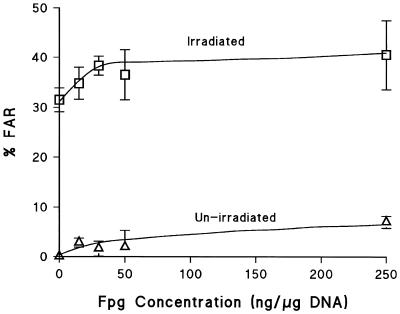
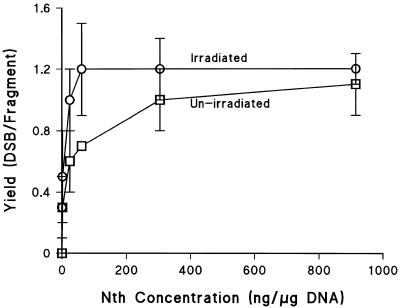
The signature DNA lesion induced by ionizing radiation is clustered DNA damage. Gamma radiation-induced clustered DNA damage containing base lesions was investigated in plasmid DNA under cell mimetic conditions and in two cell lines, V79-4 (hamster) and HF19 (human), using bacterial endonucleases Nth (endonuclease III) and Fpg (formamidopyrimidine DNA glycosylase). Following irradiation with 60Co gamma-rays, induction of double-strand breaks (DSB) and clustered DNA damage, revealed as DSB by the proteins, was determined in plasmid using the plasmid-nicking assay and in cells by either conventional pulsed field gel electrophoresis or a hybridization assay, in which a 3 Mb restriction fragment of the X chromosome is used as a radioactive labeled probe. Enzyme concentrations (30-60 ng/microg DNA) were optimized to minimize visualization of background levels of endogenous DNA damage and DSB produced by non-specific cutting by Fpg and Nth in cellular DNA. 60Co gamma-radiation produces a 1.8-fold increase in the yields of both types of enzyme sensitive sites, visualized as DSB compared with that of prompt DSB in plasmid DNA. In mammalian cells, the increase in yields of clustered DNA damage containing either Fpg or Nth sensitive sites compared with that of prompt DSB is 1.4-2.0- and 1.8-fold, respectively. Therefore, clustered DNA damage is induced in cells by sparsely ionizing radiation and their yield is significantly greater than that of prompt DSB.
Figures
References
-
- O’Neill P. and Fielden,E.M. (1993) Primary free radical processes in DNA. Adv. Radiat. Biol., 17, 53–120.
-
- von Sonntag C. (1987) The Chemical Basis of Radiation Biology. Taylor and Francis, London.
-
- Friedberg E.C., Walker,G.C. and Siede,W. (1995) DNA Repair and Mutagenesis. ASM Press, Washington DC.
-
- Jenner T.J., de Lara,C.M., O’Neill,P. and Stevens,D.L. (1993) Induction and rejoining of DNA double-strand breaks in V79-4 mammalian cells following gamma- and alpha-irradiation. Int. J. Radiat. Biol., 64, 264–273. - PubMed
Publication types
MeSH terms
Substances
LinkOut - more resources
Full Text Sources
Miscellaneous
