


Identification, characterization, and regulation of a cluster of genes involved in carbapenem biosynthesis in Photorhabdus luminescens
- PMID: 12147472
- PMCID: PMC124005
- DOI: 10.1128/AEM.68.8.3780-3789.2002
Identification, characterization, and regulation of a cluster of genes involved in carbapenem biosynthesis in Photorhabdus luminescens
Abstract
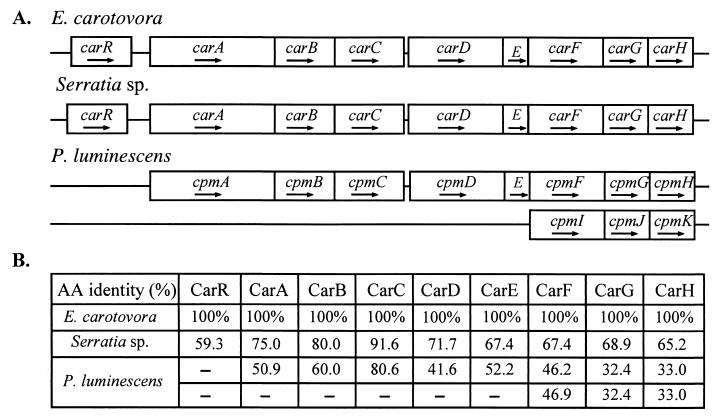
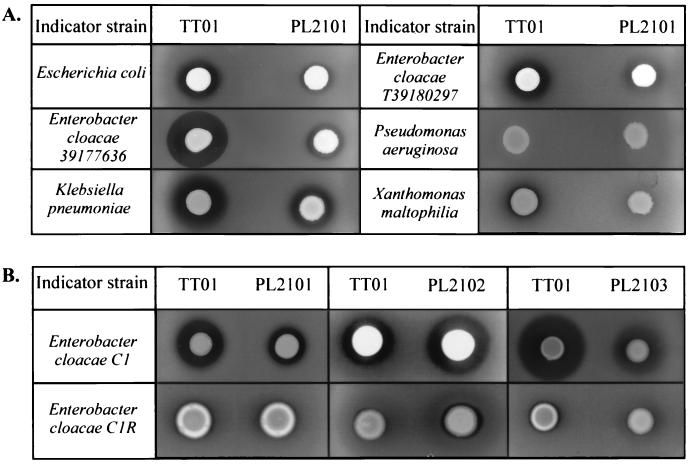
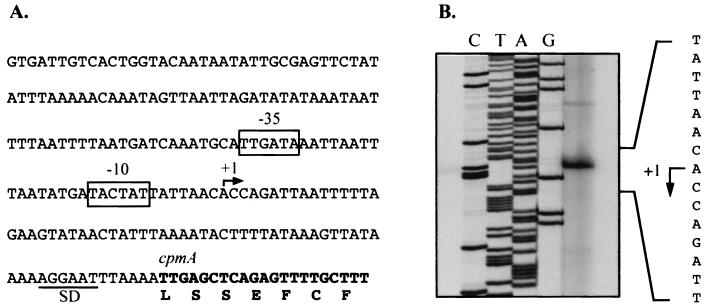
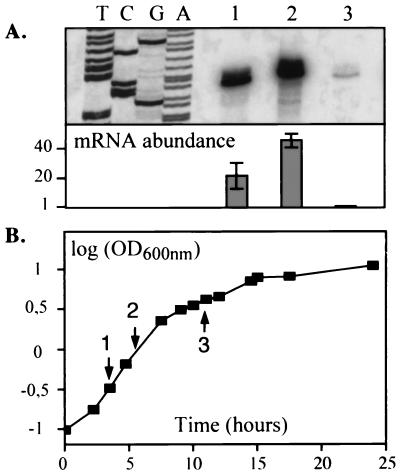
The luminescent entomopathogenic bacterium Photorhabdus luminescens produces several yet-uncharacterized broad-spectrum antibiotics. We report the identification and characterization of a cluster of eight genes (named cpmA to cpmH) responsible for the production of a carbapenem-like antibiotic in strain TT01 of P. luminescens. The cpm cluster differs in several crucial aspects from other car operons. The level of cpm mRNA peaks during exponential phase and is regulated by a Rap/Hor homolog identified in the P. luminescens genome. Marker-exchange mutagenesis of this gene in the entomopathogen decreased antibiotic production. The luxS-like signaling mechanism of quorum sensing also plays a role in the regulation of the cpm operon. Indeed, luxS, which is involved in the production of a newly identified autoinducer, is responsible for repression of cpm gene expression at the end of the exponential growth phase. The importance of this carbapenem production in the ecology of P. luminescens is discussed.
Figures
References
-
- Bassler, B. L., M. Wright, and M. R. Silverman. 1993. Intercellular signalling in Vibrio harveyi: sequence and function of genes regulating expression of luminescence. Mol. Microbiol. 9:773-786. - PubMed
-
- Boemare, N., A. Givaudan, M. Brehelin, and C. Laumond. 1997. Symbiosis and pathogenicity of nematode-bacterium complexes. Symbiosis 22:21-45.
-
- Bradley, J. S., J. Garau, H. Lode, K. V. Rolston, S. E. Wilson, and J. P. Quinn. 1999. Carbapenems in clinical practice: a guide to their use in serious infection. Int. J. Antimicrob. Agents 11:93-100. - PubMed
-
- Bycroft, B. W., C. Maslen, S. J. Box, A. Brown, and J. W. Tyler. 1988. The biosynthetic implications of acetate and glutamate incorporation into (3R,5R)-carbapenem-3-carboxylic acid and (5R)-carbapen-2-em-3-carboxylic acid by Serratia sp. J. Antibiot. (Tokyo) 41:1231-1242. - PubMed
Publication types
MeSH terms
Substances
Associated data
- Actions
- Actions
- Actions
- Actions
LinkOut - more resources
Full Text Sources
Other Literature Sources
