


Microtubule-associated protein 1B: a neuronal binding partner for gigaxonin
- PMID: 12147674
- PMCID: PMC2173828
- DOI: 10.1083/jcb.200202055
Microtubule-associated protein 1B: a neuronal binding partner for gigaxonin
Erratum in
- J Cell Biol. 2003 Oct 13;163(1):189
Abstract
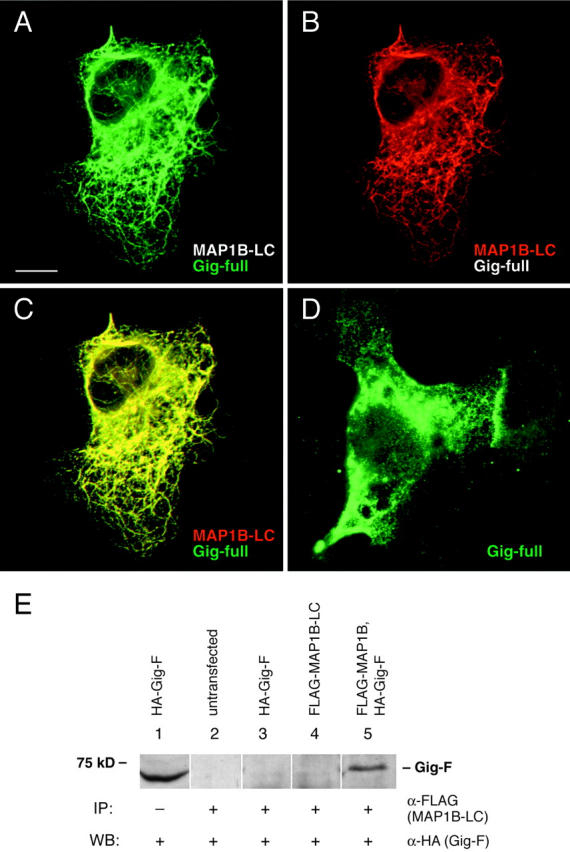
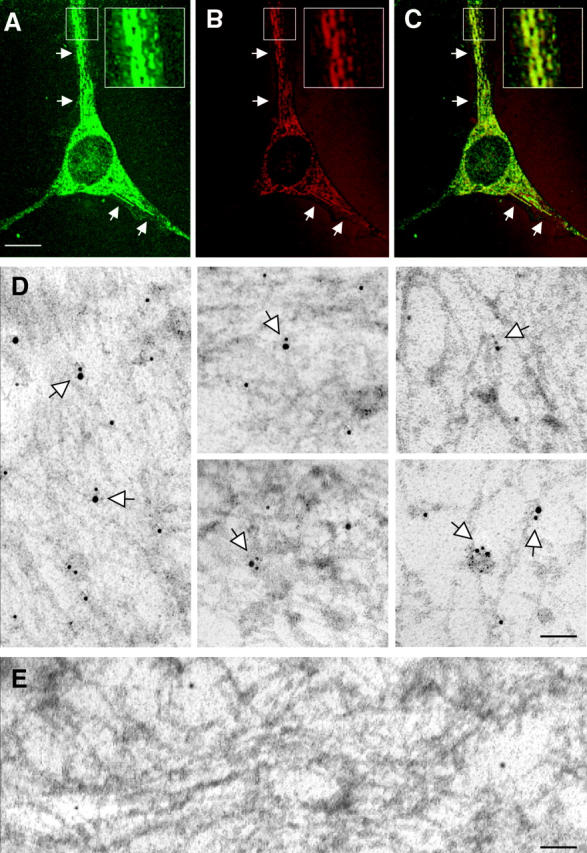
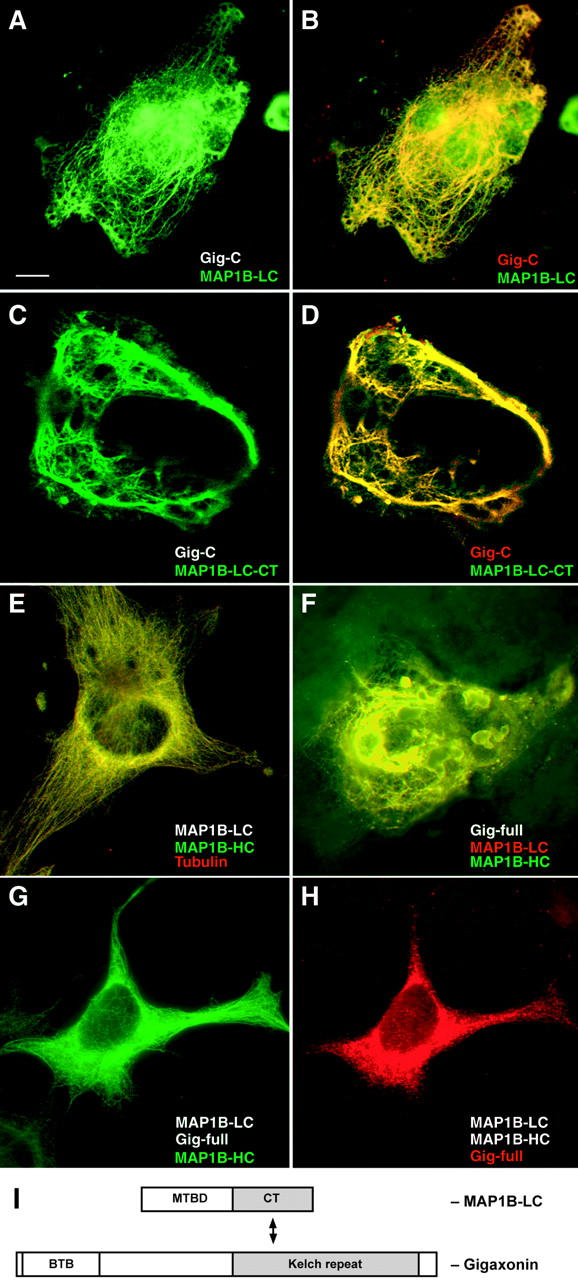
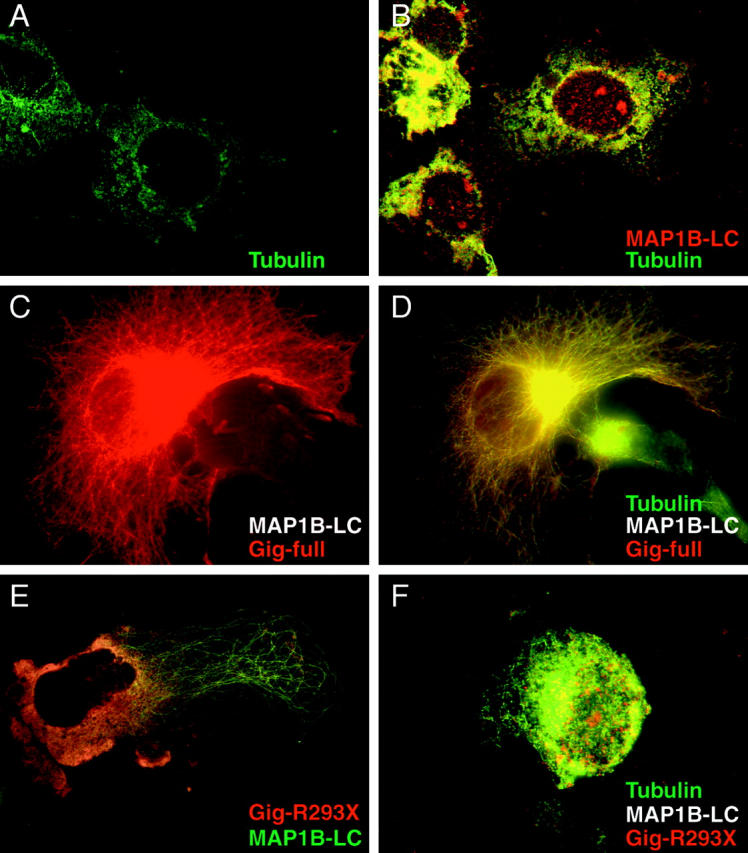
Giant axonal neuropathy (GAN), an autosomal recessive disorder caused by mutations in GAN, is characterized cytopathologically by cytoskeletal abnormality. Based on its sequence, gigaxonin contains an NH2-terminal BTB domain followed by six kelch repeats, which are believed to be important for protein-protein interactions (Adams, J., R. Kelso, and L. Cooley. 2000. Trends Cell Biol. 10:17-24.). Here, we report the identification of a neuronal binding partner of gigaxonin. Results obtained from yeast two-hybrid screening, cotransfections, and coimmunoprecipitations demonstrate that gigaxonin binds directly to microtubule-associated protein (MAP)1B light chain (LC; MAP1B-LC), a protein involved in maintaining the integrity of cytoskeletal structures and promoting neuronal stability. Studies using double immunofluorescent microscopy and ultrastructural analysis revealed physiological colocalization of gigaxonin with MAP1B in neurons. Furthermore, in transfected cells the specific interaction of gigaxonin with MAP1B is shown to enhance the microtubule stability required for axonal transport over long distance. At least two different mutations identified in GAN patients (Bomont, P., L. Cavalier, F. Blondeau, C. Ben Hamida, S. Belal, M. Tazir, E. Demir, H. Topaloglu, R. Korinthenberg, B. Tuysuz, et al. 2000. Nat. Genet. 26:370-374.) lead to loss of gigaxonin-MAP1B-LC interaction. The devastating axonal degeneration and neuronal death found in GAN patients point to the importance of gigaxonin for neuronal survival. Our findings may provide important insights into the pathogenesis of neurodegenerative disorders related to cytoskeletal abnormalities.
Figures
References
-
- Adams, J., R. Kelso, and L. Cooley. 2000. The kelch repeat superfamily of proteins: propellers of cell function. Trends Cell Biol. 10:17–24. - PubMed
-
- Ben Hamída, C., L. Cavalier, S. Belal, H. Sanhaji, N. Nadal, C. Barhoumi, N. M'Rissa, N. Marzouki, J.L. Mandel, M. Ben Hamída, et al. 1997. Homozygosity mapping of giant axonal neuropathy gene to chromosome 16q24.1. Neurogenetics. 1:129–133. - PubMed
-
- Berg, B.O., S.H. Rosenberg, and A.K. Asbury. 1972. Giant axonal neuropathy. Pediatrics. 49:894–899. - PubMed
-
- Bomont, P., L. Cavalier, F. Blondeau, C. Ben Hamida, S. Belal, M. Tazir, E. Demir, H. Topaloglu, R. Korinthenberg, B. Tuysuz, et al. 2000. The gene encoding gigaxonin, a new member of the cytoskeletal BTB/kelch repeat family, is mutated in giant axonal neuropathy. Nat. Genet. 26:370–374. - PubMed
-
- Bousquet, O., M. Basseville, E. Vila-Porcile, T. Billette de Villemeur, J.J. Hauw, P. Landrieu, and M.M. Portier. 1996. Aggregation of a subpopulation of vimentin filaments in cultured human skin fibroblasts derived from patients with giant axonal neuropathy. Cell Motil. Cytoskeleton. 33:115–129. - PubMed
Publication types
MeSH terms
Substances
LinkOut - more resources
Full Text Sources
Other Literature Sources
Molecular Biology Databases
