


Chaperonins in disease: mechanisms, models, and treatments
- PMID: 12147708
- PMCID: PMC1187180
- DOI: 10.1136/mp.55.4.209
Chaperonins in disease: mechanisms, models, and treatments
Abstract
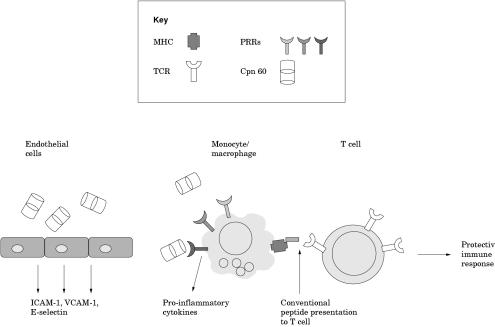
Chaperonins are oligomeric proteins that assist in the folding of nascent or denatured proteins. Bacterial chaperonins are strongly immunogenic and can cause tissue pathology. They have been implicated in infection, autoimmune disease, and idiopathic or multifactorial diseases, such as arthritis and atherosclerosis. Chaperonin 60 proteins are also involved in prion diseases. In the past few years, much progress has been made in unravelling the involvement of various bacterial and mammalian chaperonin 60 (Cpn 60 or hsp 60) proteins in such diseases, and in proposing mechanisms for their biological actions, although we are still some way from a full understanding of chaperonin action that might lead to immunotherapeutic approaches. This review focuses on the current knowledge of the roles of Cpn 60 in the pathology of infectious and immune diseases, and discusses models for the actions of this molecule. Some potential therapeutic strategies will also be reviewed.
Figures
References
-
- Morimoto RI, Tissiéres A, Georgopoulos C, eds. The biology of heat shock proteins and molecular chaperones. Plainview, NY: Cold Spring Harbor Laboratory Press, 1994.
-
- Hartl FU. Molecular chaperones in cellular protein folding. Nature 1996;381:571–9. - PubMed
-
- Hemmingsen SM, Woolford C, van der Vies SM, et al. Homologous plant and bacterial proteins chaperone oligomeric protein assembly. Nature 1988;333:330–4. - PubMed
-
- Fink AL. Chaperone-mediated protein folding. Physiol Rev 1999;79:425–49. - PubMed
-
- Houry WA, Frishman D, Eckerskorn C, et al. Identification of in vivo substrates of the chaperonin GroEL. Nature 1999;402:147–54. - PubMed
Publication types
MeSH terms
Substances
LinkOut - more resources
Full Text Sources
Research Materials
Miscellaneous
