


Molecular characterization of multidrug-resistant Salmonella enterica subsp. enterica serovar Typhimurium isolates from swine
- PMID: 12149335
- PMCID: PMC120621
- DOI: 10.1128/JCM.40.8.2813-2822.2002
Molecular characterization of multidrug-resistant Salmonella enterica subsp. enterica serovar Typhimurium isolates from swine
Abstract
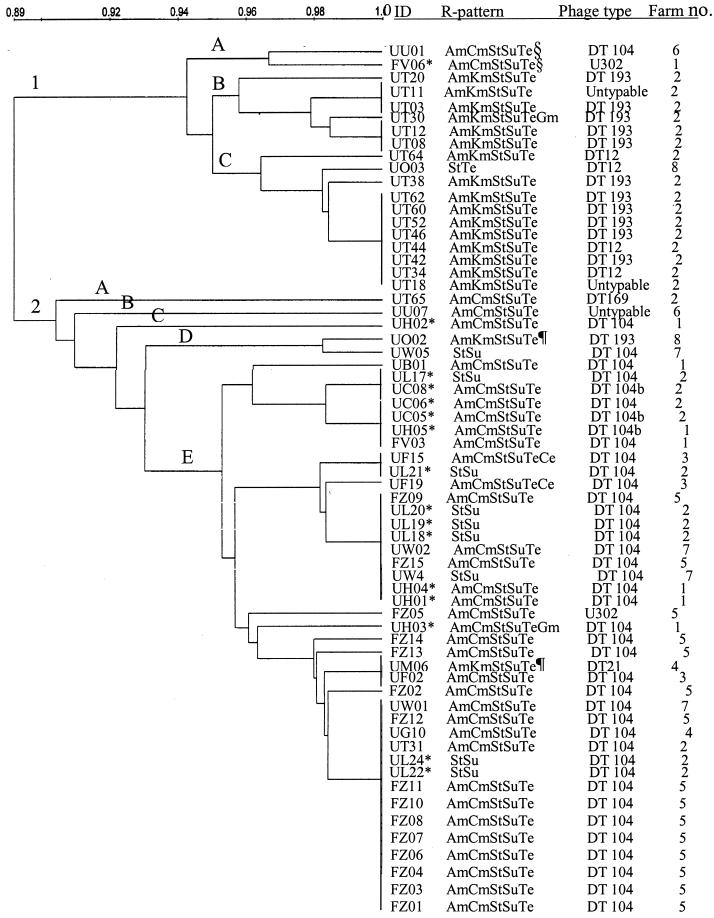
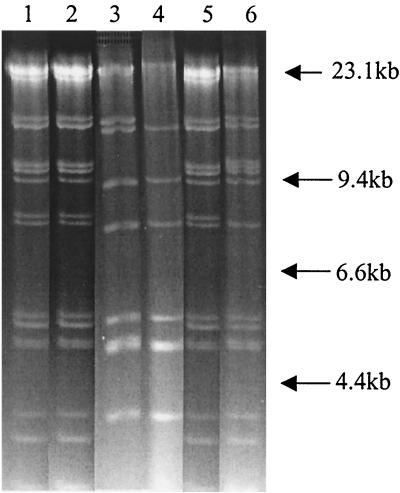
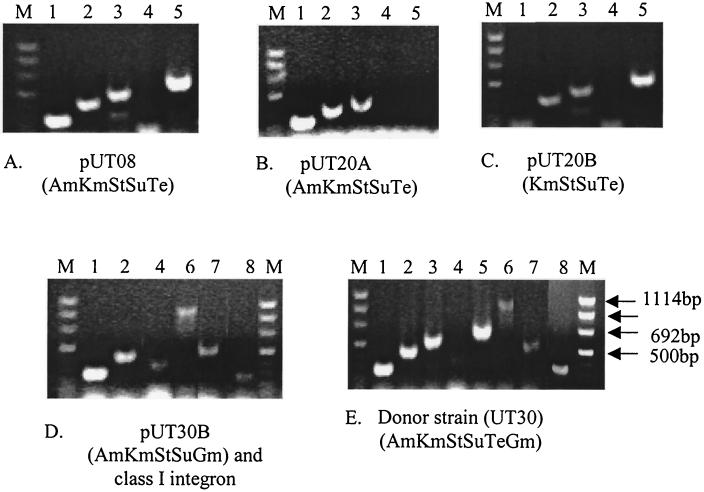
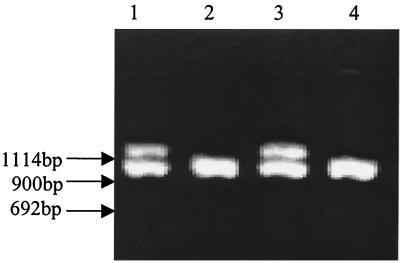
As part of a longitudinal study of antimicrobial resistance among salmonellae isolated from swine, we studied 484 Salmonella enterica subsp. enterica serovar Typhimurium (including serovar Typhimurium var. Copenhagen) isolates. We found two common pentaresistant phenotypes. The first was resistance to ampicillin, chloramphenicol, streptomycin, sulfamethoxazole, and tetracycline (the AmCmStSuTe phenotype; 36.2% of all isolates), mainly of the definitive type 104 (DT104) phage type (180 of 187 isolates). The second was resistance to ampicillin, kanamycin, streptomycin, sulfamethoxazole, and tetracycline (the AmKmStSuTe phenotype; 44.6% of all isolates), most commonly of the DT193 phage type (77 of 165 isolates), which represents an unusual resistance pattern for DT193 isolates. We analyzed 64 representative isolates by amplified fragment length polymorphism (AFLP) analysis, which revealed DNA fingerprint similarities that correlated with both resistance patterns and phage types. To investigate the genetic basis for resistance among DT193 isolates, we characterized three AmKmStSuTe pentaresistant strains and one hexaresistant strain, which also expressed resistance to gentamicin (Gm phenotype), all of which had similar DNA fingerprints and all of which were collected during the same sampling. We found that the genes encoding the pentaresistance pattern were different from those from isolates of the DT104 phage type. We also found that all strains encoded all of their resistance genes on plasmids, unlike the chromosomally encoded genes of DT104 isolates, which could be transferred to Escherichia coli via conjugation, but that the plasmid compositions varied among the isolates. Two strains (strains UT08 and UT12) had a single, identical plasmid carrying bla(TEM) (which encodes ampicillin resistance), aphA1-Iab (which encodes kanamycin resistance), strA and strB (which encode streptomycin resistance), class B tetA (which encodes tetracycline resistance), and an unidentified sulfamethoxazole resistance allele. The third pentaresistant strain (strain UT20) was capable of transferring by conjugation two distinct resistance patterns, AmKmStSuTe and KmStSuTe, but the genes were carried on plasmids with slightly different restriction patterns (differing by a single band of 15 kb). The hexaresistant strain (strain UT30) had the same plasmid as strains UT08 and UT12, but it also carried a second plasmid that conferred the AmKmStSuGm phenotype. The second plasmid harbored the gentamicin resistance methylase (grm), which has not previously been reported in food-borne pathogenic bacteria. It also carried the sul1 gene for sulfamethoxazole resistance and a 1-kb class I integron bearing aadA for streptomycin resistance. We also characterized isolates of the DT104 phage type. We found a number of isolates that expressed resistance only to streptomycin and sulfamethoxazole (the StSu phenotype; 8.3% of serovar Typhimurium var. Copenhagen strains) but that had AFLP DNA fingerprints similar or identical to those of strains with genes encoding the typical AmCmStSuTe pentaresistance phenotype of DT104. These atypical StSu DT104 isolates were predominantly cultured from environmental samples and were found to carry only one class I integron of 1.0 kb, in contrast to the typical two integrons (InC and InD) of 1.0 and 1.2 kb, respectively, of the pentaresistant DT104 isolates. Our findings show the widespread existence of multidrug-resistant Salmonella strains and the diversity of multidrug resistance among epidemiologically related strains. The presence of resistance genes on conjugative plasmids and duplicate genes on multiple plasmids could have implications for the spread of resistance factors and for the stability of multidrug resistance among Salmonella serovar Typhimurium isolates.
Figures
References
-
- Anderson, E. S., and M. J. Lewis. 1965. Drug resistance and its transfer in Salmonella typhimurium. Nature 206:579-583. - PubMed
-
- Baggesen, D. L., and F. M. Aarestrup. 1998. Characterisation of recently emerged multiple antibiotic-resistant Salmonella enterica serovar Typhimurium DT104 and other multiresistant phage types from Danish pig herds. Vet. Rec. 143:95-97. - PubMed
-
- Beltran, P., J. M. Musser, R. Helmuth, J. J. Farmer III, W. M. Frerichs, I. K. Wachsmuth, K. Ferris, A. C. McWhorter, J. G. Wells, A. Cravioto, et al. 1988. Toward a population genetic analysis of Salmonella: genetic diversity and relationships among strains of serotypes S. choleraesuis, S. derby, S. dublin, S. enteritidis, S. heidelberg, S. infantis, S. newport, and S. typhimurium. Proc. Natl. Acad. Sci. USA 85:7753-7757. - PMC - PubMed
Publication types
MeSH terms
Substances
LinkOut - more resources
Full Text Sources
