Pharmacoepidemiological analysis of provincial differences between consumption of macrolides and rates of erythromycin resistance among Streptococcus pyogenes isolates in Spain
- PMID: 12149359
- PMCID: PMC120652
- DOI: 10.1128/JCM.40.8.2959-2963.2002
Pharmacoepidemiological analysis of provincial differences between consumption of macrolides and rates of erythromycin resistance among Streptococcus pyogenes isolates in Spain
Abstract
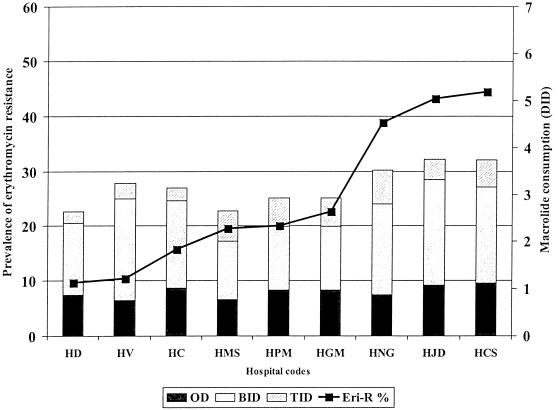
The M phenotype is by far the most common mechanism of erythromycin resistance among Streptococcus pyogenes isolates in Spain. A geographic analysis of the relationship between within-country differences in the prevalence of M-type resistance to erythromycin in S. pyogenes and the level of consumption of 14- and 15-membered macrolides within different provinces was carried out. From 1998 to 1999, a nationwide multicenter surveillance study yielded 2,039 consecutive pharyngeal isolates of S. pyogenes. Data on antibiotic consumption for the same period were gathered from IMS Health, and the corresponding daily defined doses per 1,000 inhabitants per day were calculated according to the Anatomic Therapeutic Classification index. Macrolide use was subdivided into dosages given three times a day (TID), twice a day (BID), or once a day (OD). Spearman nonparametric correlation coefficients (R) were calculated, and variables proving to be significantly associated (P < 0.1) were introduced into a linear regression model. The total consumption of macrolides presented a significant correlation with the prevalence of resistance (R = 0.527; P = 0.032). Neither TID nor BID macrolide consumption showed significant correlations. Only OD consumption had a significance below 0.1. These data are consistent with the hypothesis that only the total consumption of macrolides influences the local rates of M-type erythromycin resistance in S. pyogenes, and subgroups of macrolides seem to have an additive rather than a selective effect by contributing to increasing the final amount of macrolides used. Local variations in total consumption were associated only with BID consumption (R = 0.849; P = 0.004). The simple linear regression with total macrolide consumption showed a considerable determination coefficient (R(2) = 0.678; P = 0.006). The model explains up to 68% of the measured variation and is clearly better as a predictor of the prevalence of resistance than the mere mean is. By solving the regression equation, the resultant value of 2.2 defined doses per 1,000 inhabitants per day fits with the existence of a critical threshold of selective pressure.
Figures
References
-
- Bessen, D. E., M. W. Izzo, T. R. Fiorentino, R. M. Caringal, S. K. Hollingshead, and B. Beall. 1999. Genetic linkage of exotoxin alleles and emm gene markers for tissue tropism in group A streptococci. J. Infect. Dis. 179:627-636. - PubMed
-
- Bronzwaer, S. L., O. Cars, U. Buchholz, S. Mölstad, W. Goettsch, I. K. Veldhuijzen, J. L. Kool, M. JW. Sprenger, J. E. Degener, and the European Antimicrobial Resistance Surveillance System. 2002. A European study on the relationship between antimicrobial use and antimicrobial resistance. Emerg. Infect. Dis. 8:278-282. - PMC - PubMed
-
- Cars, O., S. Molstad, and A. Melander. 2001. Variation in antibiotic use in the European Union. Lancet 357:1851-1853. - PubMed
-
- Cizman, M., M. Pokorn, K. Seme, A. Orazem, and M. Paragi. 2001. The relationship between trends in macrolide use and resistance to macrolides of common respiratory pathogens. J. Antimicrob. Chemother. 47:475-477. - PubMed
-
- Cornaglia, G., M. Ligozzi, A. Mazzariol, L. Masala, G. Lo Cascio, G. Orefici, R. Fontana, et al. 1998. Resistance of Streptococcus pyogenes to erythromycin and related antibiotics in Italy. Clin. Infect. Dis. 1:S87-S92. - PubMed
MeSH terms
Substances
LinkOut - more resources
Full Text Sources
Medical