Phenotyping and genotyping of Sporothrix schenckii isolates according to geographic origin and clinical form of Sporotrichosis
- PMID: 12149366
- PMCID: PMC120692
- DOI: 10.1128/JCM.40.8.3004-3011.2002
Phenotyping and genotyping of Sporothrix schenckii isolates according to geographic origin and clinical form of Sporotrichosis
Abstract
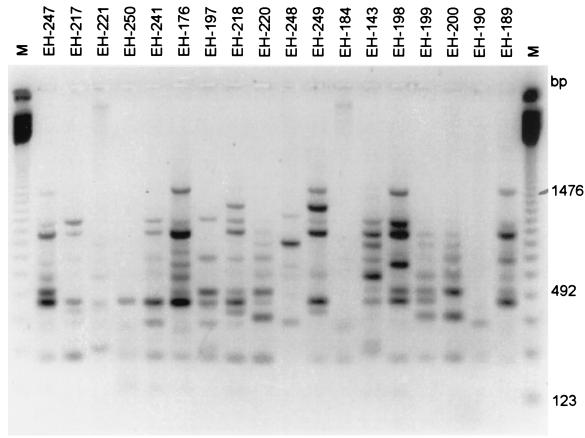
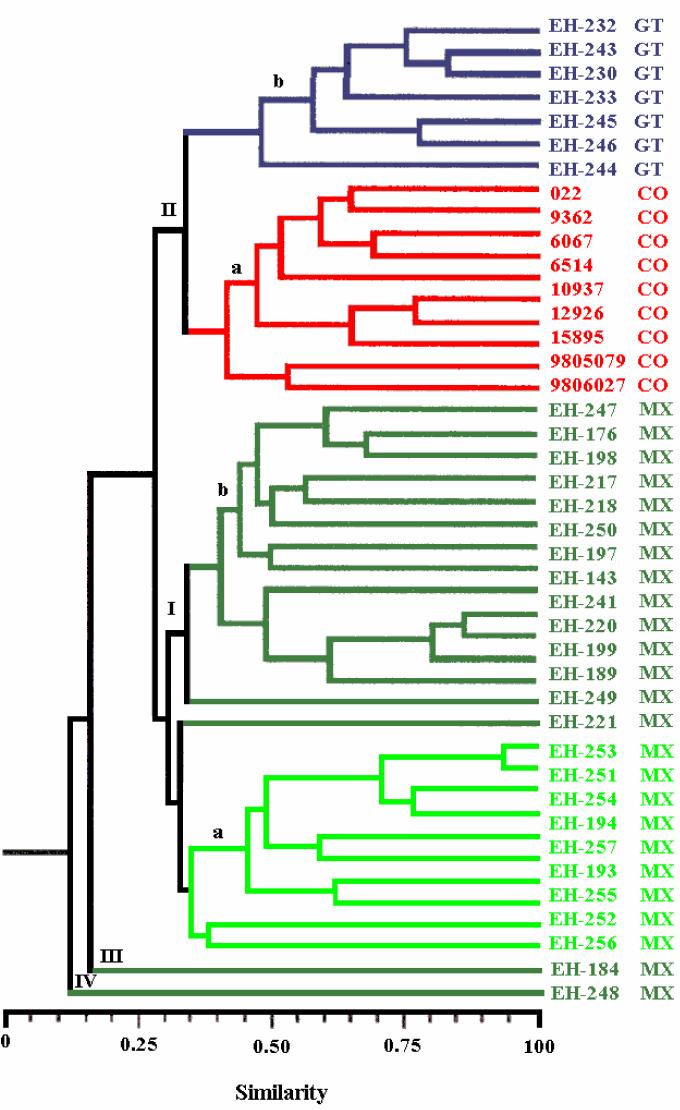
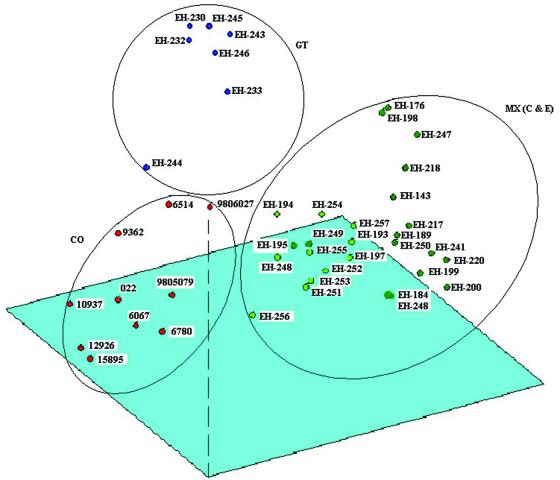
Sporothrix schenckii isolates of fixed and lymphocutaneous clinical forms from Mexico (MX), Guatemala (GT), and Colombia (CO) as well as environmental isolates from MX were studied by analyzing their phenotypic characteristics (conidial length, thermotolerance by percent growth inhibition [GI] at 35 and 37 degrees C, median lethal dose [LD(50)]) and genotypic characteristics (by random amplified polymorphic DNA [RAPD] analysis-PCR). A significant difference (P < 0.01) in the mean conidial length of S. schenckii clinical isolates from CO ( = 4.03 +/- 1.04 microm) compared with those of clinical isolates from MX ( = 2.06 +/- 0.53 microm) and GT ( = 2.68 +/- 0.83 microm) was observed. The lowest thermotolerance, as determined by measurement of percent GI, was exhibited by isolates from CO at 35 degrees C ( = 50.1% +/- 15.9%) and 37 degrees C ( = 72.7% +/- 10.9%). In general, the highest virulence, as determined by measurement of the LD(50) for mice, was observed for the MX environmental isolates. RAPD analysis-PCR with 10-mer primers OPBG-01, OPBG-14, and OPBG-19 generated 52 reproducible bands. The 44 Sporothrix isolates fell into four major groups by hierarchical cluster analysis. The first group (group I), formed by 25 (of 27) isolates from MX, had two subgroups: subgroup Ia with 10 environmental isolates and subgroup Ib with 14 clinical isolates. The second group (group II) had two subgroups: subgroup IIa, formed by isolates from CO, and subgroup IIb, formed by isolates from GT. Groups III and IV each had only one clinical isolate from MX. A principal-component analysis of the same data yielded three distinct groups, depending on the geographical origins of the isolates, including the isolates in groups III and IV from MX, which were grouped with the isolates from MX by principal-component analysis. This study revealed that isolates from CO had low thermotolerances at 35 and 37 degrees C and could be associated with superficial skin lesions in patients with fixed clinical forms of sporotrichosis, the most frequent form of the disease in CO. Distinct patterns dependent on geographical origins were also revealed by RAPD analysis-PCR, but these had no relation to the clinical form of the disease.
Figures
References
-
- Albornoz, M. B., M. Mendoza, and E. D. Torres. 1986. Growth temperatures of isolates of Sporothrix schenckii from disseminated and fixed cutaneous lesions of sporotrichosis. Mycopathologia 95:81-83. - PubMed
-
- Arenas, G., and C. Toriello. 1986. Actividad inmunológica de antígenos miceliales-levaduriformes de diferentes fases de crecimiento de Sporothrix schenckii. Rev. Mex. Microsc. 2:131-144.
-
- Arenas, R. 1993. Micología médica ilustrada. Interamericana. McGraw-Hill, México D.F., Mexico.
-
- Berbee, M. L., and J. W. Taylor. 1992. 18S ribosomal RNA gene sequence characters place the human pathogen Sporothrix schenckii in the genus Ophiostoma. Exp. Mycol. 16:87-91.
-
- Boekhout, T., and A. Belkum. 1997. Variability of kariotypes and RAPD types in genetically related isolates of Cryptococcus neoformans. Curr. Genet. 32:203-208. - PubMed
Publication types
MeSH terms
Substances
LinkOut - more resources
Full Text Sources
Research Materials
Miscellaneous