


doi: 10.1073/pnas.162219099.
Epub 2002 Jul 29.
Experimental evaluation of topological parameters determining protein-folding rates
Affiliations
- PMID: 12149462
- PMCID: PMC124919
- DOI: 10.1073/pnas.162219099
Item in Clipboard
Experimental evaluation of topological parameters determining protein-folding rates
Proc Natl Acad Sci U S A.
.
Abstract
Recent work suggests that structural topology plays a key role in determining protein-folding rates and pathways. The refolding rates of small proteins that fold without intermediates are found to correlate with simple structural parameters such as relative contact order, long-range order, or the fraction of short-range contacts. To test and evaluate the role of structural topology experimentally, a set of circular permutants of the ribosomal protein S6 from Thermus thermophilus was analyzed. Despite a wide range of relative contact order, the permuted proteins all fold with similar rates. These results suggest that alternative topological parameters may better describe the role of topology in protein-folding rates.
Figures
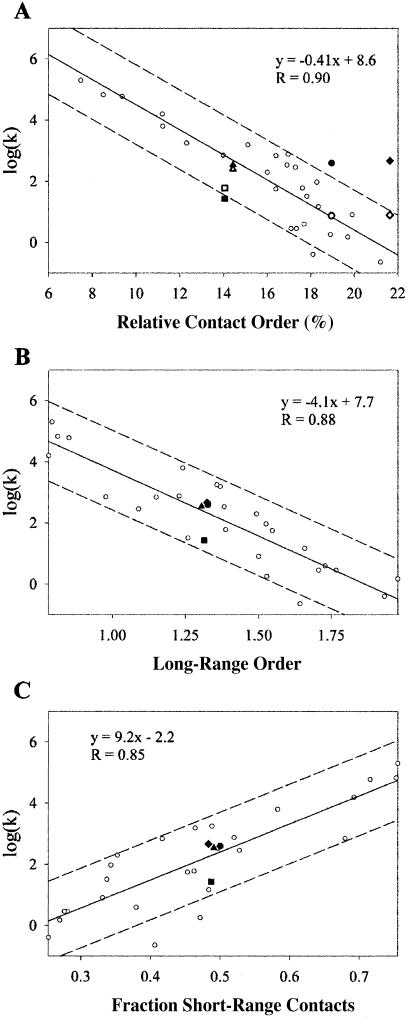
Parameters for predicting refolding kinetics. (A) RCO correlates to protein-refolding rates for naturally occurring proteins (open circles) but not for circular permutants of S6 (closed circle for S6, closed square for S6cp14, closed triangle for S6cp36, and closed diamond for S6cp55). Folding rates for S6 and permutants were also corrected to the average stability of the data set,  where α is the solvent exposure of the transition state (bold symbols). (B) Long-range order correlates with protein-refolding rates including circular permutants of S6. (C) The percentage of short-range contacts correlates with protein-refolding rates including circular permutants of S6. Fits and correlation coefficients were calculated excluding S6 and permutants by using SIGMAPLOT 2000 (SPSS, Chicago).
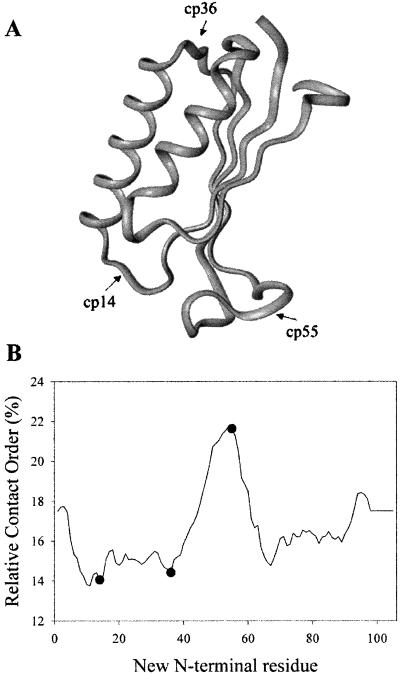
Effect of circular permutation on RCO. (A) Permutation sites are marked on a ribbon diagram of S6 generated from PDB ID code . (B) The predicted RCO of every permutant of S6 is shown, with closed circles showing the permutations selected for this study.
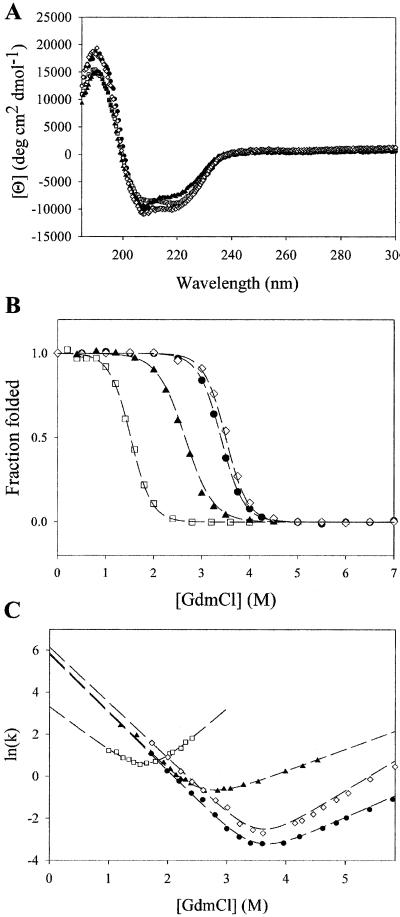
Characterization of the permutants. Far-UV CD spectra (A), equilibrium denaturation with Gdm⋅Cl (B), and relaxation kinetics as a function of Gdm⋅Cl (C) are shown. Closed circles are data for S6, open squares for S6cp14, closed triangles for S6cp36, and open diamonds for S6cp55.
References
Publication types
MeSH terms
Substances
LinkOut - more resources
Full Text Sources
Other Literature Sources
