. 2002 Aug 6;99(16):10567-70.
doi: 10.1073/pnas.162369899. Epub 2002 Jul 29.

Somatic stem cells and the kinetics of mutagenesis and carcinogenesis

Affiliations

Somatic stem cells and the kinetics of mutagenesis and carcinogenesis

John Cairns. Proc Natl Acad Sci U S A. .

Abstract

There is now strong experimental evidence that epithelial stem cells arrange their sister chromatids at mitosis such that the same template DNA strands stay together through successive divisions; DNA labeled with tritiated thymidine in infancy is still present in the stem cells of adult mice even though these cells are incorporating (and later losing) bromodeoxyuridine [Potten, C. S., Owen, G., Booth, D. & Booth, C. (2002) J. Cell Sci.115, 2381-2388]. But a cell that preserves "immortal strands" will avoid the accumulation of replication errors only if it inhibits those pathways for DNA repair that involve potentially error-prone resynthesis of damaged strands, and this appears to be a property of intestinal stem cells because they are extremely sensitive to the lethal effects of agents that damage DNA. It seems that the combination, in the stem cell, of immortal strands and the choice of death rather than error-prone repair makes epithelial stem cell systems resistant to short exposures to DNA-damaging agents, because the stem cell accumulates few if any errors, and any errors made by the daughters are destined to be discarded. This paper discusses these issues and shows that they lead to a model that explains the strange kinetics of mutagenesis and carcinogenesis in adult mammalian tissues. Coincidentally, the model also can explain why cancers arise even though the spontaneous mutation rate of differentiated mammalian cells is not high enough to generate the multiple mutations needed to form a cancer and why loss of nucleotide-excision repair does not significantly increase the frequency of the common internal cancers.


Figures
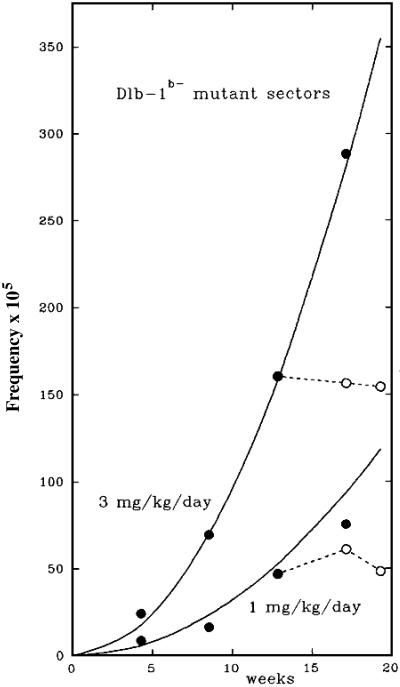
Fig 1.
Fig 1.
The accumulation of mutant clones in the wall of the small intestine of mice that received a daily i.p. injection of either 1 or 3 mg/kg ENU (7). The mice carried one copy of Dlb-1b, which codes for a stainable cell-surface lectin, and that allowed microscopic measurement of the frequency of unstainable, mutant sectors (clones) in the epithelium. The points show the observed frequency of mutant sectors during treatment (filled circles) and after treatment ceased (open circles). The curves show the expected values if the frequency of sectors equals 3.3 × 10⁻⁶ × (mg/kg ENU) × (weeks)2. To allow for the time between mutation in a cell and the appearance of a visible clone of mutant descendants, the points were displaced 4 days to the left (7). The raw data for this figure were kindly provided by John Heddle (York University, Toronto).
Fig 2.
Fig 2.
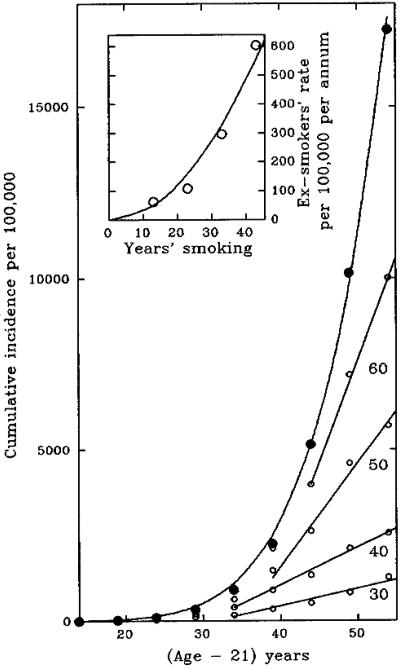
Lung cancer in male smokers (12). The points in the main graph show the cumulative incidence of lung cancer (per 100,000) in relation to age (filled circles), and the curve shows the expected values if cumulative incidence per 100,000 equals 7.1 × 10⁻⁷ × (years − 21)6; the open circles show the cumulative incidence per 100,000 smokers who stopped smoking at 30, 40, 50, or 60 years old, less the cumulative incidence in people who never smoked. (Inset) The final annual incidence (rate of increase in cumulative incidence) per 100,000 ex-smokers (open circles) in relation to their duration of smoking; the curve shows the expected values if the final annual incidence in ex-smokers equals 0.3 × (duration of smoking)2, assuming that people start smoking at the age of 17. The raw data for this figure were kindly provided by Sarah Darby.

References

    1. Cairns J. (1975) Nature (London) 255, 197-200. - PubMed
    1. Potten C. S. (1977) Nature (London) 269, 518-521. - PubMed
    1. Ijiri K. & Potten, C. S. (1987) Br. J. Cancer 55, 113-123. - PMC - PubMed
    1. Roth R. B. & Samson, L. D. (2002) Cancer Res. 62, 656-660. - PubMed
    1. Potten C. S., Taylor, Y. & Hendry, J. H. (1988) Int. J. Radiat. Biol. 54, 1041-1051. - PubMed