Review
. 2002 Aug 1;542(Pt 3):669-83.
doi: 10.1113/jphysiol.2002.017483.

Short-term cardiovascular oscillations in man: measuring and modelling the physiologies

Affiliations
Review

Short-term cardiovascular oscillations in man: measuring and modelling the physiologies

Michael A Cohen et al. J Physiol. .

Abstract

Research into cardiovascular variabilities intersects both human physiology and quantitative modelling. This is because respiratory and Mayer wave (or 10 s) cardiovascular oscillations represent the integrated control of a system through both autonomic branches by systemic haemodynamic changes within a fluid-filled, physical system. However, our current precise measurement of short-term cardiovascular fluctuations does not necessarily mean we have an adequate understanding of them. Empirical observation suggests that both respiratory and Mayer wave fluctuations derive from mutable autonomic and haemodynamic inputs. Evidence strongly suggests that respiratory sinus arrhythmia both contributes to and buffers respiratory arterial pressure fluctuations. Moreover, even though virtual abolition of all R-R interval variability by cholinergic blockade suggests that parasympathetic stimulation is essential for expression of these variabilities, respiratory sinus arrhythmia does not always reflect a purely vagal phenomenon. The arterial baroreflex has been cited as the mechanism for both respiratory and Mayer wave frequency fluctuations. However, data suggest that both cardiac vagal and vascular sympathetic fluctuations at these frequencies are independent of baroreflex mechanisms and, in fact, contribute to pressure fluctuations. Results from cardiovascular modelling can suggest possible sources for these rhythms. For example, modelling originally suggested low frequency cardiovascular rhythms derived from intrinsic delays in baroreceptor control, and experimental evidence subsequently corroborated this possibility. However, the complex stochastic relations between and variabilities in these rhythms indicate no single mechanism is responsible. If future study of cardiovascular variabilities is to move beyond qualitative suggestions of determinants to quantitative elucidation of critical physical mechanisms, both experimental design and model construction will have to be more trenchant.


Figures
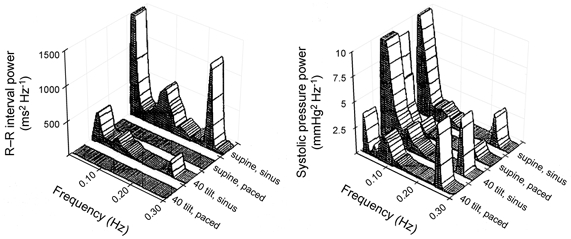
Figure 1
Figure 1. R-R interval and systolic pressure power in 20 healthy young subjects in the supine and 40 deg tilt positions with and without fixed rate atrial pacing
Elimination of R-R interval variability significantly reduces pressure oscillations at the respiratory frequency in supine humans, but increases them in the 40 deg tilt position. Moreover, it has no effect on Mayer wave (≈0.1 Hz) pressure oscillations in supine humans, but increases them in the 40 deg tilt position. This demonstrates the frequency and state dependence of cardiovascular oscillations (modified from Taylor & Eckberg, 1996).
Figure 2
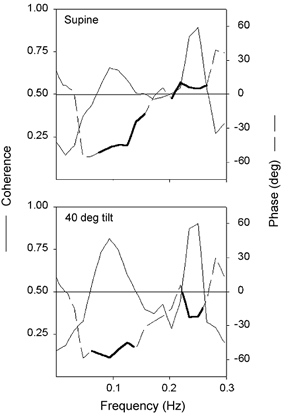
Figure 2. The cross-spectral phase and coherence between R-R interval and systolic pressure in 20 healthy young subjects in the supine and 40 deg tilt positions with normal sinus rhythm
Thick lines indicate phase where coherence is significant. Phase at the respiratory frequency shifts from R-R interval in phase with or slightly leading arterial pressure changes in supine humans to R-R interval following pressure changes in the upright position. This may reveal differential baroreflex engagement and explain contrasting effects of atrial pacing in supine and tilt positions. However, the phase relation at the respiratory frequency is consistently negative, and therefore provides no insight to the contrasting effects of atrial pacing the two positions (modified from Taylor & Eckberg, 1996).
Figure 3
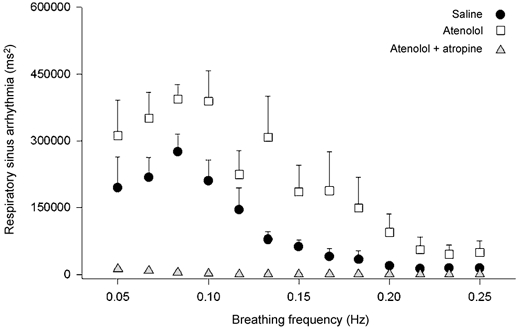
Figure 3. Effects of cardioselective β-adrenergic blockade (0.2 mg kg−1 atenolol) and double autonomic blockade (atenolol + 0.04 mg kg−1 atropine) on respiratory sinus arrhythmia during controlled frequency breathing from 0.25 to 0.05 Hz in the 40 deg tilt position
n = 10. β-blockade enhances respiratory sinus arrhythmia at all breathing frequencies, not just at higher breathing frequencies. This undermines the contention that respiratory sinus arrhythmia is a purely vagal phenomenon (redrawn from Taylor et al. 2001).
Figure 4
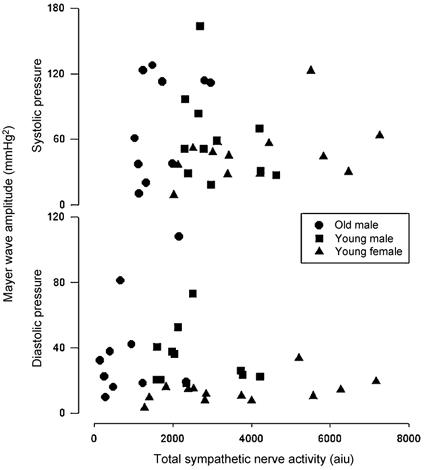
Figure 4. Relations between resting peroneal nerve muscle sympathetic activity and arterial pressure Mayer wave amplitude in 10 young females (18-28 years old), 11 young males (18-29 years old) and 13 older males (60-72 years old)
There were no consistent relations among arterial pressure Mayer wave amplitude and vascular sympathetic outflow. Despite striking differences in resting sympathetic outflow, young females and older males have comparable Mayer wave amplitude (redrawn from Taylor et al. 1998b). aiu, arbitrary integration units.
Figure 5
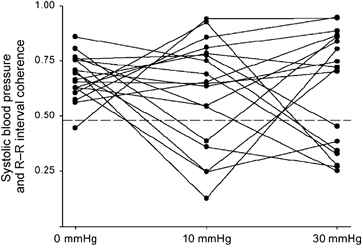
Figure 5. Coherence between systolic pressure and R-R interval in 18 young males during 5 min of supine rest, and of 0.1 Hz oscillatory lower body suction at 10 and 30 mmHg
The oscillatory suction significantly augments arterial pressure oscillations and cardiac interval oscillations at the Mayer wave frequency; however, the correlation (i.e. coherence) between the oscillations is highly variable, both among subjects and across levels of suction (modified from Hamner et al. 2001).
Figure 6
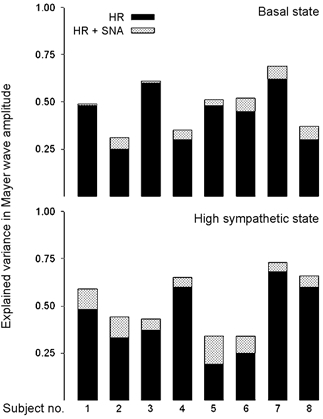
Figure 6. Contribution to explained variance in arterial pressure Mayer waves from preceding heart rate and sympathetic nerve activity waves for each of 8 subjects in two conditions, basal and stimulated (i.e. heightened) sympathetic nervous outflow
This simple model of arterial pressure Mayer wave amplitude suggests that sympathetic outflow contributes more when sympathetic activity is high. However, heart rate consistently appears to contribute much more to arterial pressure oscillations regardless of the sympathetic state (modified from Myers et al. 2001). HR, heart rate; SNA, sympathetic nerve activity.

References

    1. Abbiw-Jackson RM, Langford WF. Gain-induced oscillations in blood pressure. Journal of Mathematical Biology. 1998;37:203–234. - PubMed
    1. Abdel-Rahman AR, Merrill RH, Wooles WR. Gender-related differences in the baroreceptor reflex control of heart rate in normotensive humans. Journal of Applied Physiology. 1994;77:606–613. - PubMed
    1. Akselrod S, Gordon D, Madwed JB, Snidman NC, Shannon DC, Cohen RJ. Hemodynamic regulation: Investigation by spectral analysis. American Journal of Physiology. 1985;249:H867–875. - PubMed
    1. Badra LJ, Cooke WH, Hoag JB, Crossman AA, Kuusela TA, Tahvanainen KU, Eckberg DL. Respiratory modulation of human autonomic rhythms. American Journal of Physiology – Heart and Circulatory Physiology. 2001;280:H2674–2688. - PubMed
    1. Barbieri R, Bianchi AM, Triedman JK, Mainardi LT, Cerutti S, Saul JP. Model dependency of multivariate autoregressive spectral analysis. IEEE Engineering in Medicine and Biology. 1997;16:74–85. - PubMed

Publication types

LinkOut - more resources