Comparative Study
. 2002 Aug 5:3:21.
doi: 10.1186/1471-2105-3-21.

The SGS3 protein involved in PTGS finds a family

Affiliations
Comparative Study

The SGS3 protein involved in PTGS finds a family

Alex Bateman. BMC Bioinformatics. .

Abstract

Background: Post transcriptional gene silencing (PTGS) is a recently discovered phenomenon that is an area of intense research interest. Components of the PTGS machinery are being discovered by genetic and bioinformatics approaches, but the picture is not yet complete.

Results: The gene for the PTGS impaired Arabidopsis mutant sgs3 was recently cloned and was not found to have similarity to any other known protein. By a detailed analysis of the sequence of SGS3 we have defined three new protein domains: the XH domain, the XS domain and the zf-XS domain, that are shared with a large family of uncharacterised plant proteins. This work implicates these plant proteins in PTGS.

Conclusion: The enigmatic SGS3 protein has been found to contain two predicted domains in common with a family of plant proteins. The other members of this family have been predicted to be transcription factors, however this function seems unlikely based on this analysis. A bioinformatics approach has implicated a new family of plant proteins related to SGS3 as potential candidates for PTGS related functions.


Figures
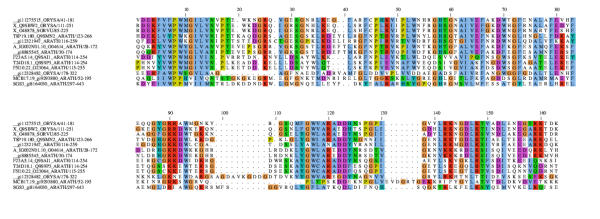
Figure 1
Figure 1
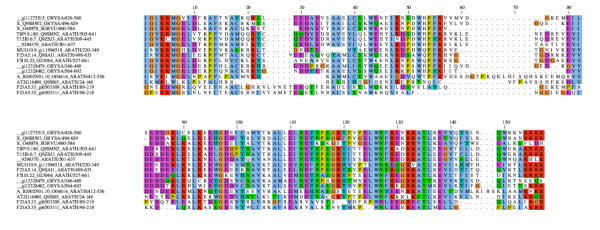
Multiple sequence alignments of the XS domain. Figures have been generated using the Jalview program written by Michele Clamp. The protein identifiers are given as name_accession number_species/start-end. The five letter species designations are those used in SWISS-PROT. Alignments are colored using the ClustalX scheme in Jalview (orange: glycine (G); gold: Proline (P); blue: small and hydrophobic amino-acids (A, V, L, I, M, F, W); green: hydroxyl and amine amino-acids (S, T, N, Q); magenta: negative-charged amino-acids (D, E); red: positive-charged amino-acids (R, K); dark-blue: histidine (H) and tyrosine (Y)).
Figure 2
Figure 2
Multiple sequence alignments of the XH domain. See caption of figure 1 for details
Figure 3
Figure 3
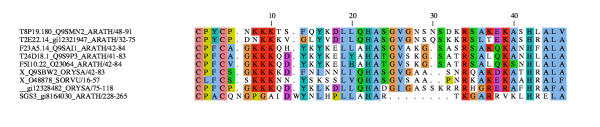
Multiple sequence alignments of zf-XS domain. An alignment of SGS3-type C2H2 zinc binding domain. See caption of figure 1 for details
Figure 4
Figure 4
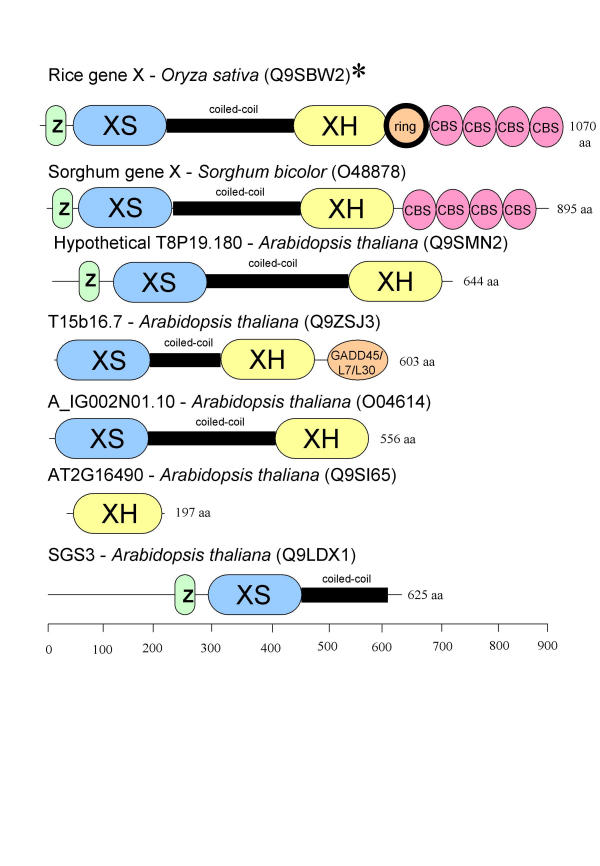
A schematic figure showing the architectures of proteins containing XS domains. More information about the ring finger domain, the CBS domain and the GADD45/L7/L30 domain can be found in the Pfam database [13] at http://www.sanger.ac.uk/Software/Pfam with accession numbers PF00097, PF00571 and PF01248 respectively. The asterisk denotes where the domain architecture shown is not from ring finger in rice gene X (Q9SBW2) sequence deposited in the protein database but is that found in the manuscript by Chen et al. [7]. The XS, XH and the zinc finger found in SGS3 have been submitted to Pfam and given accession numbers PF03468, PF03469, PF03470 respectively.

References

    1. Finnegan EJ, Wang M, Waterhouse P. Gene silencing: fleshing out the bones. Curr Biol. 2001;11:R99–R102. doi: 10.1016/S0960-9822(01)00039-2. - DOI - PubMed
    1. Hutvagner G, McLachlan J, Pasquinelli AE, Balint E, Tuschl T, Zamore PD. A cellular function for the RNA-interference enzyme Dicer in the maturation of the let-7 small temporal RNA. Science. 2001;293:834–8. doi: 10.1126/science.1062961. - DOI - PubMed
    1. Grishok A, Pasquinelli AE, Conte D, Li N, Parrish S, Ha I, Baillie DL, Fire A, Ruvkun G, Mello CC. Genes and mechanisms related to RNA interference regulate expression of the small temporal RNAs that control C. elegans developmental timing. Cell. 2001;106:23–34. - PubMed
    1. Knight SW, Bass BL. A Role for the RNase III Enzyme DCR-1 in RNA Interference and Germ Line Development in C. elegans. Science. 2001;2:2. - PMC - PubMed
    1. Mourrain P, Beclin C, Elmayan T, Feuerbach F, Godon C, Morel JB, Jouette D, Lacombe AM, Nikic S, Picault N. Arabidopsis SGS2 and SGS3 genes are required for posttranscriptional gene silencing and natural virus resistance. Cell. 2000;101:533–542. - PubMed

Publication types

MeSH terms