


Inverse relationship between APC gene mutation in gastric adenomas and development of adenocarcinoma
- PMID: 12163385
- PMCID: PMC1850731
- DOI: 10.1016/S0002-9440(10)64216-2
Inverse relationship between APC gene mutation in gastric adenomas and development of adenocarcinoma
Abstract
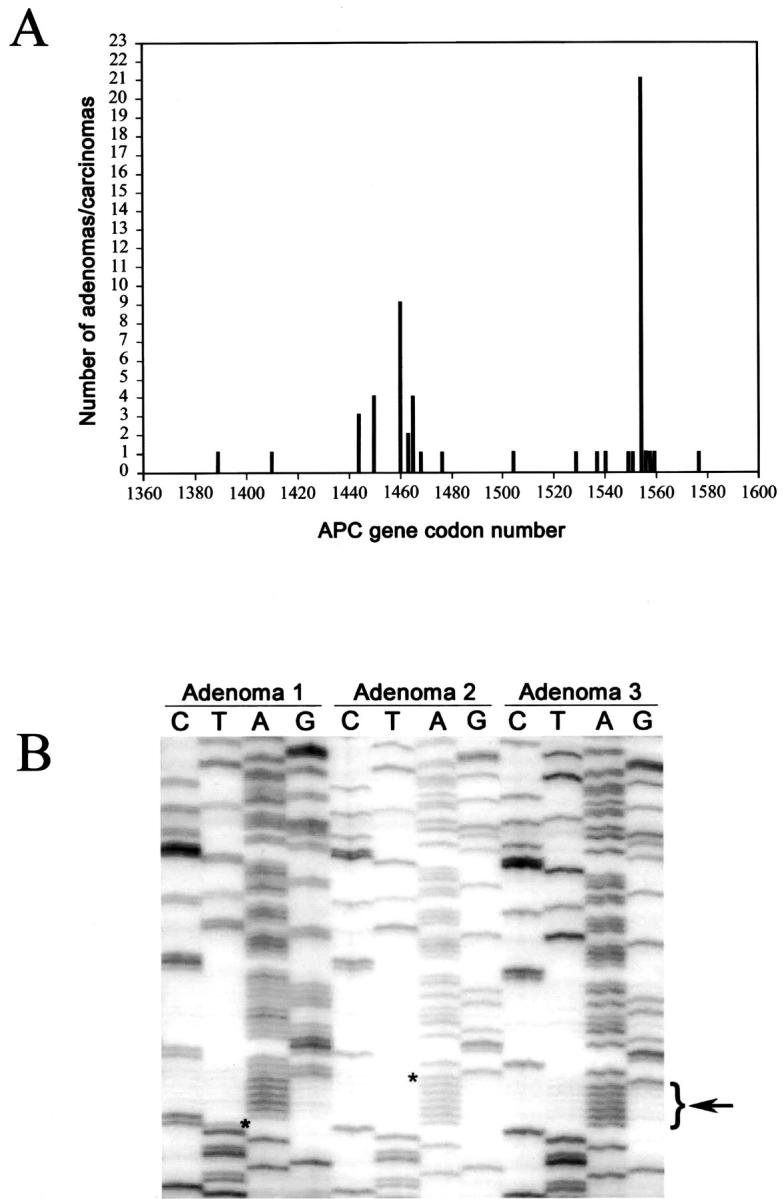
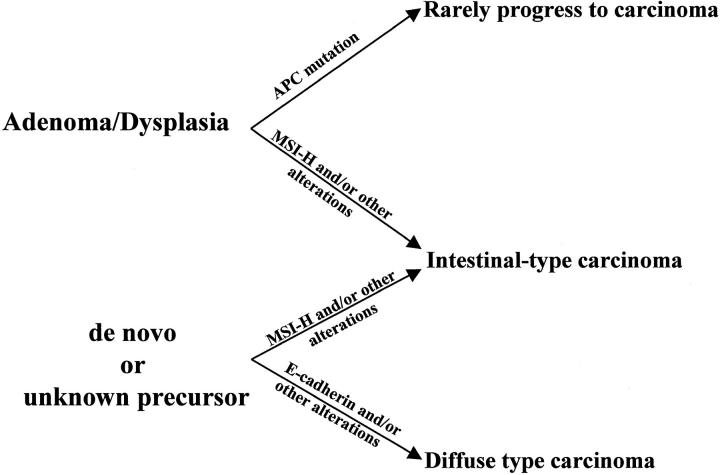
Gastric cancer is common among the world, but genetic mechanisms of gastric carcinogenesis are not well understood. Gastric polypoid adenomas and flat dysplasias are regarded as precursor lesions. However, a detailed molecular study of these lesions has not been done to determine their role as precancerous lesions. We investigated mutations of the APC, beta-catenin, and K-ras genes, and microsatellite instability (MSI) status in 35 adenomas and 47 flat dysplasias without adenocarcinoma, 35 adenomas/dysplasias associated with adenocarcinomas, and 39 adenocarcinomas (20 diffuse type and 19 intestinal type). Somatic APC gene mutations were identified in 76% (59 of 78) of adenomas or flat dysplasias without associated adenocarcinoma, but in only 3% (1 of 30) of adenomas/dysplasias associated with adenocarcinoma, and in only 4% (3 of 69) of adenocarcinomas (P < 0.000001). No mutations of beta-catenin were found in adenocarcinomas, or adenomas/dysplasia without APC mutation. K-ras mutations were detected in 5% (4 of 82) of gastric adenomas/dysplasia without carcinoma, 3% (1 of 39) of adenocarcinomas without associated adenoma/dysplasia, and not in 32 adenocarcinomas with associated adenoma/dysplasia. High level of MSI (MSI-H) was more frequent in gastric adenoma/dysplasia associated with carcinoma (17%, 6 of 35) than in adenomas/dysplasia without carcinoma (3%, 2 of 75; P = 0.01). MSI-H was also more frequent in intestinal type adenocarcinoma (20%, 11 of 54) than in diffuse type (0%, 0 of 20; P = 0.03). APC gene mutations were present in six of nine (67%) of gastric adenomas/dysplasias with low level of MSI, but in none of the eight adenomas/dysplasia with MSI-H phenotype (P = 0.009). Our results indicate that somatic mutation of the APC gene plays an important role in the pathogenesis of gastric adenoma and dysplasia but has a limited role in neoplastic progression to adenocarcinoma. Gastric adenomas or dysplasias without APC mutations but with or without MSI may have a different biological behavior, and are precursors of intestinal-type of gastric adenocarcinomas.
Figures

References
-
- Rhyu MG, Park WS, Jung YJ, Choi SW, Meltzer SJ: Allelic deletions of MCC/APC and p53 are frequent late events in human gastric carcinogenesis. Gastroenterology 1994, 106:1584-1588 - PubMed
-
- Kang GH, Kim CJ, Kim WH, Kang YK, Kim HO, Kim YI: Genetic evidence for the multicentric origin of synchronous multiple gastric carcinoma. Lab Invest 1997, 76:407-417 - PubMed
-
- Horii A, Nakatsuru S, Miyoshi Y, Ichii S, Nagase H, Kato Y, Yanagisawa A, Nakamura Y: The APC gene, responsible for familial adenomatous polyposis, is mutated in human gastric cancer. Cancer Res 1992, 52:3231-3233 - PubMed
-
- Nishimura K, Yokozaki H, Jaruma K, Kajiyama G, Tahara E: Alternations of the APC gene in carcinoma cell lines and precancerous lesions of the stomach. Int J Oncol 1995, 7:587-592 - PubMed
-
- Arber N, Shapira I, Ratan J, Stern B, Hibshoosh H, Moshkowitz M, Gammon M, Fabian I, Halpern Z: Activation of c-K-ras mutations in human gastrointestinal tumors. Gastroenterology 2000, 118:1045-1050 - PubMed
MeSH terms
Substances
LinkOut - more resources
Full Text Sources
Medical
Molecular Biology Databases
Miscellaneous
