Accuracy of cervicovaginal fetal fibronectin test in predicting risk of spontaneous preterm birth: systematic review
- PMID: 12169504
- PMCID: PMC117763
- DOI: 10.1136/bmj.325.7359.301
Accuracy of cervicovaginal fetal fibronectin test in predicting risk of spontaneous preterm birth: systematic review
Abstract
Objective: To determine the accuracy with which a cervicovaginal fetal fibronectin test predicts spontaneous preterm birth in women with or without symptoms of preterm labour.
Design: Systematic quantitative review of studies of test accuracy.
Data sources: Medline, Embase, PASCAL, Biosis, Cochrane Library, Medion, National Research Register, SCISEARCH, conference papers, manual searching of bibliographies of known primary and review articles, and contact with experts and manufacturer.
Study selection: Two reviewers independently selected and extracted data on study characteristics, quality, and accuracy.
Data extraction: Accuracy data were used to form 2x2 contingency tables with spontaneous preterm birth before 34 and 37 weeks' gestation and birth within 7-10 days of testing (for symptomatic pregnant women) as reference standards. Data were pooled to produce summary receiver operating characteristic curves and summary likelihood ratios for positive and negative test results.
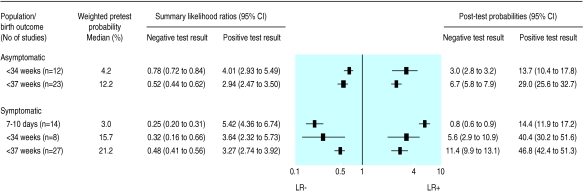
Data synthesis: 64 primary articles were identified, consisting of 28 studies in asymptomatic women and 40 in symptomatic women, with a total of 26 876 women. Among asymptomatic women the best summary likelihood ratio for positive results was 4.01 (95% confidence interval 2.93 to 5.49) for predicting birth before 34 weeks' gestation, with corresponding summary likelihood ratio for negative results of 0.78 (0.72 to 0.84). Among symptomatic women the best summary likelihood ratio for positive results was 5.42 (4.36 to 6.74) for predicting birth within 7-10 days of testing, with corresponding ratio for negative results of 0.25 (0.20 to 0.31).
Conclusion: Cervicovaginal fetal fibronectin test is most accurate in predicting spontaneous preterm birth within 7-10 days of testing among women with symptoms of threatened preterm birth before advanced cervical dilatation.
Figures




Comment in
-
Predicting spontaneous preterm birth.BMJ. 2002 Aug 10;325(7359):289-90. doi: 10.1136/bmj.325.7359.289. BMJ. 2002. PMID: 12169489 Free PMC article. No abstract available.
References
-
- Maternal and Child Health Consortium. Confidential enquiries into stillbirths and deaths in infancy (CESDI): 6th annual report. London: Stationery Office; 1999.
-
- Peters KD, Kochanek KD, Murphy SL. Deaths: final data for 1996. Natl Vital Stat Rep. 1998;47:1–100. - PubMed
-
- Department of Health (UK) NHS maternity statistics, England: 1989-90 to 1994-95. London: Stationery Office; 1997. www.doh.gov.uk/public/sb9728.htm (accessed 23 August 2001).
-
- Stewart AL, Rifkin L, Amess PN, Kirkbride V, Townsend JP, Miller DH, et al. Brain structure and neurocognitive and behavioural function in adolescents who were born very preterm. Lancet. 1999;353:1653–1657. - PubMed
-
- Wolke D, Meyer R. Cognitive status, language attainment, and prereading skills of 6-year-old very preterm children and their peers: the Bavarian longitudinal study. Dev Med Child Neurol. 1999;41:94–109. - PubMed
Publication types
MeSH terms
Substances
LinkOut - more resources
Full Text Sources
Other Literature Sources
Medical