


Anti-inflammatory effect of cholecystokinin and its signal transduction mechanism in endotoxic shock rat
- PMID: 12174384
- PMCID: PMC4656326
- DOI: 10.3748/wjg.v8.i4.712
Anti-inflammatory effect of cholecystokinin and its signal transduction mechanism in endotoxic shock rat
Abstract
Aim: To study the anti-inflammatory effects of cholecystokinin-octapeptide (CCK-8) on lipopolysaccharide (LPS)-induced endotoxic shock (ES) and further investigate its signal transduction pathways involving p38 mitogen-activated protein kinase (MAPK) and IkappaB-alpha.
Methods: Eighty-four rats were divided randomly into four groups: LPS (8 mg.kg(-1), iv) induced ES; CCK-8 (40 microg.kg(-1), iv) pretreatment 10 min before LPS (8 mg.kg(-1)); CCK-8 (40 microg.kg(-1), iv) or normal saline (control) groups. The inflammatory changes of lung and spleen, phagocytic function of alveolar macrophage, quantification of inflammatory cells in bronchoalveolar lavage (BAL) were investigated in rats by using hematoxylin and eosin (HE) staining, phagocytosis of Candida albicans and differential cell counting. Nitric oxide (NO) production in serum, lung and spleen was measured with the Griess reaction. The mechanism involving p38 MAPK and IkappaB-alpha signal pathways was investigated by Western blot.
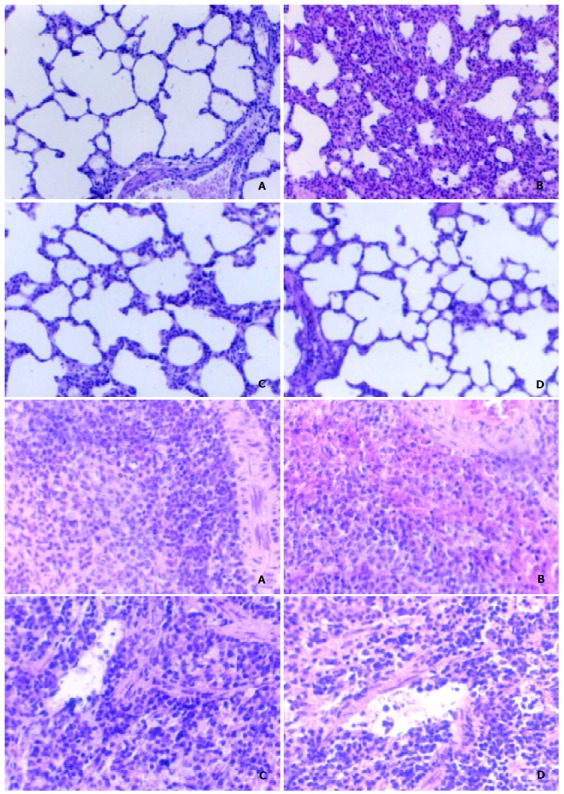
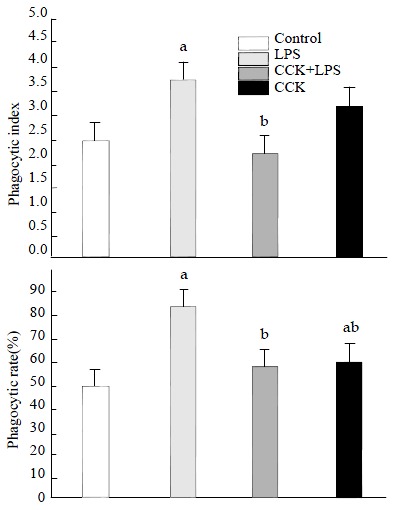
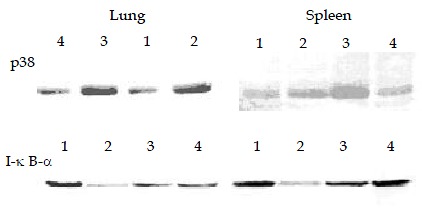
Results: Inflammatory changes of lung and spleen induced by LPS were alleviated by CCK-8, the increase of NO induced by LPS in serum, lung and spleen was significantly inhibited and the neutrophil infiltration in BAL was significantly reduced by CCK-8. The number of neutrophils was (52+/-10)X10(6) cells. (-1) in LPS group, while it decreased to (18+/-4)X10(6) cells. (-1) in CCK-8+LPS (P<0.01). The phagocytic rate of CCK-8 group increased to (62.49+/-9.49) %, compared with control group (48.16+/-14.20) %, P<0.05. The phagocytosis rate was (85.14+/-4.64) % in LPS group, which reduced to (59.33+/-3.14) % in CCK-8+LPS group (P<0.01). The results of phagocytosis indexes showed similar changes. CCK-8 may play an important role in increasing the expression of p38 MAPK and decreasing the degradation of IkappaB-alpha in lung and spleen of ES rats.
Conclusion: CCK-8 can result in anti-inflammatory effects, which may be related to activation of p38 MAPK and inhibition on the degradation of IkappaB-alpha.
Figures
References
-
- Molina PE, Abumrad NN. Differential effects of hemorrhage and LPS on tissue TNF-alpha, IL-1 and associate neuro-hormonal and opioid alterations. Life Sci. 2000;66:399–409. - PubMed
-
- Chen F, Castranova V, Shi X, Demers LM. New insights into the role of nuclear factor-kappaB, a ubiquitous transcription factor in the initiation of diseases. Clin Chem. 1999;45:7–17. - PubMed
-
- Kang JL, Lee K, Castranova V. Nitric oxide up-regulates DNA-binding activity of nuclear factor-kappaB in macrophages stimulated with silica and inflammatory stimulants. Mol Cell Biochem. 2000;215:1–9. - PubMed
Publication types
MeSH terms
Substances
LinkOut - more resources
Full Text Sources
Other Literature Sources
