


The mechanisms of interhemispheric inhibition in the human motor cortex
- PMID: 12181302
- PMCID: PMC2290496
- DOI: 10.1113/jphysiol.2002.017673
The mechanisms of interhemispheric inhibition in the human motor cortex
Abstract
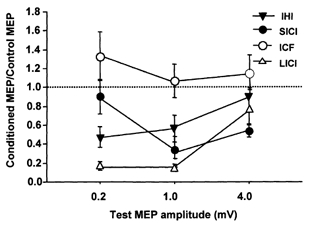
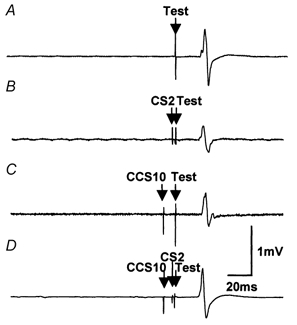
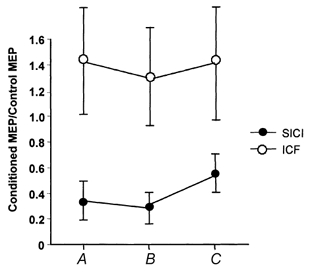
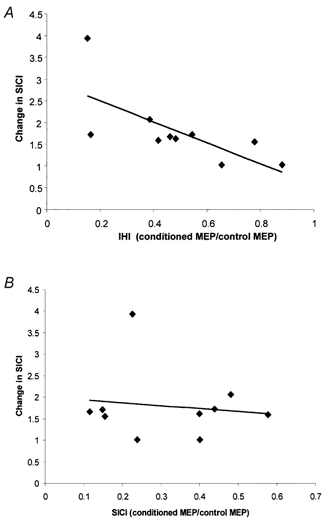
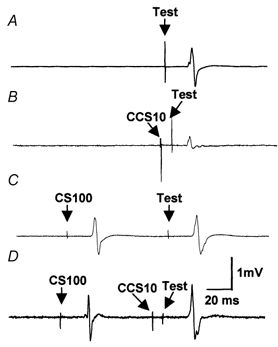
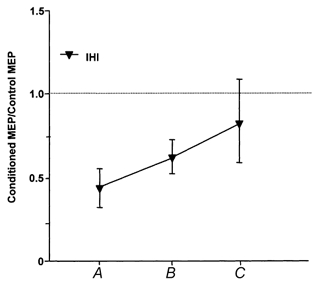
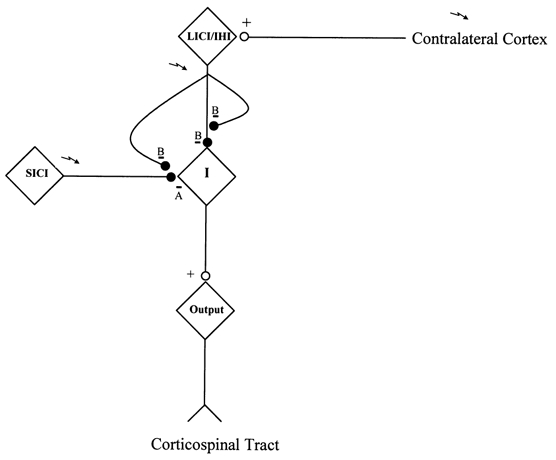
Transcranial magnetic stimulation can be used to non-invasively study inhibitory processes in the human motor cortex. Interhemispheric inhibition can be measured by applying a conditioning stimulus to the motor cortex resulting in inhibition of the contralateral motor cortex. Transcranial magnetic stimulation can also be used to demonstrate ipsilateral cortico-cortical inhibition in the motor cortex. At least two different ipsilateral cortico-cortical inhibitory processes have been identified: short interval intracortical inhibition and long interval intracortical inhibition. However, the relationship between interhemispheric inhibition and ipsilateral cortico-cortical inhibition remains unclear. This study examined the relationship between interhemispheric inhibition, short interval intracortical inhibition and long interval intracortical inhibition. First, the effect of test stimulus intensity on each inhibitory process was studied. Second, the effects of interhemispheric inhibition on short interval intracortical inhibition and long interval intracortical inhibition on interhemispheric inhibition were examined. Motor evoked potentials were recorded from the right first dorsal interosseous muscle in 11 right-handed healthy volunteers. For interhemispheric inhibition, conditioning stimuli were applied to the right motor cortex and test stimuli to the left motor cortex. For short interval intracortical inhibition and long interval intracortical inhibition, both conditioning stimuli and test stimuli were applied to the left motor cortex. With increasing test stimulus intensities, long interval intracortical inhibition and interhemispheric inhibition decreased, while short interval intracortical inhibition increased. Moreover, short interval intracortical inhibition was significantly reduced in the presence of interhemispheric inhibition. Interhemispheric inhibition was significantly reduced in the presence of long interval intracortical inhibition when matched for test motor evoked potential amplitude but the difference was not significant when matched for test pulse intensity. These findings suggest that both interhemispheric inhibition and long interval intracortical inhibition are predominately mediated by low threshold cortical neurons and may share common inhibitory mechanisms. In contrast, the mechanisms mediating short interval intracortical inhibition are probably different from those mediating long interval intracortical inhibition and interhemispheric inhibition although these systems appear to interact.
Figures
References
-
- Asanuma H, Okuda O. Effects of transcallosal volleys on pyramidal tract cell activity of cat. Journal of Neurophysiology. 1962;25:198–208. - PubMed
-
- Awiszus F, Feistner H, Urbach D, Bostock H. Characterisation of paired-pulse transcranial magnetic stimulation conditions yielding intracortical inhibition or I-wave facilitation using a threshold-hunting paradigm. Experimental Brain Research. 1999;129:317–324. - PubMed
-
- Berlucci G. Commisurotomy studies in animals. In: Boller F, Grafman J, editors. Handbook of Neuropsychology. Vol. 4. Amsterdam: Elsevier; 1990. pp. 9–47.
-
- Chang HT. Cortical response to activity of callosal neurons. Journal of Neurophysiology. 1953;16:117–131. - PubMed
-
- Chen R, Garg R. Facilitatory I wave interaction in proximal arm and lower limb muscle representations of the human motor cortex. Journal of Neurophysiology. 2000;83:1426–1434. - PubMed
Publication types
MeSH terms
LinkOut - more resources
Full Text Sources
