


Mechanism of blood pressure and R-R variability: insights from ganglion blockade in humans
- PMID: 12181304
- PMCID: PMC2290470
- DOI: 10.1113/jphysiol.2001.013398
Mechanism of blood pressure and R-R variability: insights from ganglion blockade in humans
Abstract
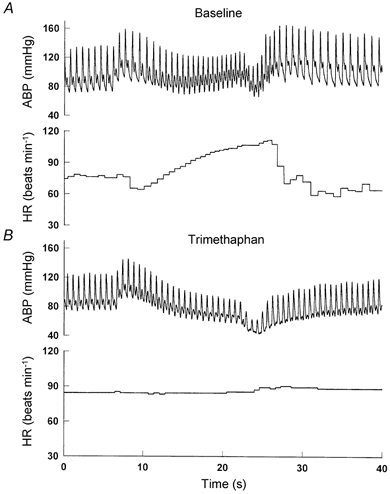
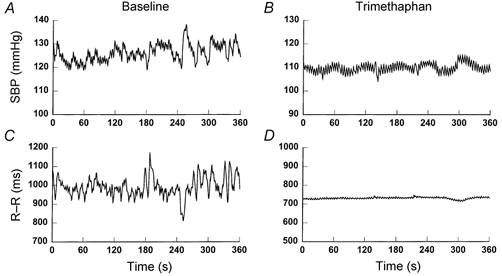
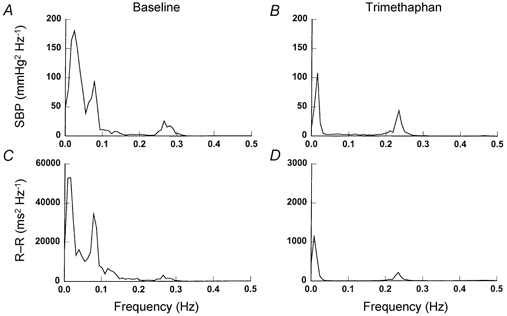
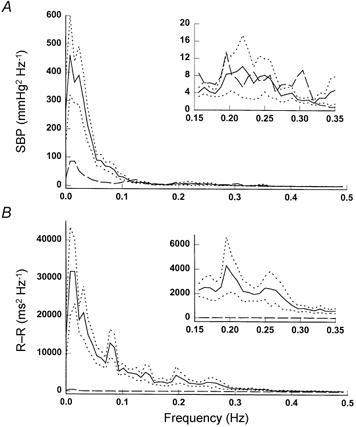
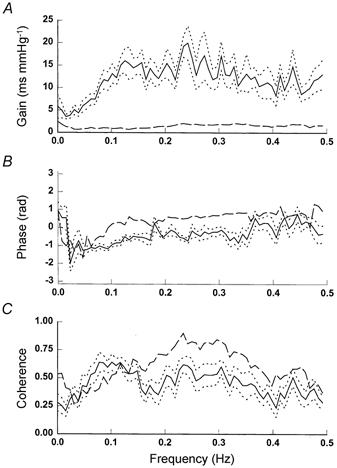
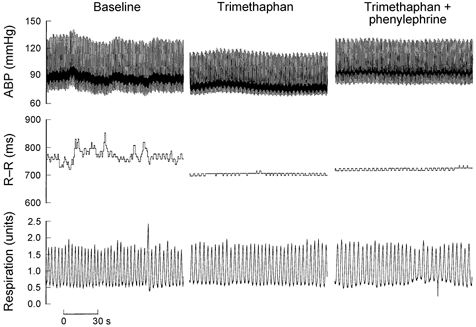
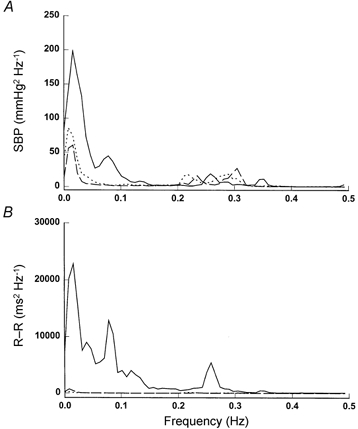
Spontaneous blood pressure (BP) and R-R variability are used frequently as 'windows' into cardiovascular control mechanisms. However, the origin of these rhythmic fluctuations is not completely understood. In this study, with ganglion blockade, we evaluated the role of autonomic neural activity versus other 'non-neural' factors in the origin of BP and R-R variability in humans. Beat-to-beat BP, R-R interval and respiratory excursions were recorded in ten healthy subjects (aged 30 +/- 6 years) before and after ganglion blockade with trimethaphan. The spectral power of these variables was calculated in the very low (0.0078-0.05 Hz), low (0.05-0.15 Hz) and high (0.15-0.35 Hz) frequency ranges. The relationship between systolic BP and R-R variability was examined by cross-spectral analysis. After blockade, R-R variability was virtually abolished at all frequencies; however, respiration and high frequency BP variability remained unchanged. Very low and low frequency BP variability was reduced substantially by 84 and 69 %, respectively, but still persisted. Transfer function gain between systolic BP and R-R interval variability decreased by 92 and 88 % at low and high frequencies, respectively, while the phase changed from negative to positive values at the high frequencies. These data suggest that under supine resting conditions with spontaneous breathing: (1) R-R variability at all measured frequencies is predominantly controlled by autonomic neural activity; (2) BP variability at high frequencies (> 0.15 Hz) is mediated largely, if not exclusively, by mechanical effects of respiration on intrathoracic pressure and/or cardiac filling; (3) BP variability at very low and low frequencies (< 0.15 Hz) is probably mediated by both sympathetic nerve activity and intrinsic vasomotor rhythmicity; and (4) the dynamic relationship between BP and R-R variability as quantified by transfer function analysis is determined predominantly by autonomic neural activity rather than other, non-neural factors.
Figures
References
-
- Akselrod S, Gordon D, Madwed JB, Snidman NC, Shannon DC, Cohen RJ. Hemodynamic regulation: investigation by spectral analysis. American Journal of Physiology. 1985;249:H867–875. - PubMed
-
- Anrep GV, Pascual W, Rossler R. Respiratory variations of the heart rate, I – the reflex mechanism of respiratory arrhythmia. Proceedings of the Royal Society of Edinburgh B. 1936;119B:191–217.
-
- Aviado DM. Hemodynamic effects of ganglion blocking drugs. Circulation Research. 1960;8:304–314.
-
- Baselli G, Cerutti S, Civardi S, Malliani A, Pagani M. Cardiovascular variability signals: towards the identification of a closed-loop model of the neural control mechanisms. IEEE Transactions on Biomedical Engineering. 1988;35:1033–1046. - PubMed
-
- Bernardi L, Keller F, Sanders M, Reddy PS, Griffith B, Meno F, Pinsky MR. Respiratory sinus arrhythmia in the denervated human heart. Journal of Applied Physiology. 1989;67:1447–1455. - PubMed
Publication types
MeSH terms
Substances
Grants and funding
LinkOut - more resources
Full Text Sources
