. 2002 Aug 15:2:4.
doi: 10.1186/1472-6904-2-4.

PKQuest: measurement of intestinal absorption and first pass metabolism - application to human ethanol pharmacokinetics

Affiliations

PKQuest: measurement of intestinal absorption and first pass metabolism - application to human ethanol pharmacokinetics

David G Levitt. BMC Clin Pharmacol. .

Abstract

Background: PKQuest, a new physiologically based pharmacokinetic (PBPK) program, is applied to human ethanol data. The classical definition of first pass metabolism (FPM) based on the differences in the area under the curve (AUC) for identical intravenous and oral doses is invalid if the metabolism is non-linear (e.g. ethanol). Uncertainties in the measurement of FPM have led to controversy about the magnitude of gastric alcohol metabolism. PKQuest implements a new, rigorous definition of FPM based on finding the equivalent intravenous input function that would produce a blood time course identical to that observed for the oral intake. This input function equals the peripheral availability (PA) and the FPM is defined by: FPM = Total oral dose - PA. PKQuest also provides a quantitative measurement of the time course of intestinal absorption.

Methods: PKQuest was applied to previously published ethanol pharmacokinetic data.

Results: The rate of ethanol absorption is primarily limited by the rate of gastric emptying. For oral ethanol with a meal: absorption is slow (Tilde; 3 hours) and the fractional PKQuest FPM was 36% (0.15 gm/Kg dose) and 7% (0.3 gm/Kg). In contrast, fasting oral ethanol absorption is fast (Tilde; 50 minutes) and FPM is small.

Conclusions: The standard AUC and one compartment methods significantly overestimate the FPM. Gastric ethanol metabolism is not significant. Ingestion of a coincident meal with the ethanol can reduce the peak blood level by about 4 fold at low doses. PKQuest and all the examples are freely available on the web at www.pkquest.com.


Figures
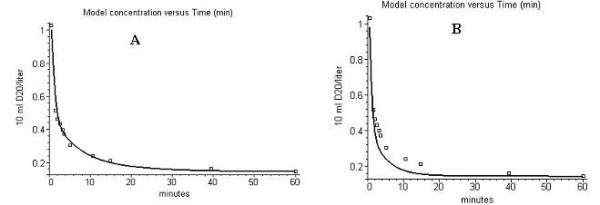
Figure 1
Figure 1
Comparison of the time course of the D2O arterial blood water concentration (solid line) and the experimental results (squares) of Schloerb et al. [15] using the default PBPK parameters. A) Default muscle blood flow. B) Twice the default muscle blood flow.
Figure 2
Figure 2
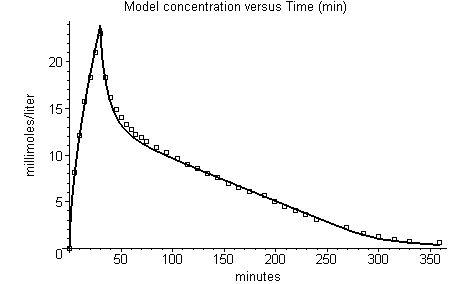
Comparison of the time course of the ethanol arterial blood water concentration (solid line) and the experimental results of Norberg et al. [16].
Figure 3
Figure 3
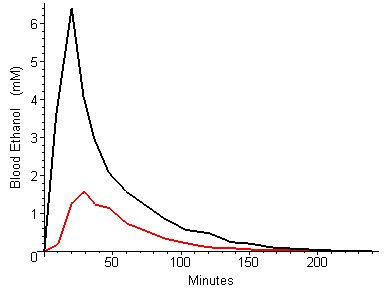
Experimental venous ethanol concentration when a dose of 0.15 gm/Kg ethanol is administered either IV (black) or orally (red) along with a coincident meal. (Data taken from fig. 1 of DiPadova et al. [17]).
Figure 4
Figure 4
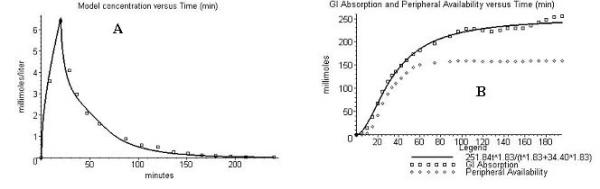
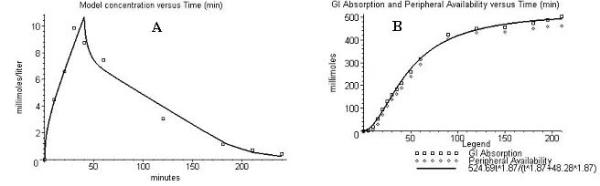
PKQuest predictions for an IV or oral input of 0.15 gm/Kg coincident with a standard meal. A) Comparison of the model time course of the ethanol venous whole blood concentration (solid line) and the experimental results (squares) of DiPadova et al. [17] for the IV input. B) Predicted total ethanol intestinal absorption (squares) and peripheral availability (diamonds) for the oral dose. The solid line is a 3 parameter approximation to the model absorption data.
Figure 5
Figure 5
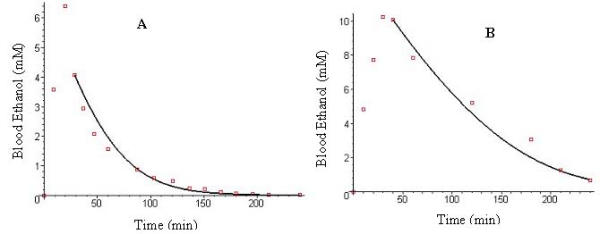
Optimized one compartment fit to the tail of the venous blood curve for IV ethanol. A) IV input of 0.15 gm/Kg. B) IV input of 0.3 gm/Kg.
Figure 6
Figure 6
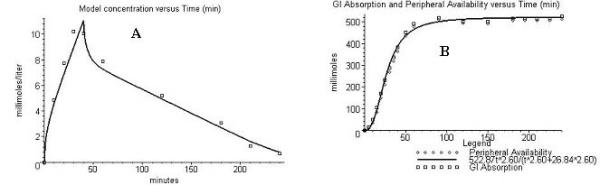
Similar to fig. 4 except that the IV dose was 0.3 gm/Kg.
Figure 7
Figure 7
Similar to fig. 6 except that the subjects were fasting.
Figure 8
Figure 8
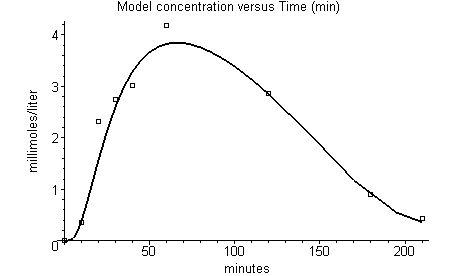
Comparison of PKQuest prediction of venous blood level (line) versus the experimental data for an oral dose of 0.15 gm/Kg. The PKQuest intestinal absorption was described by the 3 parameter Hill equation obtained in fig. 6.
Figure 9
Figure 9
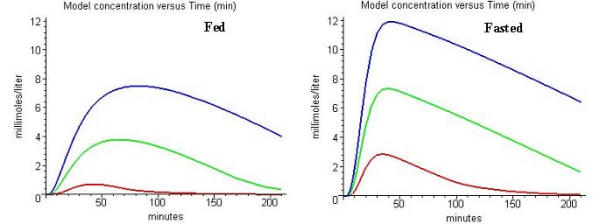
Predicted venous ethanol concentration for an oral intake of 1 (red), 2 (green) or 3 (blue) cans of beer over a 20 minute period. A) Coincident with a standard meal. B) With no other food.

References

    1. Levitt MD, Levitt DG. Appropriate use and misuse of blood concentration measurements to quantitate first-pass metabolism. J Lab Clin Med. 2000;136:275–80. doi: 10.1067/mlc.2000.109100. - DOI - PubMed
    1. Levitt MD, Levitt DG. Use of a two-compartment model to assess the pharmacokinetics of human ethanol metabolism. Alcohol Clin Exp Res. 1998;22:1680–8. - PubMed
    1. Gentry RT, Sharma R, Lim RT, Baraona E, DiPadova C, Lieber CS. A new method to quantify first pass metabolism of alcohol: Application to the effects of H2-blockers on alcohol bioavailability. Gastroenterology. 1992;92:A811.
    1. Baraona E, Abittan CS, Dohmen K, Moretti M, Pozzato G, Chayes ZW, Schaefer C, Lieber CS. Gender differences in pharmacokinetics of alcohol. Alcohol Clin Exp Res. 2001;25:502–7. doi: 10.1097/00000374-200104000-00004. - DOI - PubMed
    1. Levitt DG. PKQUEST: A general physiologically based pharmacokinetic model. Introduction and application to propranolol. BMC Clinical Pharmacology. 2002;2:5. doi: 10.1186/1472-6904-2-5. - DOI - PMC - PubMed

LinkOut - more resources