. 2002 Aug 15;2(1):5.
doi: 10.1186/1471-2253-2-5.

PKQuest: volatile solutes - application to enflurane, nitrous oxide, halothane, methoxyflurane and toluene pharmacokinetics

Affiliations

PKQuest: volatile solutes - application to enflurane, nitrous oxide, halothane, methoxyflurane and toluene pharmacokinetics

David G Levitt. BMC Anesthesiol. .

Abstract

BACKGROUND: The application of physiologically based pharmacokinetic models (PBPK) to human studies has been limited by the lack of the detailed organ information that is required for this analysis. PKQuest is a new generic PBPK that is designed to avoid this problem by using a set of "standard human" default parameters that are applicable to most solutes. RESULTS: PKQuest is used to model the human pharmacokinetics of the volatile solutes. A "standard human" value for the lipid content of the blood and each organ (klip) was chosen. This set of klip and the oil/water partition coefficient then specifies the organ/blood partition for each organ. Using this approach, the pharmacokinetics of inert volatile solute is completely specified by just 2 parameters: the water/air and oil/water partition coefficients. The model predictions of PKQuest were in good agreement with the experimental data for the inert solutes enflurane and nitrous oxide and the metabolized solutes halothane and toluene. METHODS: The experimental data that was modeled was taken from previous publications. CONCLUSIONS: This approach greatly increases the predictive power of the PBPK. For inert volatile solutes the pharmacokinetics are determined just from the water/air and oil/water partition coefficient. Methoxyflurane cannot be modeled by this PBPK because the arterial and end tidal partial pressures are not equal (as assumed in the PBPK). This inequality results from the "washin-washout" artifact in the large airways that is established for solutes with large water/air partition coefficients.PKQuest and the worked examples are available on the web www.pkquest.com.


Figures
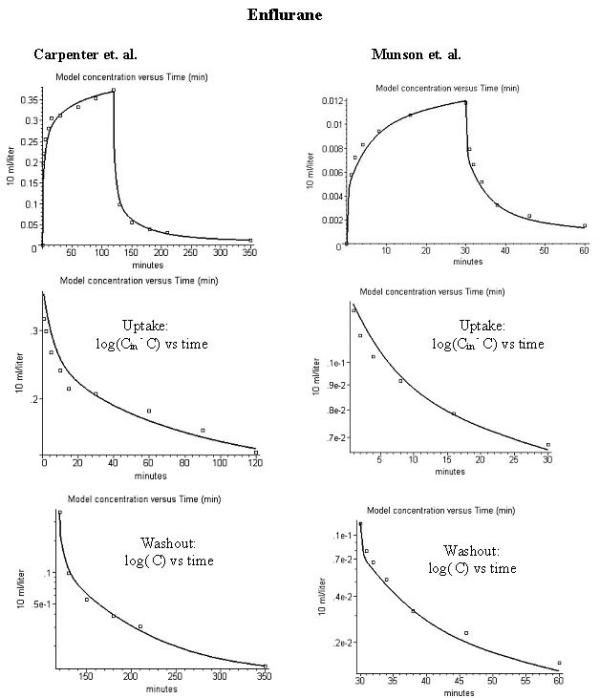
Figure 1
Figure 1
Comparison of PKQuest model alveolar gas concentration (line) and experimental data (squares) for the end tidal concentration (volume %) during uptake and washout of enflurane. The figures in the left hand column are for the data of Carpenter et al. [28] (inspired concentration = 0.518%) and those in the right hand column are for data of Munson et al. [4] (inspired concentration = 0.0186%). The figures in the second row are for the uptake in the form of a semi log plot of the difference between the inhaled concentration (which would correspond to the long time equilibrium concentration) and the end expired concentration as a function of time. The figures in the third row are a semi log plot of the end expired concentration as a function of time. The data are the mean values for 9 (Carpenter et al) and 6 (Munson et al.) subjects.
Figure 2
Figure 2
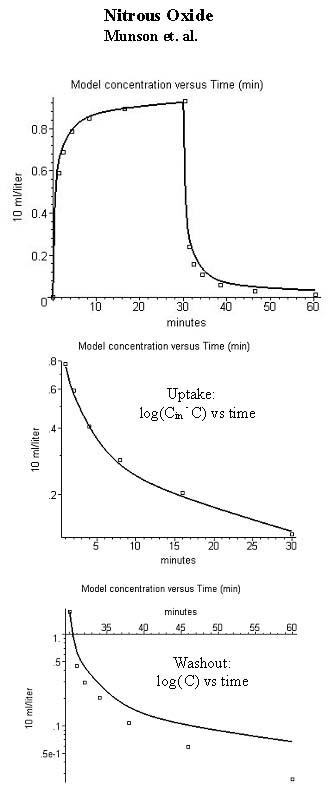
Comparison of model alveolar gas concentration (line) and experimental data for the end tidal concentration (volume %) during uptake and washout of nitrous oxide (inhaled concentration = 1.88%). The figures in the 3 rows are similar to those in fig. 1.
Figure 3
Figure 3
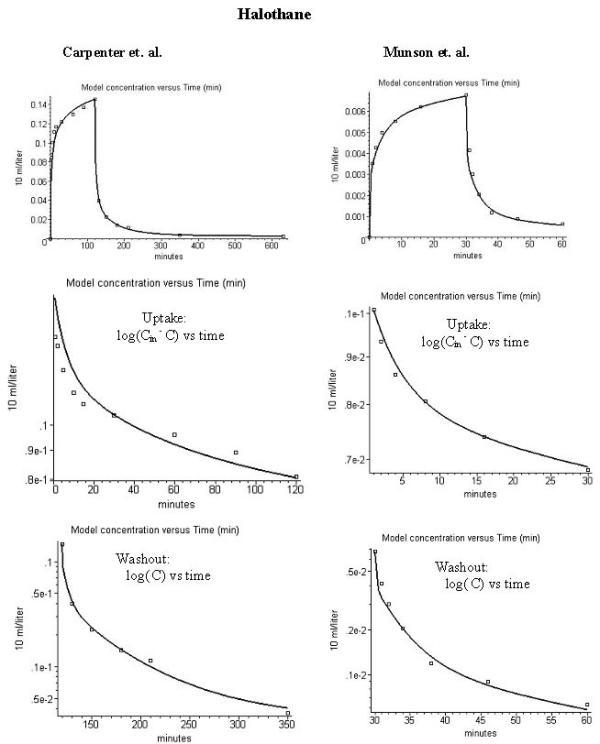
Comparison of model alveolar gas concentration (line) and experimental data for the end tidal concentration (volume %) during uptake and washout of halothane. The left column is for the data of carpenter et al. [28] (inspired concentration = 0.226%) and the right column is for the data of Munson et al. [4] (inspired concentration = 0.0135%). The figures in the 3 rows are similar to those in fig. 1.
Figure 4
Figure 4
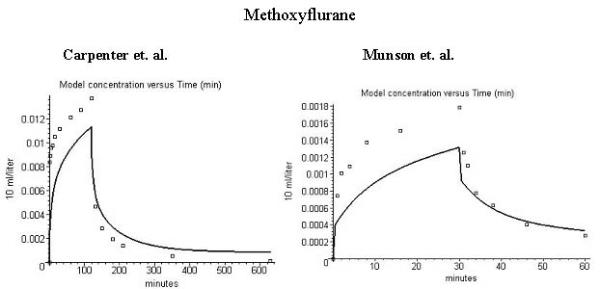
Comparison of model alveolar gas concentration (line) and experimental data for the end tidal concentration (volume %) during uptake and washout of methoxyflurane. (No metabolism). Left column is data of carpenter et al. [28] (inspired concentration = 0.0469%) and right column data of Munson et al. [4] (inspired concentration = 0.0069%). The figures in the 3 rows are similar to those in fig. 1.
Figure 5
Figure 5
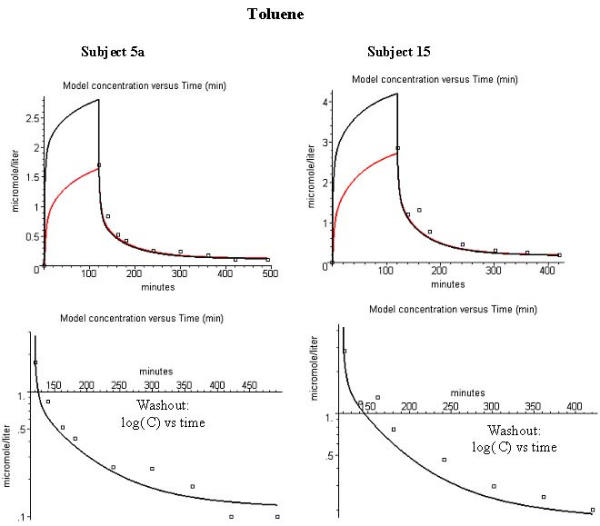
Comparison of model arterial (black) and venous (red) whole blood concentration (μM) and experimental arterialized blood data during washout of toluene. Left column is for subject 5a, right column is for subject 15. The figures in the 3 rows are similar to those in fig. 1.
Figure 6
Figure 6
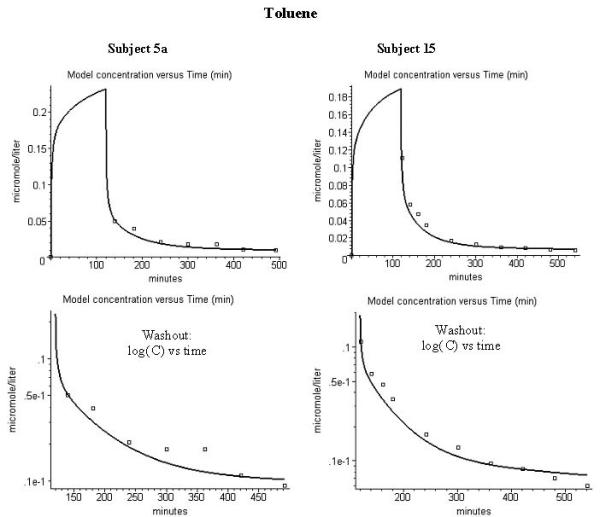
Comparison of model alveolar gas concentration (line) and experimental data for the end tidal concentration (μM) during washout of toluene. Left column is for subject 5a, right column is for subject 15. The figures in the 3 rows are similar to those in fig. 1.
Figure 7
Figure 7
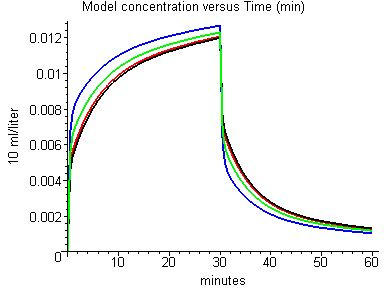
Effect of perfusion-ventilation mismatch on the model alveolar enflurane concentration: black: 1 compartment homogeneous model; red: 16 compartment model with default (normal) values of log standard deviation of flow and ventilation; green: 2 times normal values of log standard deviation; blue: 3 times normal values of log standard deviation.
Figure 8
Figure 8
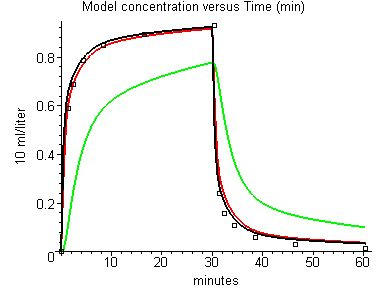
Effect of perfusion-ventilation mismatch on the model alveolar (black), arterial (red) and venous (green) partial pressure for nitrous oxide uptake and washout. Sixteen compartment lung model with default log standard deviations of perfusion and ventilation.
Figure 9
Figure 9
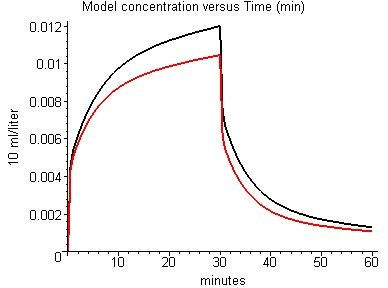
Effect of fat blood flow on model alveolar enflurane concentration (volume %). Black: default fat blood flow (0.056 liters/min/Kg); Red: 2 times default value.

References

    1. Levitt DG. PKQUEST: A general physiologically based pharmacokinetic model. Introduction and application to propranolol. BMC Clinical Pharmacology. 2002;2:5. doi: 10.1186/1472-6904-2-5. - DOI - PMC - PubMed
    1. Levitt DG. PKQUEST: Measurement of Intestinal Absorption and First Pass Metabolism – Application to Human Ethanol Pharmacokinetics. BMC Clinical Pharmacology. 2002;2:4. doi: 10.1186/1472-6904-2-4. - DOI - PMC - PubMed
    1. Levitt DG. PKQUEST: Capillary Permeability Limitation and Plasma Protein Binding – Application to Human Inulin, Dicloxacillin and Ceftriaxone Pharmacokinetics. Submitted: BMC Clinical Pharmacology. 2002. - PMC - PubMed
    1. Munson ES, Eger EI, 2nd, Tham MK, Embro WJ. Increase in anesthetic uptake, excretion, and blood solubility in man after eating. Anesth Analg. 1978;57:224–31. - PubMed
    1. Carpenter RL, Eger EI, 2nd, Johnson BH, Unadkat JD, Sheiner LB. Pharmacokinetics of inhaled anesthetics in humans: measurements during and after the simultaneous administration of enflurane, halothane, isoflurane, methoxyflurane, and nitrous oxide. Anesth Analg. 1986;65:575–82. - PubMed

LinkOut - more resources