


Different levels of genetic homogeneity in vancomycin-resistant and -susceptible Enterococcus faecium isolates from different human and animal sources analyzed by amplified-fragment length polymorphism
- PMID: 12183228
- PMCID: PMC127427
- DOI: 10.1128/AAC.46.9.2779-2783.2002
Different levels of genetic homogeneity in vancomycin-resistant and -susceptible Enterococcus faecium isolates from different human and animal sources analyzed by amplified-fragment length polymorphism
Abstract
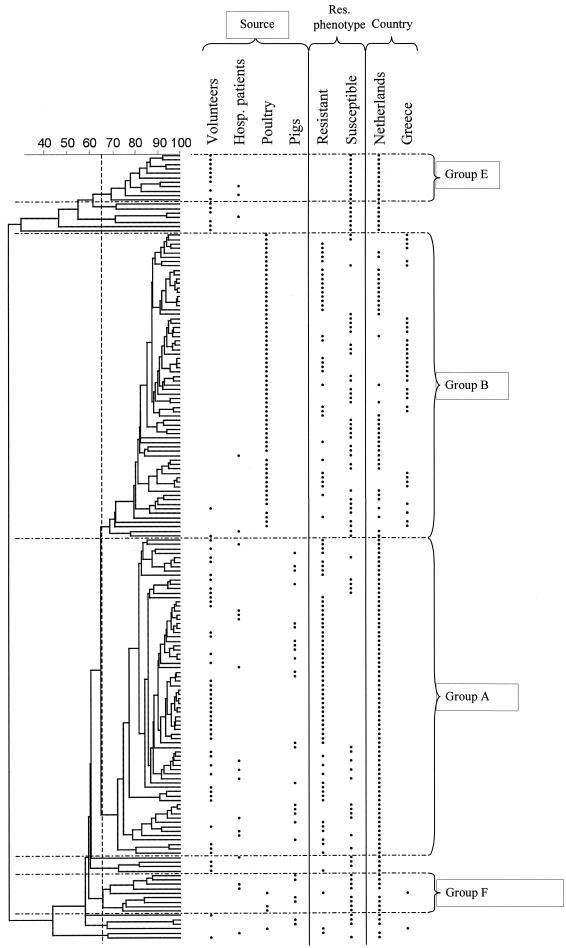
The genetic relationship among fecal vancomycin-resistant Enterococcus faecium (VREF) and vancomycin-susceptible E. faecium (VSEF) isolates (n = 178) from the same populations of pigs, human healthy volunteers, and hospitalized patients (from The Netherlands) and chickens (from The Netherlands and Greece) was studied by amplified-fragment length polymorphism (AFLP). The majority of VREF isolates from pigs, healthy volunteers, and hospitalized patients grouped together (genetic similarity, >or=65%). In a previous AFLP study by our group the VREF isolates from hospitalized patients grouped separately, most likely because these were clinical and not fecal isolates as in the present study. Furthermore, VSEF isolates from humans and pigs were found much more genetically diverse than VREF isolates, whereas VREF and VSEF isolates from chickens clustered together in a separate genogroup (genetic similarity, >or=65%), a pattern clearly distinct from the patterns for human and pig isolates. The present study suggests that pigs are a more important source of VREF for humans than chickens and that human- and pig-derived VSEF isolates seem much more heterogeneous than VREF isolates.
Figures
References
-
- Devriese, L. A., A. V. D. Kerckhove, R. Klipper-Balz, and K. H. Schleifer. 1987. Characterization and identification of Enterococcus species isolated from the intestines of animals. Int. J. Syst. Bacteriol. 37:257-259.
-
- Endtz, H. P., N. van den Braak, A. van Belkum, J. A. J. W. Kluytmans, J. G. M. Koeleman, L. Spanjaard, A. Voss, A. J. L. Weersink, C. M. J. E. Vandenbroucke-Grauls, A. G. M. Buiting, A. van Duin, and H. A. Verbrugh. 1997. Fecal carriage of vancomycin-resistant enterococci in hospitalized patients and those living in the community in The Netherlands. J. Clin. Microbiol. 35:3026-3031. - PMC - PubMed
Publication types
MeSH terms
Substances
LinkOut - more resources
Full Text Sources
