. 2002 Sep;70(9):4772-6.
doi: 10.1128/IAI.70.9.4772-4776.2002.

Role of the htrA gene in Klebsiella pneumoniae virulence

Affiliations

Role of the htrA gene in Klebsiella pneumoniae virulence

Guadalupe Cortés et al. Infect Immun. 2002 Sep.

Abstract

We recently described the use of mini-Tn5 to generate complement-sensitive mutants derived from a complement-resistant Klebsiella pneumoniae clinical isolate deficient in the lipopolysaccharide O side chain. One mutant with a reduced capacity to survive in nonimmune human sera carried the transposon inserted in the htrA gene. We cloned and sequenced the gene and predicted from the deduced amino acid sequence that the putative HtrA homolog contains structural features similar to those of previously described HtrA proteins. To investigate the biological functions and the role of the htrA gene in the virulence of K. pneumoniae, we constructed an isogenic mutant by insertion-duplication mutagenesis. Characterization of the mutant showed that it had greater sensitivity to temperature (50 degrees C) and oxidative stress (H(2)O(2)) than the parent strain. Furthermore, the htrA mutant produced less capsule, bound more molecules of complement component C3, and was more sensitive to complement and whole-blood killing than was the parent strain. Finally, disruption of the htrA gene in a virulent K. pneumoniae strain caused a reduction of its virulence in a mice model. Our results indicate that the htrA gene plays an important role in the virulence of K. pneumoniae.


Figures
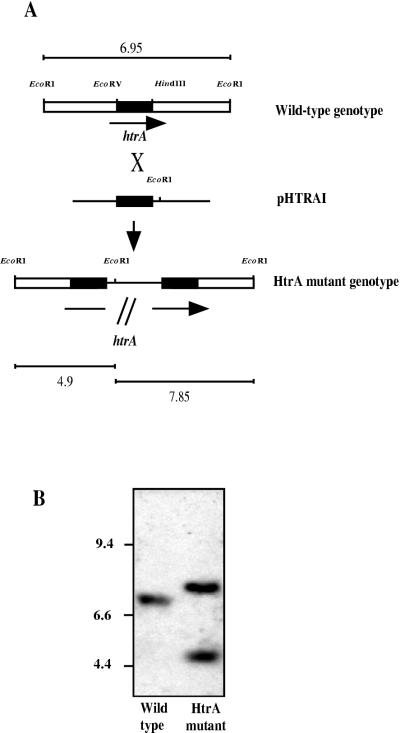
FIG. 1.
FIG. 1.
Insertion-duplication mutagenesis of htrA in strain USA0352/78. (A) Diagram of insertion-duplication mutagenesis showing homologous recombination between the K. pneumoniae chromosome of wild-type strain USA0352/78 and the pHTRAI disruption construct to generate isogenic htrA mutant USA0352-htrA. DNA fragment size in the diagram is not to scale. The line in the mutant genome represents the plasmid DNA integrated into the chromosome. Black boxes, EcoRV-HindII htrA internal fragment cloned in pHTRAI and used as probe in the Southern blot analysis. Expected sizes (kilobases) of the fragments that hybridize with the probe described above are indicated. (B) Southern blot analysis of K. pneumoniae wild-type and htrA mutant chromosomes digested with EcoRI. Molecular size markers (kilobases) are shown on the left.
FIG. 2.
FIG. 2.
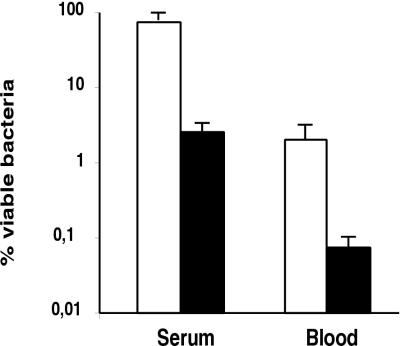
Resistance to complement and to whole-blood killing of K. pneumoniae strains. Bars indicate percentages of viable bacteria after incubation for 3 h in NHS or in fresh human blood. The results represent the means ± standard errors of three independent experiments for wild-type strain USA0352/78 (open bars) and htrA mutant strain USA0352-htrA (solid bars). A comparison of the htrA mutant and wild-type strains by a two-tailed t test yielded P values <0.01.
FIG. 3.
FIG. 3.
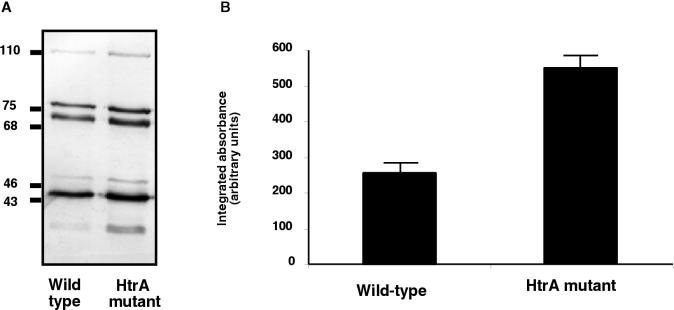
Analysis of complement C3 deposition on K. pneumoniae cell surfaces. (A) Cells of wild-type strain USA0352/78 and its derived isogenic mutant USA0352-htrA were incubated in NHS. C3 fragments deposited on the bacterial surface were released, separated by SDS-PAGE, and identified by Western blotting with anti-human C3 serum and by comparison with purified C3 fragments. (B) Quantification of the 75-kDa band of the β chain common to C3b and iC3b was carried out by densitometric analysis. Data are means ± standard deviations of three independent experiments. Control values for each strain, i.e., C3 fragment depositions with heat-inactived serum, were subtracted from experimental results. A comparison of the htrA mutant and wild-type strains by a two-tailed t test yielded P values <0.01.

References

    1. Albertí, S., D. Álvarez, S. Merino, M. T. Casado, F. Vivanco, J. M. Tomás, and V. J. Benedí. 1996. Analysis of complement C3 deposition and degradation on Klebsiella pneumoniae. Infect. Immun. 64:4726-4732. - PMC - PubMed
    1. Albertí, S., J. Imperial, J. M. Tomás, and V. J. Benedí. 1991. Bacterial lipopolysaccharide extraction in silica gel-containing tubes. J. Microbiol. Methods 14:63-69.
    1. Álvarez, D., S. Merino, J. M. Tomás, V. J. Benedí, and S. Albertí. 2000. Capsular polysaccharide is a major complement resistance factor in lipopolysaccharide O side chain-deficient Klebsiella pneumoniae clinical isolates. Infect. Immun. 68:953-955. - PMC - PubMed
    1. Ausubel, F. M., R. Brent, R. E. Kingston, D. D. Moore, J. G. Seidman, J. A. Smith, and K. Struhl (ed.). 1997. Current protocols in molecular biology. Greene Publishing and Wiley Interscience, New York, N.Y.
    1. Bartlett, J. G., P. O'Keefe, F. P. Tally, T. J. Louie, and S. L. Gorbach. 1986. Bacteriology of hospital-acquired pneumonia. Arch. Intern. Med. 146:868-871. - PubMed

Publication types

Associated data

LinkOut - more resources