. 2002 Sep;76(18):9143-51.
doi: 10.1128/jvi.76.18.9143-9151.2002.

Nucleoside analog resistance caused by insertions in the fingers of human immunodeficiency virus type 1 reverse transcriptase involves ATP-mediated excision

Affiliations

Nucleoside analog resistance caused by insertions in the fingers of human immunodeficiency virus type 1 reverse transcriptase involves ATP-mediated excision

Paul L Boyer et al. J Virol. 2002 Sep.

Abstract

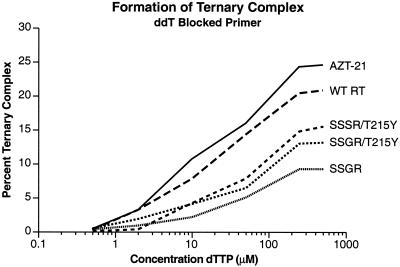
Although anti-human immunodeficiency virus type 1 (HIV-1) therapy has prolonged the lives of patients, drug resistance is a significant problem. Of particular concern are mutations that cause cross-resistance to a particular class of drugs. Among the mutations that cause resistance to several nucleoside analogs are the insertion of amino acids in the fingers subdomain of HIV-1 reverse transcriptase (RT) at positions 69 and 70. These insertions are usually associated with changes in the flanking amino acids and with a change to F or Y at position 215. We have proposed that the T215F/Y mutation makes the binding of ATP to HIV-1 RT more effective, which increases the excision of 3-azido-3'-deoxythymidine-5'-monophosphate (AZTMP) in vitro and increases zidovudine (AZT) resistance in vivo. Although the mechanism of AZT resistance involves enhanced excision, resistance to 3TC involves a block to incorporation of the analog. We measured the effects of fingers insertion mutations on the misincorporation and excision of several nucleoside analogs. RT variants with the amino acid insertions in the fingers and T215Y have a decreased level of misincorporation of ddATP and 3TCTP. These mutants also have the ability to excise AZTMP by ATP-dependent pyrophosphorylysis. However, unlike the classic AZT resistance mutations (M41L/D67N/K70R/T215Y or F/K219E or Q), the combination of the amino acid insertions in the fingers and the T215Y mutation allows efficient excision of ddTMP and d4TMP, even when relatively high levels of deoxynucleoside triphosphates are present in the reaction. Although the dideoxynucleoside analogs of other nucleosides were excised more slowly than AZTMP, ddTMP, and d4TMP, the mutants with the fingers insertion and T215Y excised all of the nucleoside analogs that were tested more efficiently than wild-type RT or a mutant RT carrying the classical AZT resistance mutations. In the ternary complex (RT/template-primer/dNTP), the presence of the bound dNTP prevents the end of the primer from gaining access to the nucleotide binding site (N site) where excision occurs. Gel shift analysis showed that the amino acid insertions in the fingers destabilized the ternary complex compared to wild-type HIV-1 RT. If the ternary complex is unstable, the end of the primer can gain access to the N site and excision can occur. This could explain the enhanced excision of the nucleoside analogs.


Figures
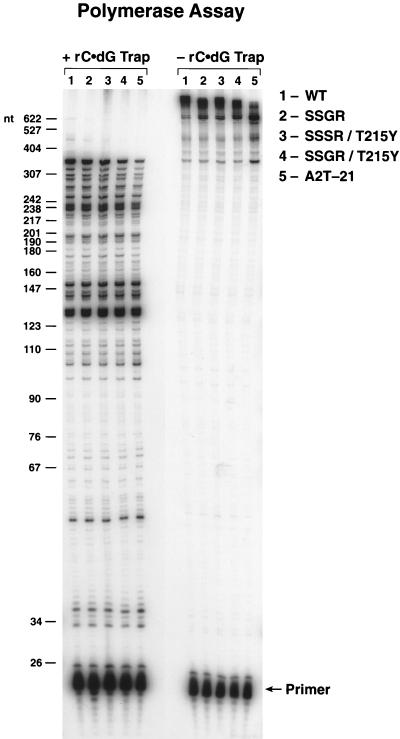
FIG. 1.
FIG. 1.
Processivity and primer extension of wild-type HIV-1 RT and the RT mutants. The addition of poly(rC) · oligo(dG) traps the HIV-1 RT after it dissociates from the labeled template-primer. This limits RT to one round of extension of the labeled primer and provides a measure of processivity (left side of figure). Without the trap, HIV-1 RT can undergo multiple rounds of primer extension (right side of figure). The reactions were run for 10 min, and the reaction products were fractionated on a 6% polyacrylamide gel. The products were visualized by autoradiography. The scale on the left indicates the sizes of the products, in nucleotides.
FIG. 2.
FIG. 2.
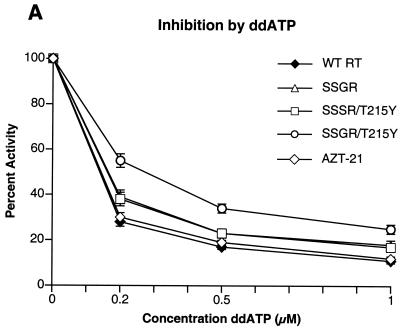
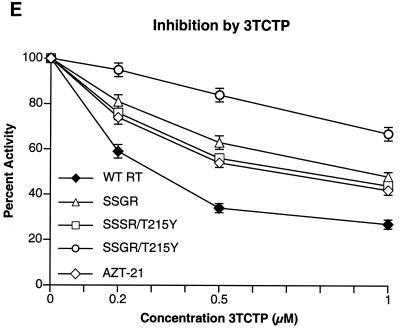
Inhibition of polymerase activity by various nucleoside analogs. To simplify the comparisons, the activity of each of the enzymes in the absence of an inhibitor was considered 100%. Polymerase activity in the presence of an inhibitor was normalized to this value. Various concentrations of the analogs were added to polymerization assays containing a −47 primer annealed to a M13mp18 DNA template (see Materials and Methods). After 30 min, the reactions were stopped by the addition of 10% trichloroacetic acid, and the newly synthesized DNA was collected on Whatman GF/C filters. All reactions were done in duplicate. SSGR was plotted for all panels; however data overlap may obscure the data points. Panel A shows the effects of adding ddATP to the polymerization reactions, while panel B shows the effects of AZTTP. Panel C shows the effects of d4TTP; panel D is for ddCTP; panel E is for 3TCTP.
FIG. 2.
FIG. 2.
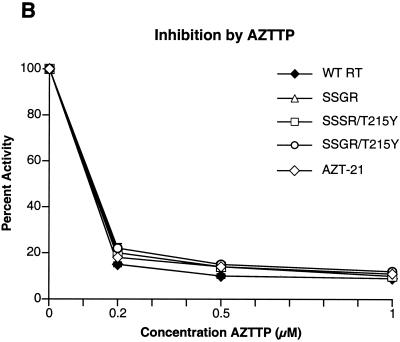
Inhibition of polymerase activity by various nucleoside analogs. To simplify the comparisons, the activity of each of the enzymes in the absence of an inhibitor was considered 100%. Polymerase activity in the presence of an inhibitor was normalized to this value. Various concentrations of the analogs were added to polymerization assays containing a −47 primer annealed to a M13mp18 DNA template (see Materials and Methods). After 30 min, the reactions were stopped by the addition of 10% trichloroacetic acid, and the newly synthesized DNA was collected on Whatman GF/C filters. All reactions were done in duplicate. SSGR was plotted for all panels; however data overlap may obscure the data points. Panel A shows the effects of adding ddATP to the polymerization reactions, while panel B shows the effects of AZTTP. Panel C shows the effects of d4TTP; panel D is for ddCTP; panel E is for 3TCTP.
FIG. 2.
FIG. 2.
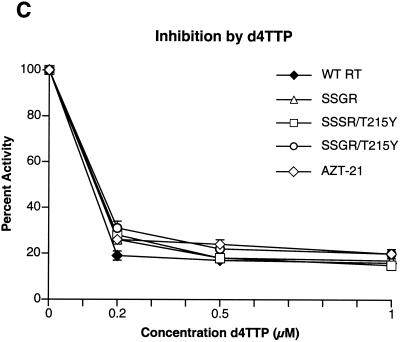
Inhibition of polymerase activity by various nucleoside analogs. To simplify the comparisons, the activity of each of the enzymes in the absence of an inhibitor was considered 100%. Polymerase activity in the presence of an inhibitor was normalized to this value. Various concentrations of the analogs were added to polymerization assays containing a −47 primer annealed to a M13mp18 DNA template (see Materials and Methods). After 30 min, the reactions were stopped by the addition of 10% trichloroacetic acid, and the newly synthesized DNA was collected on Whatman GF/C filters. All reactions were done in duplicate. SSGR was plotted for all panels; however data overlap may obscure the data points. Panel A shows the effects of adding ddATP to the polymerization reactions, while panel B shows the effects of AZTTP. Panel C shows the effects of d4TTP; panel D is for ddCTP; panel E is for 3TCTP.
FIG. 2.
FIG. 2.
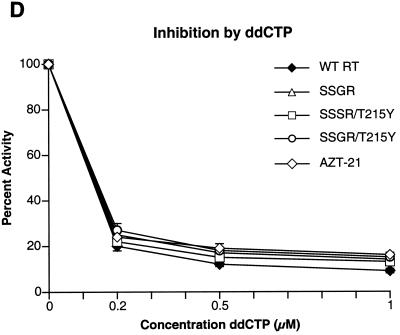
Inhibition of polymerase activity by various nucleoside analogs. To simplify the comparisons, the activity of each of the enzymes in the absence of an inhibitor was considered 100%. Polymerase activity in the presence of an inhibitor was normalized to this value. Various concentrations of the analogs were added to polymerization assays containing a −47 primer annealed to a M13mp18 DNA template (see Materials and Methods). After 30 min, the reactions were stopped by the addition of 10% trichloroacetic acid, and the newly synthesized DNA was collected on Whatman GF/C filters. All reactions were done in duplicate. SSGR was plotted for all panels; however data overlap may obscure the data points. Panel A shows the effects of adding ddATP to the polymerization reactions, while panel B shows the effects of AZTTP. Panel C shows the effects of d4TTP; panel D is for ddCTP; panel E is for 3TCTP.
FIG. 2.
FIG. 2.
Inhibition of polymerase activity by various nucleoside analogs. To simplify the comparisons, the activity of each of the enzymes in the absence of an inhibitor was considered 100%. Polymerase activity in the presence of an inhibitor was normalized to this value. Various concentrations of the analogs were added to polymerization assays containing a −47 primer annealed to a M13mp18 DNA template (see Materials and Methods). After 30 min, the reactions were stopped by the addition of 10% trichloroacetic acid, and the newly synthesized DNA was collected on Whatman GF/C filters. All reactions were done in duplicate. SSGR was plotted for all panels; however data overlap may obscure the data points. Panel A shows the effects of adding ddATP to the polymerization reactions, while panel B shows the effects of AZTTP. Panel C shows the effects of d4TTP; panel D is for ddCTP; panel E is for 3TCTP.
FIG. 3.
FIG. 3.
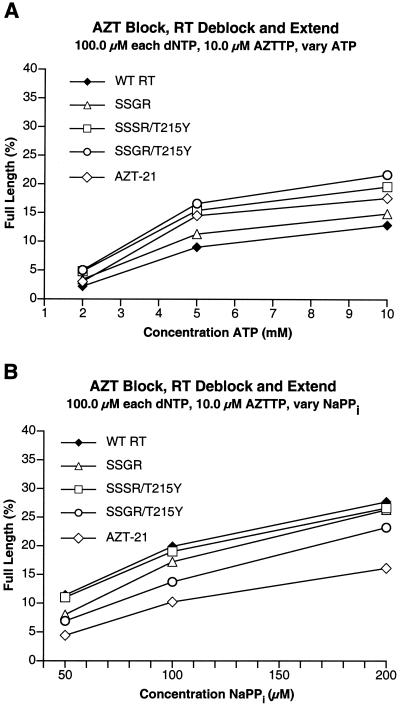
Comparison of the abilities of the various HIV-1 RTs (wild-type and mutant) to excise AZTMP from the end of the primer and extend the primer in the presence of AZTTP, high concentrations of dNTPs, and various concentrations of a pyrophosphate donor. The primer is fully blocked with AZTMP at the beginning of the reaction (see Materials and Methods). A short (25-nucleotide-long) template extension provides additional opportunity for the enzymes to incorporate AZTTP and excise AZTMP. This will tend to average out the events at individual sites. The assay measures the percentage of the primer that is completely extended by each enzyme at the various pyrophosphate donor concentrations. All assays were done in duplicate. Panel A shows the results obtained when the pyrophosphate donor is ATP; Panel B shows the results when sodium pyrophosphate (NaPPi) is the pyrophosphate donor.
FIG. 4.
FIG. 4.
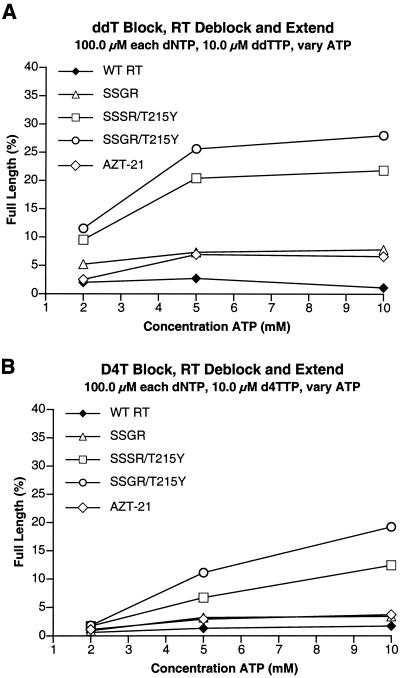
Comparison of the abilities of the various RTs to excise other thymidine analogs. The assay conditions are similar to those described in the legend to Fig. 3 except that instead of an AZTMP-terminated primer, the primer was terminated with either ddTMP or d4TMP, and in the reactions, a 10 μM concentration of the triphosphate form of the indicated nucleoside analog was used instead of AZTTP. ATP was the pyrophosphate donor in all reactions, which were run in duplicate. Panel A shows the results of reactions run with ddTMP as the blocking group on the primer. Panel B corresponds to reactions run with d4TMP as the blocking group on the primer.
FIG. 5.
FIG. 5.
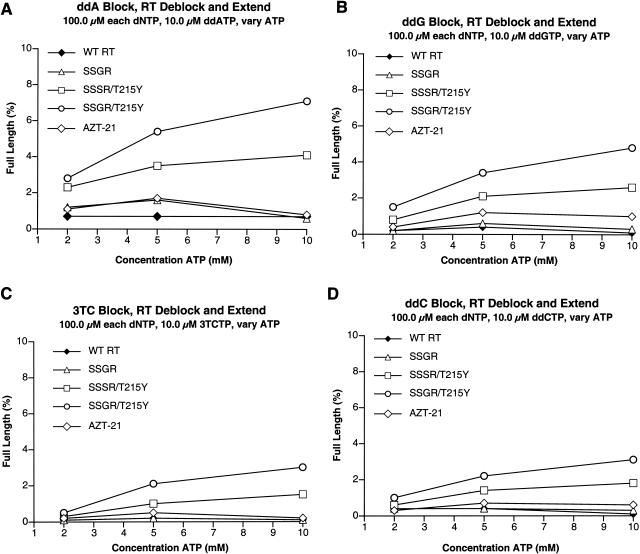
Comparison of the abilities of the various RTs to excise other nucleoside analogs. Note the change in the scale of the percent full length (y axis). All reactions were carried out in duplicate. Reactions run with ddAMP (A), ddGMP (B), 3TCMP (C), or ddCMP (D) as the primer blocking group are shown.
FIG. 6.
FIG. 6.
Detection of the ternary complex by gel electrophoresis. As described in Materials and Methods, a 5′-end-labeled primer was annealed to a template by heating and slow cooling. The end of the primer strand was then blocked by the addition of ddTMP. The blocked template-primer was then purified. For each sample, wild-type or mutant RT was allowed to bind to labeled ddTMP blocked template-primer in 1× RT binding buffer plus the indicated concentration of dTTP (0 to 500 μM) for 5 min at room temperature. The salt concentration was then increased to 100 mM KCl, and an unlabeled chase substrate, poly(rC) · oligo(dG), was added. The reactions were incubated at 37o for 5 min and then fractionated on a 6% Novex polyacrylamide DNA retardation gel. The percentage of gel-shifted complex was determined by a PhosphorImager.

References

    1. Ahluwalia, G., D. A. Cooney, H. Mitsuya, A. Fridland, K. P. Flora, Z. Hao, M. Dalal, S. Broder, and D. G. Johns. 1987. Initial studies on the cellular pharmacology of 2′,3′-dideoxyinosine, an inhibitor of HIV infectivity. Biochem. Pharmacol. 36:3797-3800. - PubMed
    1. Andréoletti, L., L. Weiss, A. Si-Mohamed, C. Piketty, T. Prazuck, G. Calamy, J.-E. Malkin, M. Matta, F.-X. Mbopi-Kéou, F. Clavel, M. D. Kazatchkine, and L. Bélec. 2002. Multidrug-resistant HIV-1 RNA and proviral DNA variants harboring new dipeptide insertions in the reverse transcriptase pol gene. J. Acquir. Immune Defic. Syndr. 29:102-104. - PubMed
    1. Arion, D., N. Kaushik, S. McCormick, G. Borkow, and M. A. Parniak. 1998. Phenotypic mechanism of HIV-1 resistance to 3′-azido-3′-deoxythymidine (AZT): increased polymerization processivity and enhanced sensitivity to pyrophosphate of the mutant viral reverse transcriptase. Biochemistry 37:15908-15917. - PubMed
    1. Bonfanti, P., I. Faggion, S. L. S. Catamancio, M. Violin, C. Balotta, and S. Rusconi. 2000. Response to antiretroviral therapy in a patient with an uncommon codon 69 insertion in the human immunodeficiency virus type 1 reverse transcriptase. Antimicrob. Agents Chemother. 44:1767-1768. - PMC - PubMed
    1. Boyer, P. L., J. Lisziewicz, F. Lori, and S. H. Hughes. 1999. Analysis of amino acid insertion mutations in the fingers subdomain of HIV-1 reverse transcriptase. J. Mol. Biol. 286:995-1008. - PubMed

Publication types

MeSH terms