


Obesigenic families: parents' physical activity and dietary intake patterns predict girls' risk of overweight
- PMID: 12187395
- PMCID: PMC2530921
- DOI: 10.1038/sj.ijo.0802071
Obesigenic families: parents' physical activity and dietary intake patterns predict girls' risk of overweight
Abstract
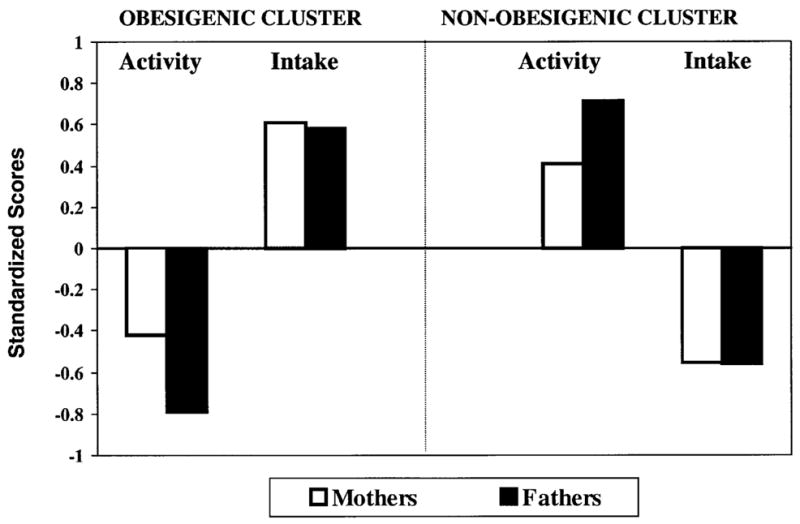
Objective: To determine whether obesigenic families can be identified based on mothers' and fathers' dietary and activity patterns.
Methods: A total of 197 girls and their parents were assessed when girls were 5 y old; 192 families were reassessed when girls were 7 y old. Measures of parents' physical activity and dietary intake were obtained and entered into a cluster analysis to assess whether distinct family clusters could be identified. Girls' skinfold thickness and body mass index (BMI) were also assessed and were used to examine the predictive validity of the clusters.
Results: Obesigenic and a non-obesigenic family clusters were identified. Mothers and fathers in the obesigenic cluster reported high levels of dietary intake and low levels of physical activity, while mothers and fathers in the non-obesigenic cluster reported low levels of dietary intake and high levels of activity. Girls from families in the obesigenic cluster had significantly higher BMI and skinfold thickness values at age 7 and showed significantly greater increases in BMI and skinfold thickness from ages 5 to 7 y than girls from non-obesigenic families; differences were reduced but not eliminated after controlling for parents' BMI.
Conclusions: Obesigenic families, defined in terms of parents' activity and dietary patterns, can be used predict children's risk of obesity.
Figures
References
-
- Garn SM, Sullivan TV, Hawthorne VM. Fatness and obesity of the parents of obese individuals. Am J Clin Nutr. 1989;50:1308–1313. - PubMed
-
- Grilo CM, Pogue-Geile MF. The nature of environmental influences on weight and obesity: a behavior genetics analysis. Psychol Bull. 1991;110:520–537. - PubMed
-
- Maffeis C, Talamini G, Tato L. Influences of diet, physical activity and parents’ obesity on children’s adiposity: a four-year longitudinal study. Int J Obes Relat Metab Disord. 1998;22:758–764. - PubMed
-
- Pérusse L, Tremblay A, Leblanc C, Cloninger CR, Reich T, Rice J, et al. Familial resemblance in energy intake: Contribution of genetic and environmental factors. Am J Clin Nutr. 1988;47:629–635. - PubMed
Publication types
MeSH terms
Grants and funding
LinkOut - more resources
Full Text Sources
Medical