


The immune system: a weapon of mass destruction invented by evolution to even the odds during the war of the DNAs
- PMID: 12190919
- PMCID: PMC1403132
- DOI: 10.1034/j.1600-065x.2002.18504.x
The immune system: a weapon of mass destruction invented by evolution to even the odds during the war of the DNAs
Abstract
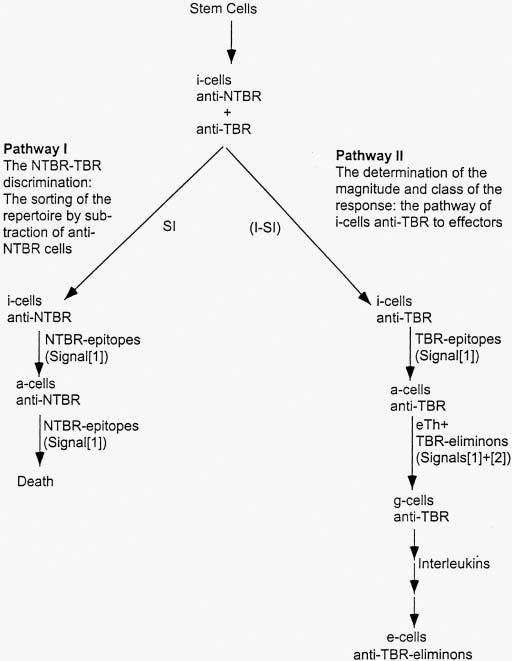
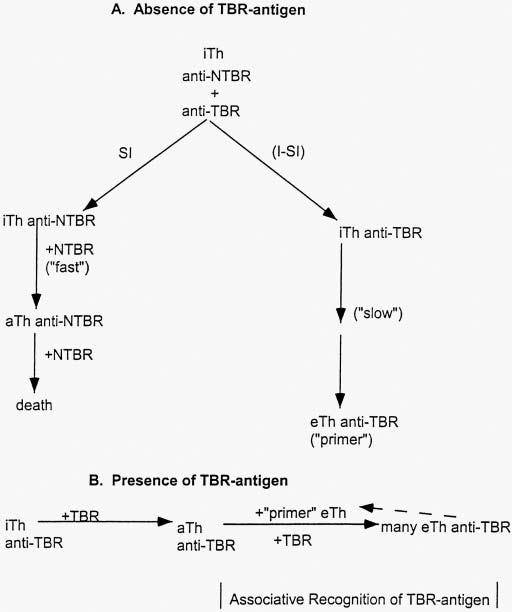
Living systems operate under interactive selective pressures. Populations have the ability to anticipate the future by generating a repertoire of elements that cope with new selective pressures. If the repertoire of such elements were transcendental, natural selection could not operate because any one of them would be too rare. This is the problem that vertebrates faced in order to deal with a vast number of pathogens. The solution was to invent an immune system that underwent somatic evolution. This required a random repertoire that was generated somatically and divided the antigenic universe into combinatorials of determinants. As a result, it became virtually impossible for pathogens to escape recognition but the functioning of such a repertoire required two new regulatory mechanisms: 1) a somatic discriminator between Not-To-Be-Ridded ('Self') and To-Be-Ridded ('Non-self') antigens, and 2) a way to optimize the magnitude and choice of the class of the effector response. The principles governing this dual regulation are analyzed in the light of natural selection.
Figures
References
-
- Hull DL, Langman RE, Glenn SS. A general account of selection: biology, immunology and behavior. Behav Brain Sci. 2001;24:511–528. - PubMed
-
- Cohn M, Langman RE. To be or not to be ridded? — That is the question addressed by the Associative Antigen Recognition model. Scand J Immunol. 2002;53:1–6. - PubMed
-
- Cohn M, Langman RE. The Protecton: the evolutionarily selected unit of humoral immunity. Immunol Rev. 1990;115:1–131. - PubMed
-
- Cohn M. A new concept of immune specificity emerges from a consideration of the Self-Nonself discrimination. Cell Immunol. 1997;181:103–108. - PubMed
-
- Langman RE. The specificity of immunological reactions. Mol Immunol. 2000;37:555–561. - PubMed
Publication types
MeSH terms
Substances
Grants and funding
LinkOut - more resources
Full Text Sources
Medical
