. 2002 Sep;22(18):6441-57.
doi: 10.1128/MCB.22.18.6441-6457.2002.

Coupling of termination, 3' processing, and mRNA export

Affiliations

Coupling of termination, 3' processing, and mRNA export

C M Hammell et al. Mol Cell Biol. 2002 Sep.

Abstract

In a screen to identify genes required for mRNA export in Saccharomyces cerevisiae, we isolated an allele of poly(A) polymerase (PAP1) and novel alleles encoding several other 3' processing factors. Many newly isolated and some previously described mutants (rna14-48, rna14-49, rna14-64, rna15-58, and pcf11-1 strains) are defective in polymerase II (Pol II) termination but, interestingly, retain the ability to polyadenylate these improperly processed transcripts at the nonpermissive temperature. Deletion of the cis-acting sequences required to couple 3' processing and termination also produces transcripts that fail to exit the nucleus, suggesting that all of these processes (cleavage, termination, and export) are coupled. We also find that several but not all mRNA export mutants produce improperly 3' processed transcripts at the nonpermissive temperature. 3' maturation defects in mRNA export mutants include improper Pol II termination and/or the previously characterized hyperpolyadenylation of transcripts. Importantly, not all mRNA export mutants have defects in 3' processing. The similarity of the phenotypes of some mRNA export mutants and 3' processing mutants indicates that some factors from each process may mechanistically interact to couple mRNA processing and export. Consistent with this assumption, we present evidence that Xpo1p interacts in vivo with several 3' processing factors and that the addition of recombinant Xpo1p to in vitro processing reaction mixtures stimulates 3' maturation. Of the core 3' processing factors tested (Rna14p, Rna15p, Pcf11p, Hrp1p, Fip1p, and Cft1p), only Hrp1p shuttles. Overexpression of Rat8p/Dbp5p suppresses both 3' processing and mRNA export defects found in xpo1-1 cells.


Figures

FIG. 1.
FIG. 1.
Flow cytometry of Ssa4-GFP reporter strains. (A) Schematic representation of the inducible fluorescent reporter used in this screen. Wild-type (B) or Δrip1 cells (C) containing an integrated SSA4-GFP reporter were sorted by FACS at 23°C or 1 h after the temperature shift to 42°C. In panels B to D, relative fluorescence is plotted on the x axis, and cell counts are plotted on the y axis. (D) An equal mixture of wild-type cells and Δrip1 cells were mixed, incubated at 42°C for 1 h, and sorted. The two peak fractions were plated on selective media to determine the relative proportion of each strain in each peak. Among those cells isolated in the dark fraction will be cells of either type which were no longer alive at the time of sorting.
FIG. 2.
FIG. 2.
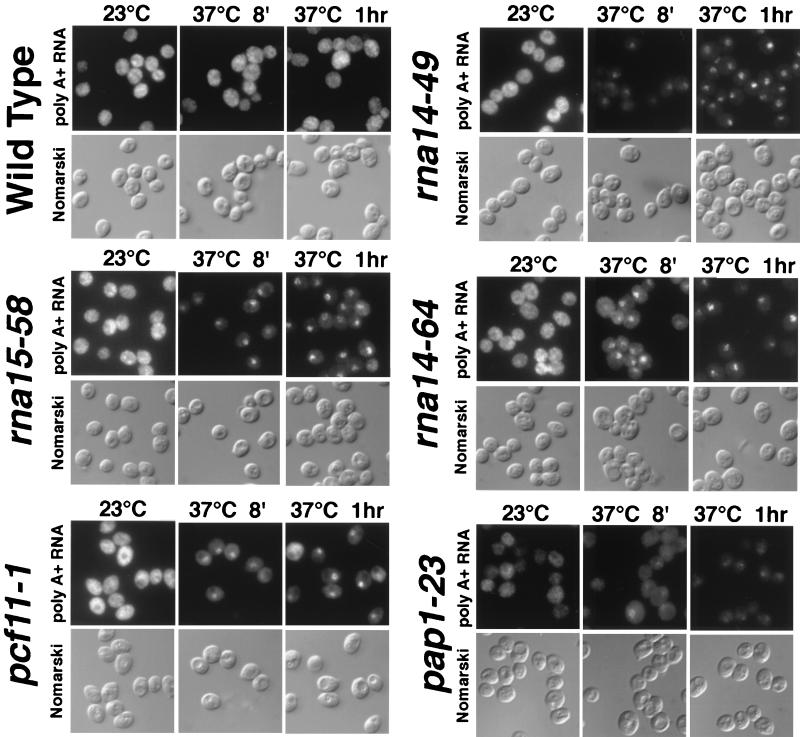
New alleles affecting the 3′ processing machinery accumulate poly(A) RNA at the nonpermissive temperature. Wild-type or mutant cells were grown at 23°C and shifted to 37°C for 8 min (8′) or 1 h. Samples were then fixed, permeabilized, and probed with an oligo(dT)50 probe to localize poly(A) RNAs. Both FITC [oligo(dT)] and Normarski images of the same fields are shown.
FIG. 3.
FIG. 3.
In vitro 3′ processing analysis of new 3′ processing mutants and in vivo poly(A) tail lengths of mRNA export mutants and 3′ processing mutants identified in this screen. (A) Extracts from wild-type (WT), pap1-23, rna15-58, or rna14-64 cells were incubated with an in vitro-transcribed GAL7 3′UTR and dATP at 23°C to measure the in vitro cleavage activity of these strains. Lane (−), negative control. (B) Extracts from the same strains were incubated with a precleaved, in vitro-transcribed GAL7 precursor at 23°C to measure polyadenylation efficiencies. (C and D) Coupled cleavage and polyadenylation reactions (C) of the GAL7 3′UTR or polyadenylation reactions (D) of the same extracts heated to 37°C for 5 min before addition to the reaction mixture at 30°C. In panels C and D, extracts from the various mutants were also mixed in equal proportions and incubated with the same GAL7 precursors to measure each extract's ability to complement other defective extracts. (E and F) The poly(A) tail length distribution of each mutant was determined by isolating total RNA from each strain that had been grown continuously at 23°C or shifted to 37°C for 30 min. The resulting RNAs were digested to completion with RNases T1 and A. The remaining oligo(A) and poly(A) fragments were then end labeled with [32P]pCp and RNA ligase and resolved on 9% polyacrylamide-7 M urea-TBE gels. Poly(A) lengths of mRNAs from several CFIA mutants isolated in this screen (E) or from several mRNA export mutants (F) are shown.
FIG. 4.
FIG. 4.
Transcriptional termination phenotypes of 3′ processing and mRNA export mutants. Temperature-sensitive CFIA mutants (A), mRNA export mutants (B), or mutants of two karyopherin b family members (C) were grown at 23°C and then shifted to 37°C for 30 min (30′). Ten micrograms of total RNA was extracted, separated on a 1% formaldehyde gel, transferred to a membrane, and probed with an antisense CUP1 riboprobe. Panel C also compares the effects of Rat8p/Dbp5p overexpression on the termination defects of xpo1-1 and kap104-16 strains. The mature form of CUP1 mRNA transcripts is approximately 600 nucleotides. The asterisks indicate improperly processed CUP1 transcripts that are approximately 1.8 kb long. WT, wild type.
FIG. 5.
FIG. 5.
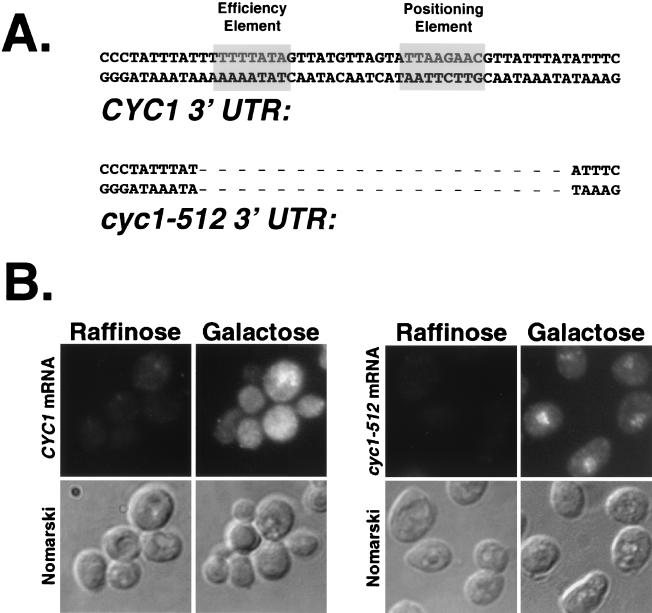
Deletion of cis-acting processing and termination elements leads to a block to mRNA export. (A) Comparison of 3′UTR sequence of CYC1 and cyc1-512 genes. cyc1-512 locus lacks a 38-bp region (dashes) required for normal cleavage, polyadenylation, and Pol II termination. (B) Wild-type cells were transformed with galactose-inducible CYC1 or cyc1-512 constructs. Cells were then grown in noninducing (raffinose) or inducing (galactose) conditions overnight, fixed, and permeabilized. Samples were then probed with a digoxigenin-labeled PCR probe complementary to the CYC1 coding region (present in both transcripts). Anti-digoxigenin-FITC antibodies were then used to localize mRNAs which hybridized with the PCR-labeled CYC1 probe.
FIG. 6.
FIG. 6.
Xpo1p stimulates 3′ processing efficiency in vitro. (A) Extracts prepared from wild-type cells were preincubated with 8, 24, 74, 220, or 660 ng of recombinant GST (lanes 2 to 6) or GST-Xpo1p (lanes 7 to 11) prior to addition of a labeled in vitro-transcribed RNA precursor containing sequences flanking the GAL7 poly(A) site. Coupled cleavage and polyadenylation reactions were then carried out at 30°C for 30 min, and the products were resolved by electrophoresis on a 5% acrylamide-urea gel. Lane 1 contains unreacted precursor. (B) Effect of LMB addition on the 3′ processing activity of extracts made from strains resistant (R; XPO1) or sensitive (S; xpo1T539C) to LMB (lanes 1 to 4). Recombinant GST-Xpo1 (R) or GST-Xpo1T539C (S) was added (lanes 5 to 12) or not added (lanes 1 to 4) to the extracts, with (lanes 3, 4, and 9 to 12) or without (lanes 1, 2, and 5 to 8) LMB, as indicated above the gel.
FIG. 7.
FIG. 7.
Most components of the core 3′ processing machinery do not shuttle. nup49-313 cells individually expressing GFP fusions of Hrp1p, Rna14p, Rna15p, Pcf11p, Fip1p, or Cft1p were incubated at 23°C or shifted to 36°C for 6 h to assay the nuclear export of these proteins. Living cells were either photographed with Nomarski optics or examined for GFP fluorescence.

References

    1. Afonina, E., R. Stauber, and G. N. Pavlakis. 1998. The human poly(A)-binding protein 1 shuttles between the nucleus and the cytoplasm. J. Biol. Chem. 273:13015-13021. - PubMed
    1. Aitchison, J. D., G. Blobel, and M. P. Rout. 1996. Kap104p: a karyopherin involved in the nuclear transport of messenger RNA binding proteins. Science 274:624-627. - PubMed
    1. Allen, N. P., L. Huang, A. Burlingame, and M. Rexach. 2001. Proteomic analysis of nucleoporin interacting proteins. J. Biol. Chem. 276:29268-29274. - PubMed
    1. Amberg, D. C., M. Fleischmann, I. Stagljar, C. N. Cole, and M. Aebi. 1993. Nuclear PRP20 protein is required for mRNA export. EMBO J. 12:233-241. - PMC - PubMed
    1. Amberg, D. C., A. L. Goldstein, and C. N. Cole. 1992. Isolation and characterization of RAT1: an essential gene of Saccharomyces cerevisiae required for the efficient nucleocytoplasmic trafficking of mRNA. Genes Dev. 6:1173-1189. - PubMed

Publication types

MeSH terms