


Prostate cancer aggressiveness locus on chromosome 7q32-q33 identified by linkage and allelic imbalance studies
- PMID: 12192601
- PMCID: PMC1564121
- DOI: 10.1038/sj.neo.7900254
Prostate cancer aggressiveness locus on chromosome 7q32-q33 identified by linkage and allelic imbalance studies
Abstract
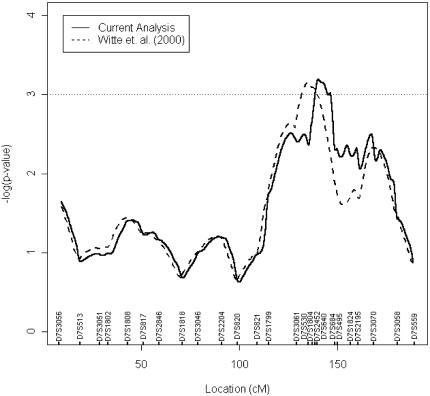
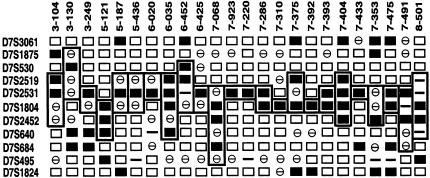
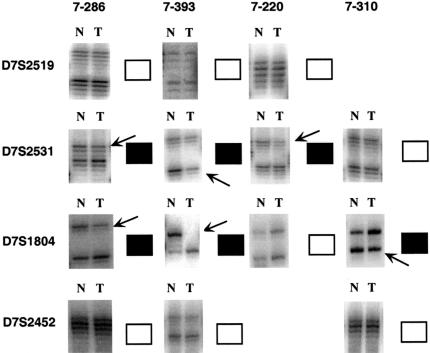
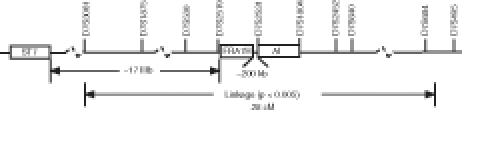
The biologic aggressiveness of prostate tumors is an important indicator of prognosis. Chromosome 7q32-q33 was recently reported to show linkage to more aggressive prostate cancer, based on Gleason score, in a large sibling pair study. We report confirmation and narrowing of the linked region using finer-scale genotyping. We also report a high frequency of allelic imbalance (AI) defined within this locus in a series of 48 primary prostate tumors from men unselected for family history or disease status. The highest frequency of AI was observed with adjacent markers D7S2531 (52%) and D7S1804 (36%). These two markers delineated a common region of AI, with 24 tumors exhibiting interstitial AI involving one or both markers. The 1.1-Mb candidate region contains relatively few transcripts. Additionally, we observed positive associations between interstitial AI at D7S1804 and early age at diagnosis (P=.03) as well as a high combined Gleason score and tumor stage (P=.06). Interstitial AI at D7S2531 was associated with a positive family history of prostate cancer (P=.05). These data imply that we have localized a prostate cancer tumor aggressiveness loci to chromosome 7q32-q33 that is involved in familial and nonfamilial forms of prostate cancer.
Figures
References
-
- American Cancer Society, Atlanta, GA, author. Cancer Facts and Figures 2002. 2002:1–41.
-
- Smith JR, Freije D, Carpten JD, Gronberg H, Xu J, Isaacs SD, Brownstein MJ, Bova GS, Guo H, Bujnovszky P, Nusskern DR, Damber JE, Bergh A, Emanuelsson M, Kallioniemi OP, Walker-Daniels J, Bailey-Wilson JE, Beaty TH, Meyers DA, Walsh PC, Collins FS, Trent JM, Isaacs WB. Major susceptibility locus for prostate cancer on chromosome 1 suggested by a genome-wide search. Science. 1996;274:1371–1374. - PubMed
-
- Berthon P, Valeri A, Cohen-Akenine A, Drelon E, Paiss T, Wohr G, Latil A, Millasseau P, Mellah I, Cohen N, Blanche H, Bellane-Chantelot C, Demenais F, Teillac P, Le Duc A, de Petriconi R, Hautmann R, Chumakov I, Bachner L, Maitland NJ, Lidereau R, Vogel W, Fournier G, Mangin P, Cohen D, Cussenot O. Predisposing gene for early-onset prostate cancer, localized on chromosome 1q42.2–43. Am J Hum Genet. 1998;62:1416–1424. - PMC - PubMed
-
- Xu J, Zheng SL, Hawkins GA, Faith DA, Kelly B, Isaacs SD, Wiley KE, Chang B, Ewing CM, Bujnovszky P, Carpten JD, Bleecker ER, Walsh PC, Trent JM, Meyers DA, Isaacs WB. Linkage and association studies of prostate cancer susceptibility: evidence for linkage at 8p22–23. Am J Hum Genet. 2001;69:341–350. - PMC - PubMed
MeSH terms
Substances
LinkOut - more resources
Full Text Sources
Medical
Miscellaneous