. 2002 Sep 3;99(18):11987-91.
doi: 10.1073/pnas.182178199. Epub 2002 Aug 22.

Sleep forms memory for finger skills

Affiliations

Sleep forms memory for finger skills

Stefan Fischer et al. Proc Natl Acad Sci U S A. .

Abstract

Practicing a motor skill triggers a process of memory consolidation that continues for hours after practice has ended, and becomes manifest in an improved skill at later testing. We used a sequential motor task (finger-to-thumb opposition task) to show that, in humans, the formation of motor skill memories essentially benefits from sleep. Independent of whether placed during daytime or nighttime, sleep after practice enhanced speed of sequence performance on average by 33.5% and reduced error rate by 30.1% as compared with corresponding intervals of wakefulness. The effect of sleep after learning proved to be stable when retesting was postponed for another night, to exclude effects of sleep loss and to assure that all subjects had sufficient sleep before retrieval testing. Also, the consolidating effect of sleep was specific for the motor sequence learned. It did not generalize to a similar sequence containing identical movement segments in a different order. Retention periods of wakefulness improved performance only moderately and only if placed during daytime. The observations demonstrate a critical role of sleep for storing and optimizing motor skills.


Figures
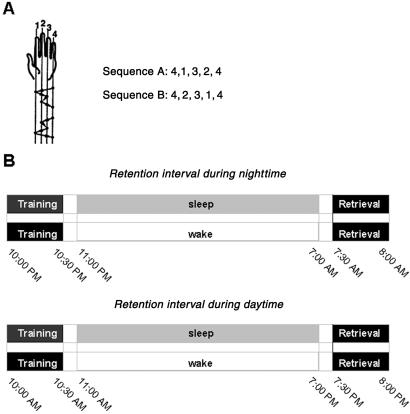
Figure 1
Figure 1
(A) Finger-to-thumb opposition task. The motor skill task was adopted from Karni et al. (10) and demanded the subject to oppose the fingers of the nondominant hand to the thumb in a certain sequence. Two sequences were used on different conditions, which both were composed of the same five movements but in a mirror-reversed manner. In sequence A, the order of the fingers was 4, 1, 3, 2, 4. In sequence B, the order was 4, 2, 3, 1, 4 (finger numbering is from index to little). During both training and retrieval testing, the subject was asked to tap the given sequence as fast and as accurately as possible without looking at his hand for three 5-min blocks. (B) Protocol for main experiments. Subjects received training (left black fields) on a finger sequence before 8-h retention intervals during which they either slept or stayed awake. Thirty minutes after the end of the retention period, retrieval was tested (right black fields). Retention periods were placed either at night (Upper) or during the day (Lower).
Figure 2
Figure 2
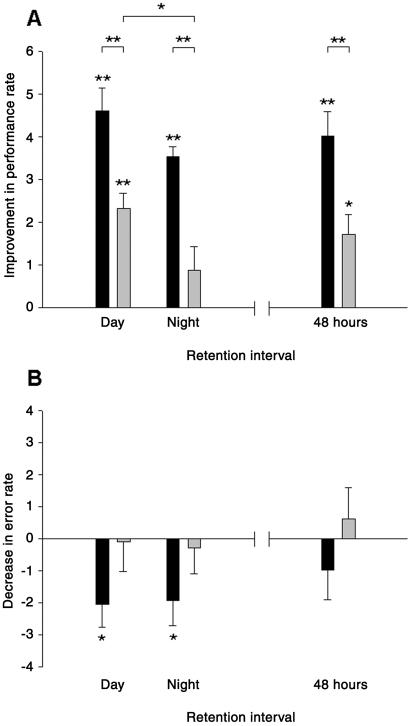
Performance gains on the finger-to-thumb opposition task are indicated by the difference between training and retrieval testing (A) for performance rate (mean number of correctly completed sequences per 30 s) and (B) error count (mean number of errors per 30 s). (Left) Mean (± SEM) differences are indicated for 8-h retention intervals of sleep (black bars) and wakefulness (gray bars) placed during daytime and at night. (Right) In additional experiments, effects of a 48-h retention interval were tested which was filled either with two nights of regular sleep (black bars) or a first night of sleep deprivation followed by a night of recovery sleep (gray bars). *, P < 0.05. **, P < 0.001 for tests against zero and for differences between the effects of the retention intervals.
Figure 3
Figure 3
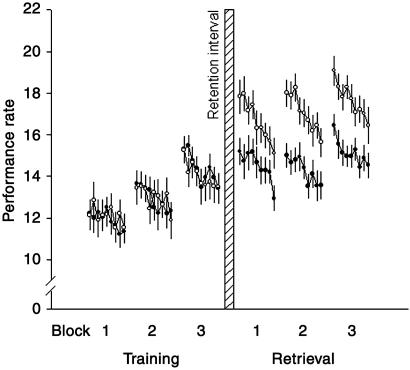
Progression of performance on the finger-to-thumb opposition task as indicated by the number of correctly completed sequences sampled at 30-s intervals. Three blocks each of 5 min duration were run before (Training) and after (Retrieval) 8-h retention intervals during which subjects slept (open circles), or remained awake (filled circles). Mean (± SEM; adjusted to first block of training) are shown collapsed across both daytime and nighttime condition (refer to text).

References

    1. Shadmehr R, Holcomb H H. Science. 1997;277:821–825. - PubMed
    1. Shadmehr R, Brashers-Krug T. J Neurosci. 1997;17:409–419. - PMC - PubMed
    1. Wolpert D M, Ghahramani Z, Jordan M I. Science. 1995;269:1880–1882. - PubMed
    1. Imamizu H, Miyauchi S, Tamada T, Sasaki Y, Takino R, Putz B, Yoshioka T, Kawato M. Nature (London) 2000;403:192–195. - PubMed
    1. Brashers-Krug T, Shadmehr R, Bizzi E. Nature (London) 1996;382:252–255. - PubMed

Publication types