


Appetite suppressants and valvular heart disease - a systematic review
- PMID: 12194699
- PMCID: PMC126245
- DOI: 10.1186/1472-6904-2-6
Appetite suppressants and valvular heart disease - a systematic review
Abstract
Background: Although appetite suppressants have been implicated in the development of valvular heart disease, the exact level of risk is still uncertain. Initial studies suggested that as many as 1 in 3 exposed patients were affected, but subsequent research has yielded substantially different figures. Our objective was to systematically assess the risk of valvular heart disease with appetite suppressants.
Methods: We accepted studies involving obese patients treated with any of the following appetite suppressants: fenfluramine, dexfenfluramine, and phentermine. Three types of studies were reviewed: controlled and uncontrolled observational studies, and randomized controlled trials. Outcomes of interest were echocardiographically detectable aortic regurgitation of mild or greater severity, or mitral regurgitation of moderate or greater severity.
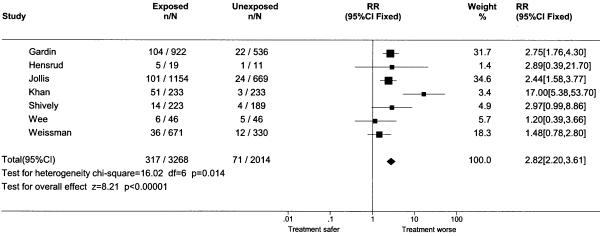
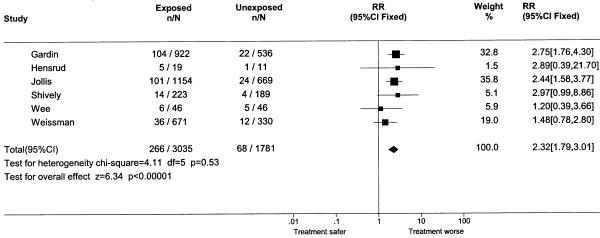
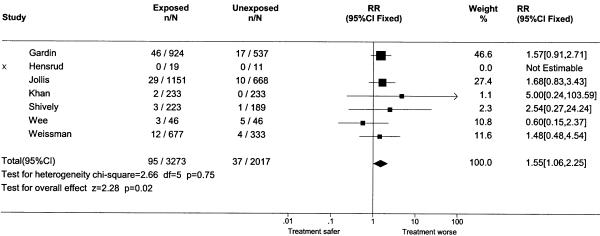
Results: Of the 1279 patients evaluated in seven uncontrolled cohort studies, 236 (18%) and 60 (5%) were found to have aortic and mitral regurgitation, respectively. Pooled data from six controlled cohort studies yielded, for aortic regurgitation, a relative risk ratio of 2.32 (95% confidence intervals 1.79 to 3.01, p < 0.00001) and an attributable rate of 4.9%, and for mitral regurgitation, a relative risk ratio of 1.55 (95% confidence intervals 1.06 to 2.25, p = 0.02) with an attributable rate of 1.0%. Only one case of valvular heart disease was detected in 57 randomized controlled trials, but this was judged unrelated to drug therapy.
Conclusions: The risk of valvular heart disease is significantly increased by the appetite suppressants reviewed here. Nevertheless, when considering all the evidence, valvulopathy is much less common than suggested by the initial, less methodologically rigorous studies.
Figures
References
-
- Cardiac valvulopathy associated with exposure to fenfluramine or dexfenfluramine: US Department of Health and Human Services interim public health recommendations, November 1997. MMWR Morb Mortal Wkly Rep. 1997;46:1061–1066. - PubMed
-
- Fisher EA, Ruden R. Pulmonary artery pressures and valvular lesions in patients taking diet suppressants. Cardiovasc Rev Rep. 1998;19:13–16.
Publication types
MeSH terms
Substances
LinkOut - more resources
Full Text Sources
Other Literature Sources
Medical
