. 2002 Aug 28:2:15.
doi: 10.1186/1472-6750-2-15.

Retrovirus-delivered siRNA

Affiliations

Retrovirus-delivered siRNA

Eric Devroe et al. BMC Biotechnol. .

Abstract

Background: The ability of transfected synthetic small interfering (si) RNAs to suppress the expression of specific transcripts has proved a useful technique to probe gene function in mammalian cells. However, high production costs limit this technology's utility for many laboratories and experimental situations. Recently, several DNA-based plasmid vectors have been developed that direct transcription of small hairpin RNAs, which are processed into functional siRNAs by cellular enzymes. Although these vectors provide certain advantages over chemically synthesized siRNAs, numerous disadvantages remain including merely transient siRNA expression and low and variable transfection efficiency.

Results: To overcome several limitations of plasmid-based siRNA, a retroviral siRNA delivery system was developed based on commerically available vectors. As a pilot study, a vector was designed to target the human Nuclear Dbf2-Related (NDR) kinase. Cells infected with the anti-NDR siRNA virus dramatically downregulate NDR expression, whereas control viruses have no effect on total NDR levels. To confirm and extend these findings, an additional virus was constructed to target a second gene, transcriptional coactivator p75.

Conclusion: The experiments presented here demonstrate that retroviruses are efficient vectors for delivery of siRNA into mammalian cells. Retrovirus-delivered siRNA provides significant advancement over previously available methods by providing efficient, uniform delivery and immediate selection of stable "knock-down" cells. This development should provide a method to rapidly assess gene function in established cell lines, primary cells, or animals.


Figures
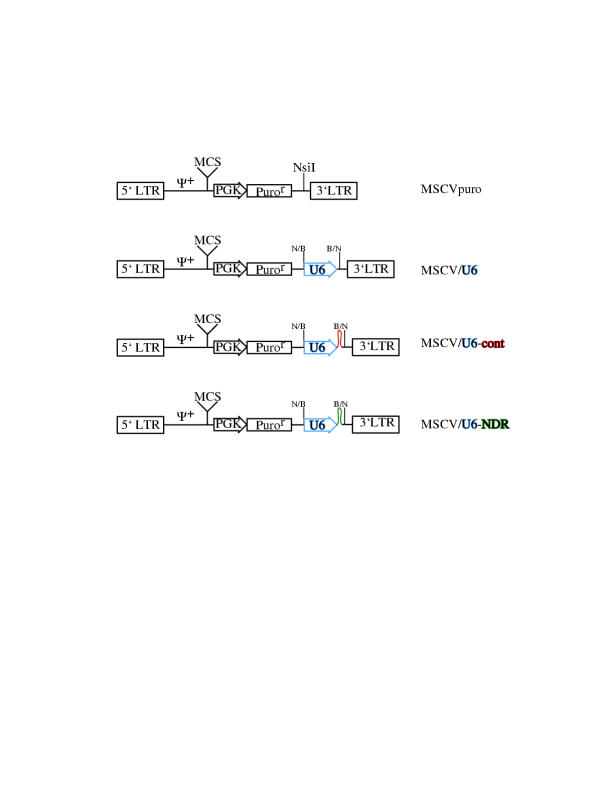
Figure 1
Figure 1
Construction of retroviral siRNA delivery vector Schematic of genome structure. All plasmids were derived from pMSCVpuro (Clontech). The inserted U6 promoter is illustrated in blue, while the control and anti-NDR hairpins are shown in red and green, respectively. Ψ+, extended packaging signal. MCS, multiple cloning site. PGK, murine phosphoglycerate kinase promoter. Puror, puromycin resistance gene. N/B and B/N, cloning junction generated by ligating the blunt ended BamHI and NsiI restriction sites.
Figure 2
Figure 2
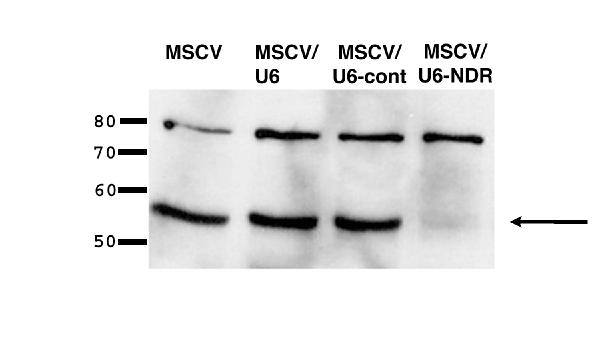
Rapid, stable suppresion of NDR by retrovirus-delivered siRNA HeLa cells were infected with the viruses illustrated in Fig. 1. Proteins were extracted from cells infected with each virus and NDR levels were examined by western blot analysis. Arrow indicates dramatic downregulation of NDR only in cells infected with MSCV/U6-NDR. The upper band was detected by the anti-p75 antibody, which serves as an internal loading and specificity control. Identical results were obtained with cells examined 24-hours post infection or after several passages (data not shown).
Figure 3
Figure 3
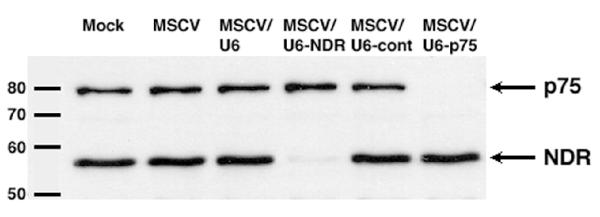
Suppression of NDR and p75 expression by retrovirus-delivered siRNA. HeLa-CD4 cells were infected the viruses illustrated in Fig. 1 plus an additional virus, MSCV/U6-p75. Western blot analysis demonstrates a dramatic downregulation of p75 in cells infected with MSCV/U6-p75 and NDR in cells infected with MSCV/U6-NDR. Infection with the various control viruses (MSCV, MSCV/U6, or MSCV/U6-cont) had no effect on p75 or NDR levels. For the mock-infected sample, puromycin selection was omitted.

References

    1. Gil J, Esteban M. Induction of apoptosis by the dsRNA-dependent protein kinase (PKR): Mechanisms of action. Apoptosis. 2000;5:107–114. doi: 10.1023/A:1009664109241. - DOI - PubMed
    1. Elbashir S, Harborth J, Lendeckel W, Yalcin A, Weber K, Tuschl T. Duplexes of 21-nucleotide RNAs mediate RNA interference in cultured mammalian cells. Nature. 2001;411:494–498. doi: 10.1038/35078107. - DOI - PubMed
    1. Caplen N, Parrish S, Imani F, Fire A, Morgan R. Specific inhibition of gene expression by small double-stranded RNAs in invertebrate and vertebrate cells. Proc Natl Acad Sci. 2001;98:9742–9747. doi: 10.1073/pnas.171251798. - DOI - PMC - PubMed
    1. Paddison P, Caudy A, Hannon G. Stable suppresion of gene expression by RNAi in mammalian cells. Proc Natl Acad Sci U S A. 2002;99:1443–1448. doi: 10.1073/pnas.032652399. - DOI - PMC - PubMed
    1. Paddison P, Caudy A, Bernstein E, Hannon G, Conklin D. Short hairpin RNAs (shRNAs) induce sequence-specific silencing in mammalian cells. Genes & Dev. 2002;16:948–958. doi: 10.1101/gad.981002. - DOI - PMC - PubMed

Publication types

Substances