


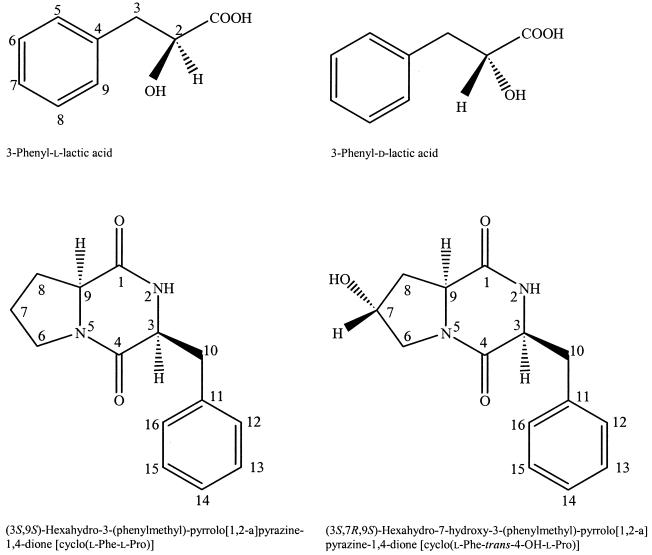
Lactobacillus plantarum MiLAB 393 produces the antifungal cyclic dipeptides cyclo(L-Phe-L-Pro) and cyclo(L-Phe-trans-4-OH-L-Pro) and 3-phenyllactic acid
- PMID: 12200282
- PMCID: PMC124062
- DOI: 10.1128/AEM.68.9.4322-4327.2002
Lactobacillus plantarum MiLAB 393 produces the antifungal cyclic dipeptides cyclo(L-Phe-L-Pro) and cyclo(L-Phe-trans-4-OH-L-Pro) and 3-phenyllactic acid
Abstract
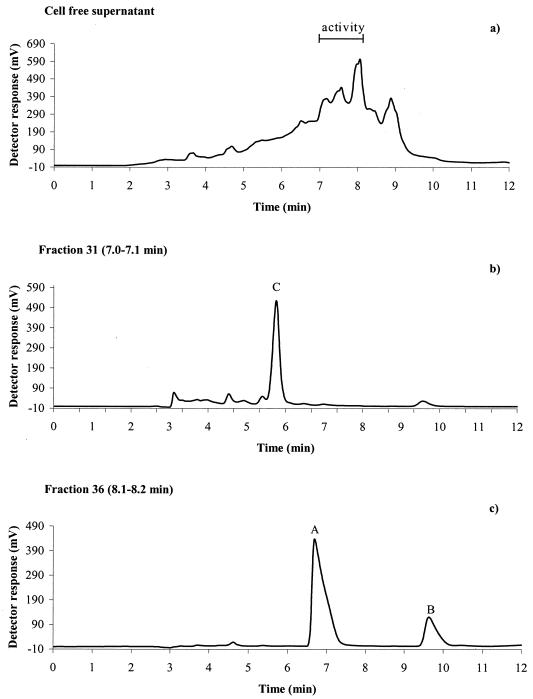
We have isolated a Lactobacillus plantarum strain (MiLAB 393) from grass silage that produces broad-spectrum antifungal compounds, active against food- and feed-borne filamentous fungi and yeasts in a dual-culture agar plate assay. Fusarium sporotrichioides and Aspergillus fumigatus were the most sensitive among the molds, and Kluyveromyces marxianus was the most sensitive yeast species. No inhibitory activity could be detected against the mold Penicillium roqueforti or the yeast Zygosaccharomyces bailii. An isolation procedure, employing a microtiter well spore germination bioassay, was devised to isolate active compounds from culture filtrate. Cell-free supernatant was fractionated on a C(18) SPE column, and the 95% aqueous acetonitrile fraction was further separated on a preparative HPLC C(18) column. Fractions active in the bioassay were then fractionated on a porous graphitic carbon column. The structures of the antifungal compounds cyclo(L-Phe-L-Pro), cyclo(L-Phe-trans-4-OH-L-Pro) and 3-phenyllactic acid (L/D isomer ratio, 9:1), were determined by nuclear magnetic resonance spectroscopy, mass spectrometry, and gas chromatography. MIC values against A. fumigatus and P. roqueforti were 20 mg ml(-1) for cyclo(L-Phe-L-Pro) and 7.5 mg ml(-1) for phenyllactic acid. Combinations of the antifungal compounds revealed weak synergistic effects. The production of the antifungal cyclic dipeptides cyclo(L-Phe-L-Pro) and cyclo(L-Phe-trans-4-OH-L-Pro) by lactic acid bacteria is reported here for the first time.
Figures
References
-
- Corsetti, A., M. Gobbetti, J. Rossi, and P. Damiani. 1998. Antimould activity of sourdough lactic acid bacteria: identification of a mixture of organic acids produced by Lactobacillus sanfrancisco CB1 Appl. Microbiol. Biotechnol. 50:253-256. - PubMed
-
- deHoog, G. S. 1996. Risk assessment of fungi reported from humans and animals. Mycoses 39:407-417. - PubMed
-
- Dieuleveux, V., S. Lemarinier, and M. Gueguen. 1998. Antimicrobial spectrum and target site of D-3-phenyllactic acid. Int. J. Food Microbiol. 40:177-183. - PubMed
-
- Frändberg, E., C. Petersson, L. N. Lundgren, and J. Schnürer. 2000. Streptomyces halstedii K122 produces the antifungal compounds bafilomycin B1 and C1. Can. J. Microbiol. 46:753-758. - PubMed
-
- Graz, M., A. Hunt, H. Jamie, G. Grant, and P. Milne. 1999. Antimicrobial activity of selected cyclic dipeptides. Pharmazie 54:772-775. - PubMed
Publication types
MeSH terms
Substances
LinkOut - more resources
Full Text Sources
Other Literature Sources
Research Materials
