. 2002 Sep 17;99(19):12001-5.
doi: 10.1073/pnas.182233999. Epub 2002 Aug 28.

Trojan particles: large porous carriers of nanoparticles for drug delivery

Affiliations

Trojan particles: large porous carriers of nanoparticles for drug delivery

N Tsapis et al. Proc Natl Acad Sci U S A. .

Abstract

We have combined the drug release and delivery potential of nanoparticle (NP) systems with the ease of flow, processing, and aerosolization potential of large porous particle (LPP) systems by spray drying solutions of polymeric and nonpolymeric NPs into extremely thin-walled macroscale structures. These hybrid LPPs exhibit much better flow and aerosolization properties than the NPs; yet, unlike the LPPs, which dissolve in physiological conditions to produce molecular constituents, the hybrid LPPs dissolve to produce NPs, with the drug release and delivery advantages associated with NP delivery systems. Formation of the large porous NP (LPNP) aggregates occurs via a spray-drying process that ensures the drying time of the sprayed droplet is sufficiently shorter than the characteristic time for redistribution of NPs by diffusion within the drying droplet, implying a local Peclet number much greater than unity. Additional control over LPNPs physical characteristics is achieved by adding other components to the spray-dried solutions, including sugars, lipids, polymers, and proteins. The ability to produce LPNPs appears to be largely independent of molecular component type as well as the size or chemical nature of the NPs.


Figures
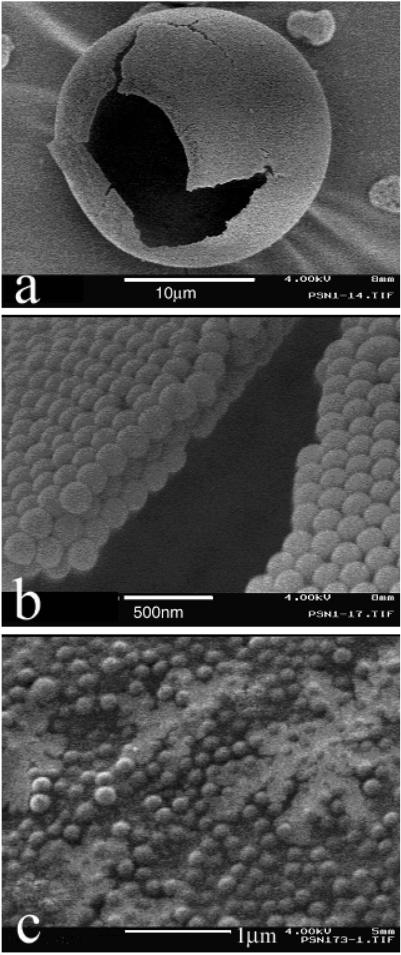
Fig 1.
Fig 1.
SEM images of (a) a typical hollow sphere LPNP observed from the spray drying of a solution of PS NPs (170 nm), (b) a magnified view of the particle surface in a, and (c) the NPs in solution after redissolving the LPNPs in a mixture of 70:30 ethanol/water (vol/vol). LPNPs dissolve readily into the NPs once in solution.
Fig 2.
Fig 2.
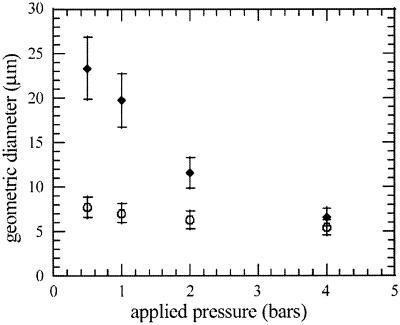
Variation of the geometric size with applied pressure for freeze-dried 170-nm NPs (⧫) and spray-dried LPNPs made of the same NPs (○). NPs show a strong dependence of aerosol particle size (≫170 nm) on applied pressure, illustrating their tendency to aggregate and flow with a nonlinear dependence with the stress, whereas the LPNPs show little such dependence, with a geometric size in good agreement with SEM pictures.
Fig 3.
Fig 3.
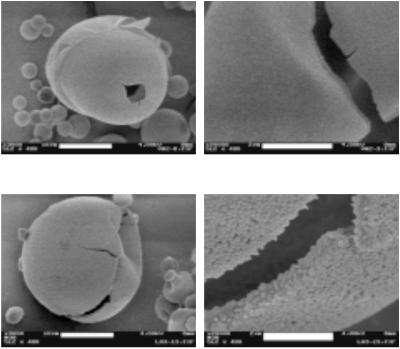
SEM images of typical hollow spheres observed from the spray drying of a solution of PS NPs (25 nm, Upper) and a solution of lactose and PS NPs (170 nm, 70% of total solid contents in weight, Lower). [Scale bars: 10 μm (Left) and 2 μm (Right).]
Fig 4.
Fig 4.
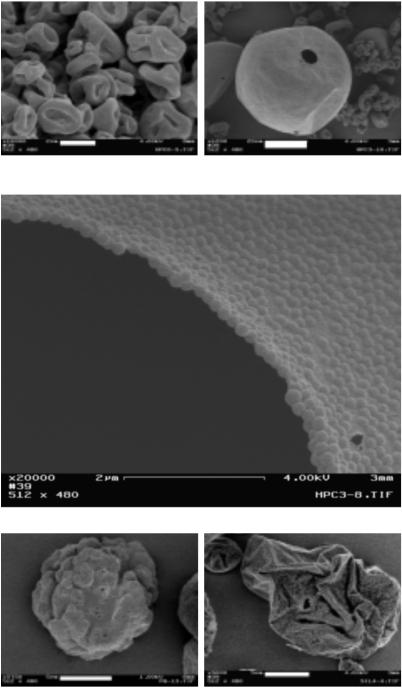
SEM images of a typical hydroxypropylcellulose spray-dried particle without (Top Left) and with (Top Right) NPs. (Middle) A magnification of the particle surface (Top Right). (Bottom) A typical particle observed from the spray drying of a solution of BSA and PS NPs (170 nm, 80% of total solid contents in weight, Bottom Left), and a typical particle observed from the spray drying of a solution of lipids/lactose and colloidal silica (≈100 nm, 88% of total solid contents in weight, Bottom Right). [Scale bars: 2 μm (Top Left and Middle), 20 μm (Top Right), and 5 μm (Bottom).]
Fig 5.
Fig 5.
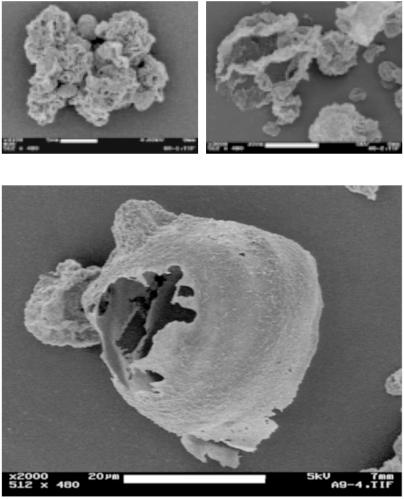
SEM pictures of typical particles from the spray drying of a solution of lipids and lactose with increasing concentration of PS NPs (170 nm): 0% (Upper Left), 35% (Upper Right), and 82% of total solid content (Lower). [Scale bars: 5 μm (Upper Left), 10 μm (Upper Right), and 20 μm (Lower).]
Fig 6.
Fig 6.
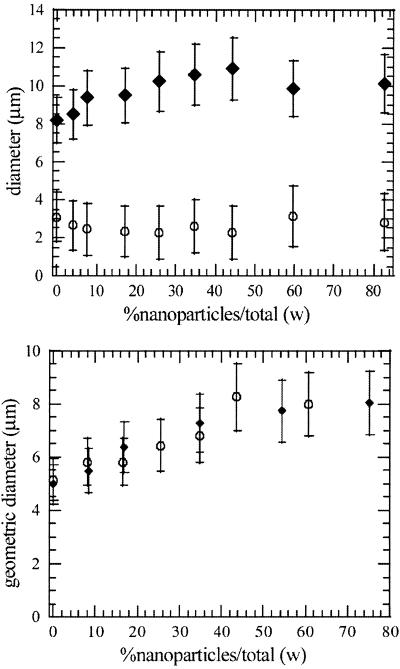
(Upper) Variation of the mass mean aerodynamic diameter (○) and the geometric diameter (⧫) of the DPPC-DMPE-lactose solution spray dried according to conditions SD1, with PS NP concentration (170 nm). (Lower) Variation of the geometric diameter of the DPPC-DMPE-lactose solution spray dried with SD2 conditions, with PS NP concentration (○, 25 nm; ⧫, 170 nm).

References

    1. Edwards D. A., Hanes, J., Caponetti, G., Hrkach, J., BenJebria, A., Eskew, M. L., Mintzes, J., Deaver, D., Lotan, N. & Langer, R. (1997) Science 276, 1868-1871. - PubMed
    1. Edwards D. A. (2002) AIChE J. 48, 2-6.
    1. French D. L., Edwards, D. A. & Niven, R. W. (1996) J. Aerosol Sci. 27, 769-783.
    1. Dunbar C., Hickey, A. & Holzner, P. (1998) KONA 16, 7-45.
    1. Kawaguchi H., Koiwai, N., Ohtsuka, Y., Miyamato, M. & Sasakawa, S. (1986) Biomaterials 7, 61-66. - PubMed