


Mechanisms of enhancement of human motor cortex excitability induced by interventional paired associative stimulation
- PMID: 12205201
- PMCID: PMC2290505
- DOI: 10.1113/jphysiol.2002.023317
Mechanisms of enhancement of human motor cortex excitability induced by interventional paired associative stimulation
Abstract
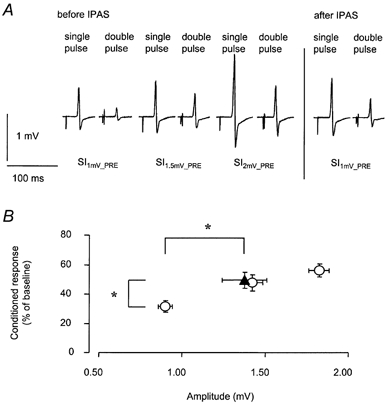
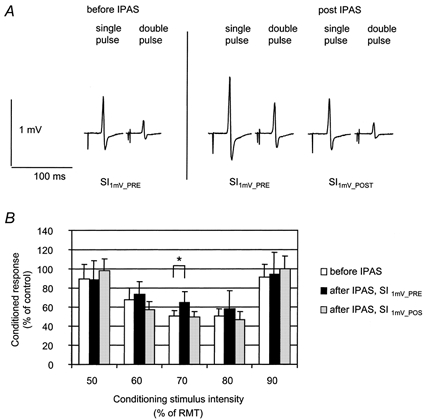
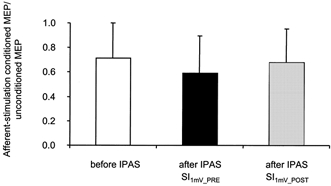
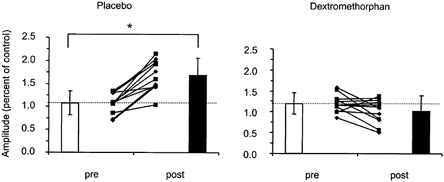
Associative stimulation has been shown to enhance excitability in the human motor cortex (Stefan et al. 2000); however, little is known about the underlying mechanisms. An interventional paired associative stimulation (IPAS) was employed consisting of repetitive application of single afferent electric stimuli, delivered to the right median nerve, paired with single pulse transcranial magnetic stimulation (TMS) over the optimal site for activation of the abductor pollicis brevis muscle (APB) to generate approximately synchronous events in the primary motor cortex. Compared to baseline, motor evoked potentials (MEPs) induced by unconditioned, single TMS pulses increased after IPAS. By contrast, intracortical inhibition, assessed using (i) a suprathreshold test TMS pulse conditioned by a subthreshold TMS pulse delivered 3 ms before the test pulse, and (ii) a suprathreshold test TMS pulse conditioned by afferent median nerve stimulation delivered 25 ms before the TMS pulse, remained unchanged when assessed with appropriately matching test stimulus intensities. The increase of single-pulse TMS-evoked MEP amplitudes was blocked when IPAS was performed under the influence of dextromethorphan, an N-methyl-D-aspartate (NMDA) receptor antagonist known to block long-term potentiation (LTP). Further experiments employing the double-shock TMS protocol suggested that the afferent pulse, as one component of the IPAS protocol, induced disinhibition of the primary motor cortex at the time when the TMS pulse, as the other component of IPAS, was delivered. Together, these findings support the view that LTP-like mechanisms may underlie the cortical plasticity induced by IPAS.
Figures
References
-
- Apland JP, Braitman DJ. Effects of non-opioid antitussives on epileptiform activity and NMDA responses in hippocampal and olfactory cortex slices. Brain Research. 1990;529:277–285. - PubMed
-
- Aroniadou VA, Keller A. Mechanisms of LTP induction in rat motor cortex in vitro. Cerebral Cortex. 1995;5:353–362. - PubMed
-
- Asanuma H, Pavlides C. Neurobiological basis of motor learning in mammals. NeuroReport. 1997;8:I–VI. - PubMed
-
- Baranyi A, Feher O. Synaptic facilitation requires paired activation of convergent pathways in the neocortex. Nature. 1981;290:413–415. - PubMed
-
- Baranyi A, Szente MB. Long-lasting potentiation of synaptic transmission requires postsynaptic modifications in the neocortex. Brain Research. 1987;423:378–384. - PubMed
Publication types
MeSH terms
Substances
LinkOut - more resources
Full Text Sources
Medical