


doi: 10.1073/pnas.192442999.
Epub 2002 Aug 30.
Nerve growth factor and galantamine ameliorate early signs of neurodegeneration in anti-nerve growth factor mice
Affiliations
- PMID: 12205295
- PMCID: PMC129462
- DOI: 10.1073/pnas.192442999
Item in Clipboard
Nerve growth factor and galantamine ameliorate early signs of neurodegeneration in anti-nerve growth factor mice
Proc Natl Acad Sci U S A.
.
Abstract
Phenotypic knockout of nerve growth factor (NGF) activity in transgenic anti-NGF mice (AD11 mice) results in a progressive neurodegenerative phenotype resembling Alzheimer's disease. In this article, we examine whether and how the progressive neurodegenerative phenotype of AD11 mice could be prevented or ameliorated by pharmacological treatments with NGF or the cholinergic agonist galantamine, at a relatively early phase of Alzheimer's disease-like neurodegeneration. We demonstrate that the neurodegeneration induced by the expression of anti-NGF antibodies in AD11 mice can be largely reversed by NGF delivery through an olfactory route.
Figures

(A) Two-month-old AD11 mice show a decreased number of ChAT-positive neurons in the BF. (B) Control mice. (C) Increased cholinergic deficit in 6-month-old AD11 mice. (D) Age-matched control. Entorhinal cortex: (E) Abnormal localization of phosphotau in 2-month-old AD11 mice, (F) absent in age-matched controls. (G) Higher number of phosphotau-positive neurons in 6-month-old AD11 mice with respect to (H) control mice. (I) APP in vessels (arrows) of 2-month-old AD11 mice. (J) No labeling in control mice. (K) APP extracellular deposits in 6-month-old AD11 mice. (L) Age-matched control mice. (M) Aβ-positive clusters of cells in 6-month-old AD11 mice. (N) Age-matched control mice. (O) β-amyloid plaques in 15-month-old AD11 mice. These plaques are not revealed in control mice (P). (Scale bars: A–J, M, and N, 200 μm; K, L, O, and P, 50 μm.)

(A) Analysis of free NGF levels in the brain, blood serum, and salivary gland from control mice, AD11 mice, and AD11 mice treated with LT4 or vehicle. (B) Total number of ChAT-positive neurons in control mice, AD11 mice, and AD11 mice treated with different concentrations of LT4. Immunohistochemical study: ChAT-positive neurons in (C) 2-month-old control mice, (D) AD11 untreated mice, and (E) LT4-treated AD11 mice. Hyperphosphorylated tau in (F) 2-month-old control mice, (G) untreated AD11 mice, and (H) LT4-treated AD11 mice. APP expression in (I) 2-month-old control mice, (J) untreated AD11 mice, and (K) LT4-treated AD11 mice. Arrows point to vessels heavily stained by the anti-APP antibody. (Scale bar = 200 μm.)
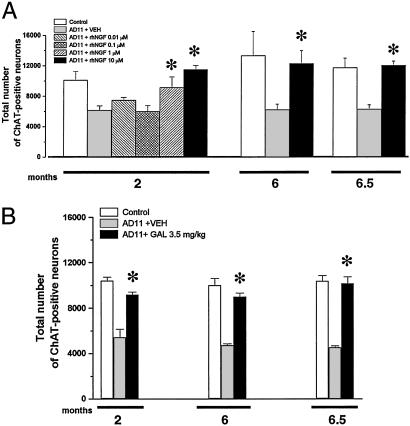
(A) Total number of ChAT-positive neurons in control mice, AD11 mice, and AD11 mice treated with different concentrations of rhNGF. (B) Total number of ChAT-positive neurons in control mice, AD11 mice, and AD11 mice treated with GAL.
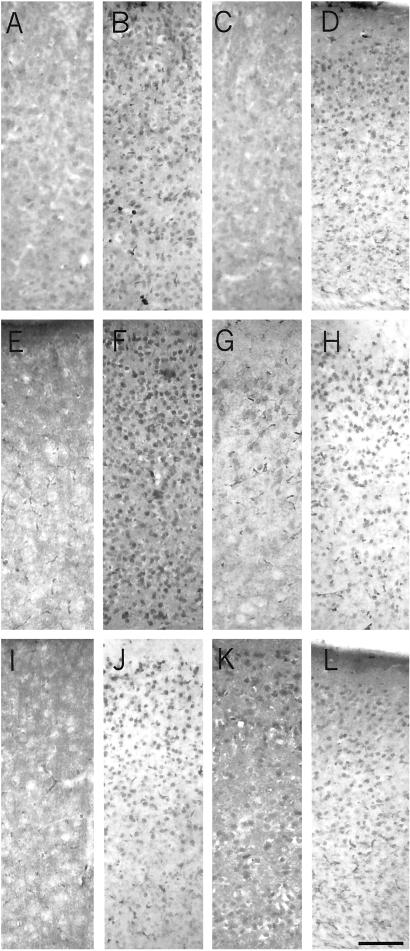
Hyperphosphorylated tau in 2-month-old mice is localized in the soma of neurons in the entorhinal cortex of AD11 mice (B) with respect to control mice (A). (C) At 2 months of age, the treatment with rhNGF decreases the expression in the soma. (D) The treatment with GAL does not decrease the expression in the soma. At 6 months of age, after a treatment for 2 months, rhNGF partially prevents the abnormal localization of phosphotau in the soma (G) with respect to control (E) and untreated AD11 mice (F). (H) GAL does not prevent the abnormal localization of phosphotau in the soma. At 6.5 months of age, phosphotau is not affected by rhNGF (K) or GAL (L). (J) Phosphotau distribution is comparable to those observed in untreated mice. (I) Control mice do not display labeling for phosphotau in neuronal soma. (Scale bar = 200 μm.)

At 2 months of age, APP is localized in the cerebral vessel of AD11 mice (B) with respect to control mice (A). (C) At this age APP increased expression in vessels in AD11 mice is not affected by rhNGF administration. (D) At this age APP increased expression in vessels in AD11 mice is reduced by GAL administration, and staining is comparable to that observed in control mice. Arrows point to APP-positive cerebral vessels. At 6 months of age, APP is extracellularly localized in AD11 mice (F) with respect to age-matched controls (E). After a treatment of 2 months, rhNGF does not influence APP extracellular deposition (G), whereas GAL is effective in decreasing APP extracellular deposition (H). At 6.5 months of age, control mice do not display APP extracellular deposits (I), whereas AD11 mice show them (J). After a treatment for 15 days, rhNGF is unable to rescue APP deposition (K), whereas GAL partially restores APP distribution (L). Arrows point to extracellular deposits of APP. (Scale bar = 200 μm.)
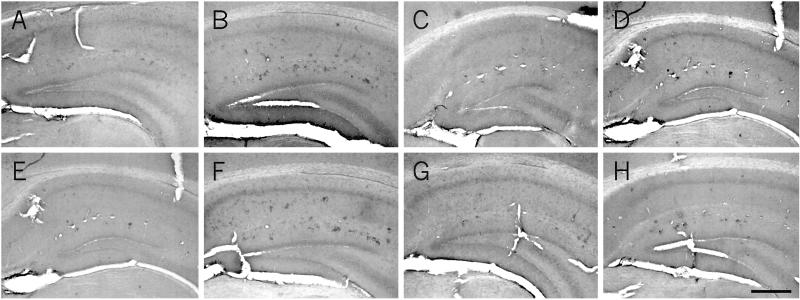
At 6 months of age, Aβ is localized in the soma of cells forming clusters in the hippocampus of AD11 mice (B) and is absent in control mice (A). At this age, treatment with rhNGF (C) and GAL (D) decreases the number of Aβ-positive clusters of cells. A more prolonged treatment, started at 4 months of age, further decreases the number of clusters in AD11-treated mice (G) compared with control mice (E) and untreated mice (F). (H) Treatment with GAL does not result in a further decrease of the number of Aβ-positive clusters of cells. (Scale bar = 100 μm.)
References
-
- Bartus R. T. (2000) Exp. Neurol. 163, 495-529. - PubMed
-
- Levi-Montalcini R. (1952) Ann. N.Y. Acad. Sci. 55, 330-343. - PubMed
-
- Levi-Montalcini R. (1987) Science 237, 1154-1162. - PubMed
-
- Sofroniew M. V., Howe, C. L. & Mobley, W. C. (2001) Annu. Rev. Neurosci. 24, 1217-1281. - PubMed
-
- Mobley W. C., Rutkwoski, J. L., Tennekoon, G. I., Gemski, J., Buchanan, K. & Johnston, M. V. (1986) Mol. Brain Res. 1, 53-52. - PubMed
MeSH terms
Substances
Grants and funding
LinkOut - more resources
Full Text Sources
Other Literature Sources
Molecular Biology Databases
