An indirect response model of homocysteine suppression by betaine: optimising the dosage regimen of betaine in homocystinuria
- PMID: 12207633
- PMCID: PMC1874404
- DOI: 10.1046/j.1365-2125.2002.01620.x
An indirect response model of homocysteine suppression by betaine: optimising the dosage regimen of betaine in homocystinuria
Abstract
Aims: To investigate the pharmacokinetics (PK) and pharmacodynamics (PD) of betaine in the treatment of classical homocystinuria due to cystathionine beta-synthase (CbetaS) deficiency with a view to optimizing the dosage regimen.
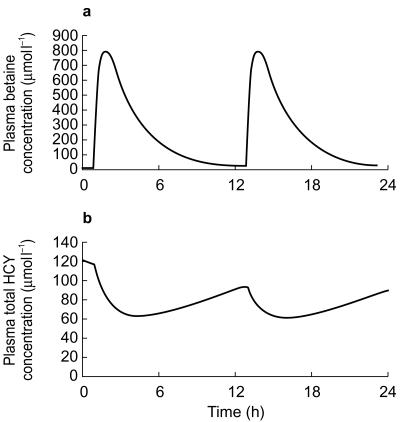
Methods: Betaine was given as a single oral dose of 100 mg kg(-1) to six patients (age range 6-17 years) who normally received betaine but whose treatment had been suspended for 1 week prior to the study. Plasma betaine and total homocysteine concentrations were measured by high performance liquid chromatography (h.p.l.c.) at frequent intervals over 24 h. The best-fit PK model was determined using the PK-PD program Win-Nonlin and the concentration-time-effect data analysed by an indirect PD model. Using the PK and PD parameters, simulations were carried out with the aim of optimizing betaine dosage.
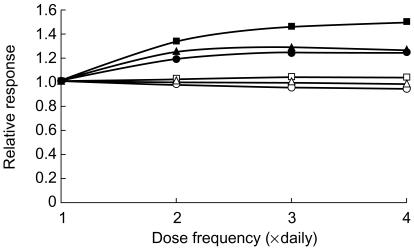
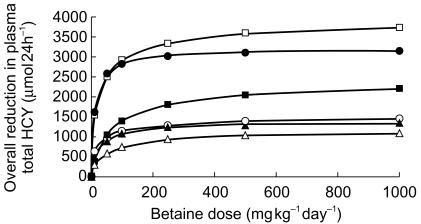
Results: Betaine PK was described by both mono- and bi-exponential disposition functions with first order absorption and a lag time. The correlation coefficient between betaine oral clearance and body weight was 0.6. Mean betaine clearance was higher in males than in females (P=0.03). PK-PD simulation indicated minimal benefit from exceeding a twice-daily dosing schedule and a 150 mg kg(-1) day(-1) dosage for betaine.
Conclusions: PK-PD modelling allows recommendations for optimal dosage of betaine in the treatment of homocystinuria, that have the potential for improved patient compliance and both therapeutic and pharmacoeconomic benefit.
Figures
References
-
- Mudd SH, Levy HL, Skovby F. Disorders of transsulphation. In: Scriver CR, Beaudet AL, Sly WS, Valle D, editors. The Metabolic Basis of Inherited Disease. 7. New York: McGraw-Hill; 1995. pp. 1279–1327.
-
- Fenton WA, Rosenberg LE. Inherited disorders of cobolamin transport and metabolism. In: Scriver CR, Beaudet AL, Sly WS, Valle D, editors. The Metabolic Basis of Inherited Disease. 7. New York: McGraw-Hill; 1995. pp. 3129–3149.
-
- Rosenblatt DS. Inherited disorders of folate transport and metabolism. In: Scriver CR, Beaudet AL, Sly WS, Valle D, editors. The Metabolic Basis of Inherited Disease. 7. New York: McGraw-Hill; 1995. pp. 3111–3128.
-
- Wilcken DEL, Wilcken B. The natural history of vascular disease in homocystinuria and the effects of treatment. J Inherit Metab Dis. 1997;20:295–300. - PubMed
MeSH terms
Substances
LinkOut - more resources
Full Text Sources
Other Literature Sources
Medical
Miscellaneous