


Review
doi: 10.1172/JCI16506.
Cholesterol modification of Hedgehog family proteins
Affiliations
- PMID: 12208857
- PMCID: PMC151115
- DOI: 10.1172/JCI16506
Item in Clipboard
Review
Cholesterol modification of Hedgehog family proteins
J Clin Invest.
2002 Sep.
No abstract available
Figures
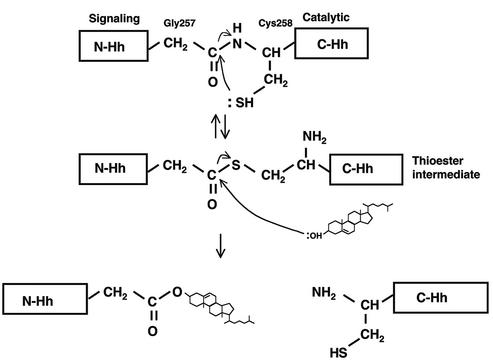
The mechanism of Hh autoprocessing. In Drosophila Hh, the cleavage takes place between Gly257 and Cys258. In the first step, the thiol group of Cys258 makes a nucleophilic attack on the carbonyl group of Gly257 to replace the peptide bond with a thioester. Subsequently, cholesterol attacks the same carbon in the thioester intermediate, which results in the covalent attachment of cholesterol to N-Hh and release of C-Hh. Both steps of the reaction depend on the catalytic activity of C-Hh, while the signaling activity resides in the N-terminal peptide. Adapted from ref. .
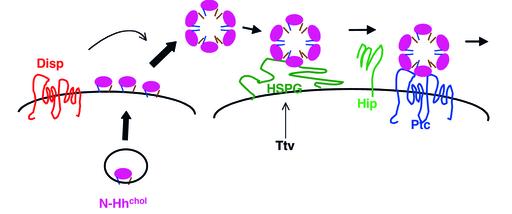
Release and movement of lipid-modified Hh. Secretion of N-Hhchol (with palmitoylation) requires the action of Disp, possibly to override the affinity of the lipid anchors to the membrane. Hexamerization of the ligand may facilitate this process by hiding the lipids inside the complex. Once released, N-Hhchol moves from one cell to another in a process dependent on HSPG whose synthesis requires Ttv. Ptc and Hip limit Hh diffusion by sequestering the ligand.
References
-
- Ingham PW, McMahon AP. Hedgehog signaling in animal development: paradigms and principles. Genes Dev. 2001;15:3059–3087. - PubMed
-
- Alexandre C, Lecourtois M, Vincent J-P. Wingless and Hedgehog pattern Drosophiladenticel belts by regulating the production of short-range signals. Development. 1999;126:5689–5698. - PubMed
-
- Zecca M, Basler K, Struhl G. Sequential organizing activities of engrailed, hedgehog, and decapentaplegic in Drosophilawing. Development. 1995;121:2265–2278. - PubMed
-
- Mullor J, Calleja M, Capdevila J, Guerrero I. Hedgehog activity, independently of decapentaplegic, participates in wing disc patterning. Development. 1997;124:1227–1237. - PubMed
-
- Strigini M, Cohen SM. A hedgehog activity gradient contributes to AP axial patterning of the Drosophilawing. Development. 1997;124:4697–4705. - PubMed
Publication types
MeSH terms
Substances
Grants and funding
LinkOut - more resources
Full Text Sources
Medical
Molecular Biology Databases
