. 2002 Sep;110(5):671-80.
doi: 10.1172/JCI16001.

Overexpression of ABCG5 and ABCG8 promotes biliary cholesterol secretion and reduces fractional absorption of dietary cholesterol

Affiliations

Overexpression of ABCG5 and ABCG8 promotes biliary cholesterol secretion and reduces fractional absorption of dietary cholesterol

Liqing Yu et al. J Clin Invest. 2002 Sep.

Abstract

Two ATP-binding cassette (ABC) transporters, ABCG5 and ABCG8, have been proposed to limit sterol absorption and to promote biliary sterol excretion in humans. To test this hypothesis, a P1 clone containing the human ABCG5 and ABCG8 genes was used to generate transgenic mice. The transgenes were expressed primarily in the liver and small intestine, mirroring the expression pattern of the endogenous genes. Transgene expression only modestly affected plasma and liver cholesterol levels but profoundly altered cholesterol transport. The fractional absorption of dietary cholesterol was reduced by about 50%, and biliary cholesterol levels were increased more than fivefold. Fecal neutral sterol excretion was increased three- to sixfold and hepatic cholesterol synthesis increased two- to fourfold in the transgenic mice. No significant changes in the pool size, composition, and fecal excretion of bile acids were observed in the transgenic mice. Transgene expression attenuated the increase in hepatic cholesterol content induced by consumption of a high cholesterol diet. These results demonstrate that increased expression of ABCG5 and ABCG8 selectively drives biliary neutral sterol secretion and reduces intestinal cholesterol absorption, leading to a selective increase in neutral sterol excretion and a compensatory increase in cholesterol synthesis.


Figures
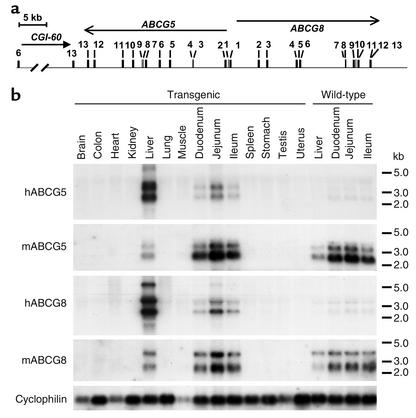
Figure 1
Figure 1
(a) The structure of the human ABCG5/ABCG8 transgene. A P1 clone (35B6; Incyte Genomics Inc.) containing a 90-kb insert was linearized with NotI, purified, and injected into fertilized embryos as described in Methods. The insert contains the entire coding regions of human ABCG5 and ABCG8, exons 6–13 of the putative gene CGI-60 at the 3′ end of ABCG5, and 6 kb of flanking sequence at the 3′ end of ABCG8. (b) Tissue distribution of human ABCG5 and ABCG8 mRNA in the transgenic mice. Total RNA was extracted from tissues of wild-type and transgenic mice consuming a chow diet. A total of 15 μg of RNA was fractionated on a 1% formaldehyde gel, transferred to a nylon membrane, and hybridized with 1 × 10⁶ cpm/ml of [α-32P]-labeled cDNA probes for human and mouse ABCG5 and ABCG8 at 65°C in Rapid-hyb Buffer (Amersham Biosciences Corp.). After stringent washing, the membrane was exposed to Kodak X-OMAT Blue XB-1 films (Eastman Kodak Co., Rochester, New York, USA) for 12–36 h at –80°C. This experiment was repeated, and the results were similar.
Figure 2
Figure 2
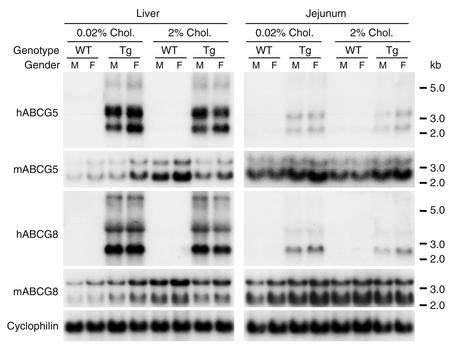
Northern blot analysis of ABCG5 and ABCG8 in male and female transgenic mice. Total RNA was isolated from the liver and jejunum of mice on a chow or 2% cholesterol diet. Equal amounts of total RNA from each mouse in each group were pooled and subjected to Northern blotting as described for Figure 1b. This experiment was repeated, and the results were similar. WT, wild-type transgene.
Figure 3
Figure 3
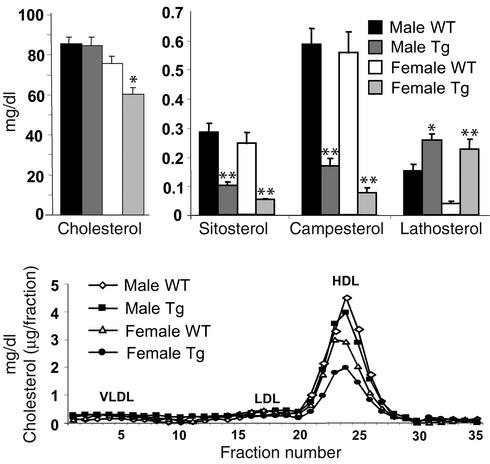
Levels of plasma sterols and lipoprotein profiles of ABCG5 and ABCG8 transgenic mice. Male and female 12-week-old transgenic mice and their littermate controls (n = 4–7 in each group) were maintained on a chow diet. After a 4-hour fast, the animals were sacrificed and the venous blood collected. The plasma was isolated by centrifugation, the plasma levels of cholesterol were measured as described in Methods, and the noncholesterol sterol levels of plasma were assayed by gas chromatography as described (8). Pooled plasma from each group of mice was subject to fast protein liquid chromatography fractionation, and the cholesterol content in each fraction was assayed as described in Methods. WT, wild-type; Tg, transgenic. *P < 0.05, **P < 0.01.
Figure 4
Figure 4
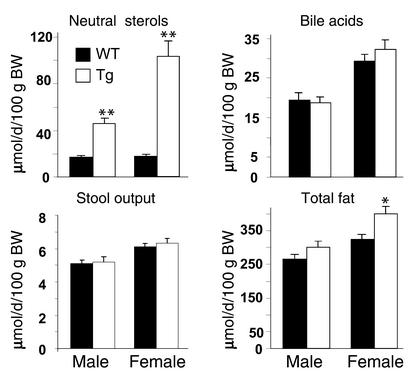
The fecal lipid content and composition of ABCG5 and ABCG8 transgenic mice. Feces were collected from 9- to 10-week-old transgenic mice and their littermate controls (n = 10 in each group) for 3 days while they consumed a chow diet. The daily total fecal weight, neutral sterols, bile acids, and total fat were measured and expressed per 100 g body weight (BW). *P < 0.01, **P < 0.001.
Figure 5
Figure 5
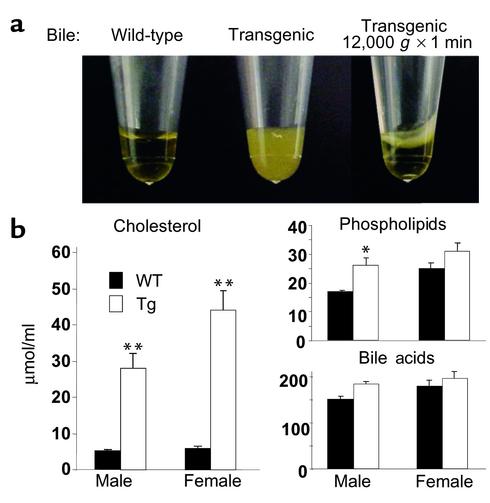
A comparison of the appearance of the bile (a) and the biliary lipid concentrations and composition (b) in the ABCG5/ABCG8 transgenic mice and littermate controls. The gallbladder bile was collected from 12-week-old wild-type (n = 4 in each group) and transgenic (n = 5 in each group) mice. The mice were fed ad libitum a chow diet and sacrificed nonfasted in the mid–light cycle. The biliary cholesterol, bile acids, and phospholipids were measured as described in Methods. This experiment was repeated in another line of transgenic mice (–1), and the results were similar. * P < 0.05, **P < 0.01.
Figure 6
Figure 6
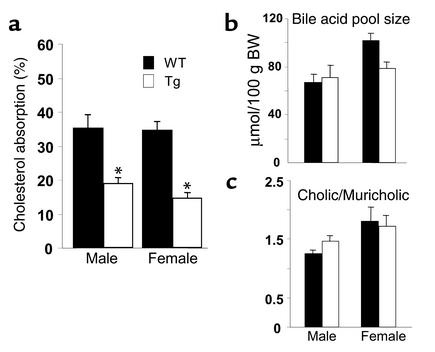
(a) The fractional absorption of dietary cholesterol in the ABCG5/ABCG8 transgenic mice. A total of six male and six female 9- to 10-week-old transgenic mice and their littermate controls were gavaged with [14C] cholesterol and [3H] sitostanol. Stool was collected for 3 days, and the ratio of the two isotopes in feces was measured to determine the fractional absorption of cholesterol, as described in Methods. (b) The bile acid pool size in the ABCG5/ABCG8 transgenic and wild-type mice. The content of total bile acids from the small intestine, gallbladder, and liver of chow-fed mice (12–13 weeks old) of the indicated genotype (n = 6 in each group) was determined by extracting the bile acids in ethanol. The bile acids were analyzed using HPLC as described in Methods. (c) The ratios of cholic to muricholic acids in the total bile acid pool. *P < 0.01.
Figure 7
Figure 7
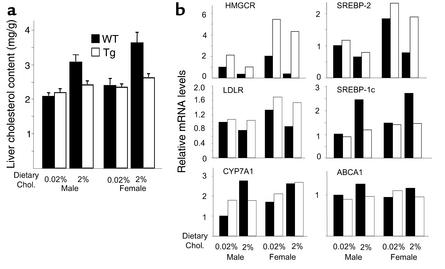
(a) The hepatic cholesterol levels in the ABCG5/ABCG8 transgenic and wild-type mice. Individually housed male and female 12-week-old mice of the indicated genotypes were fed a powdered chow diet (0.02% cholesterol) or the same diet containing 2% cholesterol for 21 days. The mice were sacrificed without fasting in the mid–light cycle. The livers were obtained and rapidly frozen in liquid nitrogen. Lipids were extracted and the hepatic cholesterol content was measured as described in Methods. The values shown represent the means of individual measurements in each experimental group (n = 5). (b) Quantitative real-time PCR from liver RNA of ABCG5/ABCG8 transgenic and wild-type mice. Total RNA from the liver of mice in each group (n = 5) was isolated and pooled for real-time PCR using oligonucleotides as described (18, 39). Cyclophilin was used as an internal control for these studies, and the values represent the amount relative to the amount in the chow-fed wild-type males, which was arbitrarily standardized to 1. This experiment was repeated in the 6-1 transgenic mouse line, and the results were similar.
Figure 8
Figure 8
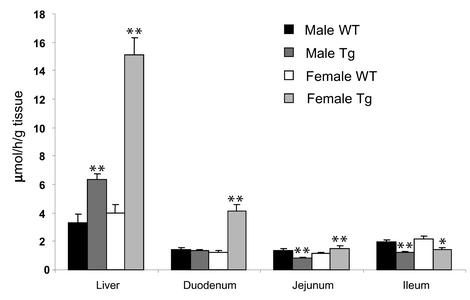
In vivo cholesterol synthesis rates in the ABCG5/ABCG8 transgenic mice and wild-type controls. Four-month-old transgenic and control mice (n = 6 in each group) maintained on a chow diet were injected intraperitoneally with 40 mCi of [3H] water. The mice were sacrificed 1 hour later, and the tissues were collected and processed as described in Methods. *P < 0.05, **P < 0.01. This experiment was repeated, and the results were similar.

Comment in

References

    1. Schoenheimer R. New contributions in sterol metabolism. Science. 1931;74:579–584. - PubMed
    1. Gould RG, Jones RJ, LeRoy GV, Wissler RW, Taylor CB. Absorbability of beta-sitosterol in humans. Metabolism. 1969;18:652–662. - PubMed
    1. Salen G, Ahrens EH, Jr, Grundy SM. Metabolism of beta-sitosterol in man. J Clin Invest. 1970;49:952–967. - PMC - PubMed
    1. Berge KE, et al. Accumulation of dietary cholesterol in sitosterolemia caused by mutations in adjacent ABC transporters. Science. 2000;290:1771–1775. - PubMed
    1. Lee MH, et al. Identification of a gene, ABCG5, important in the regulation of dietary cholesterol absorption. Nat Genet. 2001;27:79–83. - PMC - PubMed

Publication types

MeSH terms