. 2002 Oct;76(19):9664-72.
doi: 10.1128/jvi.76.19.9664-9672.2002.

The mengovirus leader protein suppresses alpha/beta interferon production by inhibition of the iron/ferritin-mediated activation of NF-kappa B

Affiliations

The mengovirus leader protein suppresses alpha/beta interferon production by inhibition of the iron/ferritin-mediated activation of NF-kappa B

Jan Zoll et al. J Virol. 2002 Oct.

Abstract

In our studies on the biological function of the mengovirus leader protein, we identified a casein kinase II (CK-2) phosphorylation site in the protein. Here we report that the mengovirus leader protein can be phosphorylated by CK-2 in vitro. Expression of a recombinant leader protein in which the consensus CK-2 sequence around threonine 47 was disturbed resulted in a mutant protein that could no longer be phosphorylated. The CK-2 consensus sequence was modified by site-directed mutagenesis and subsequently introduced into a mengovirus cDNA clone to investigate the effect of the phosphorylation of the leader protein on virus replication and on the host cell response. Modifications by which the CK-2 consensus sequence was disturbed resulted in mutant viruses with reduced growth kinetics. We demonstrated that the integrity of the CK-2 phosphorylation site of the mengovirus leader protein was specifically related to the suppression of NF-kappa B activation and subsequent suppression of alpha/beta interferon production in infected cells. We also found that the integrity of the CK-2 phosphorylation site of the leader protein coincided with an increase of ferritin expression in the infected cell. These data indicate that the leader protein suppresses the iron-mediated activation of NF-kappa B and thereby inhibits alpha/beta interferon expression in the infected cell.


Figures
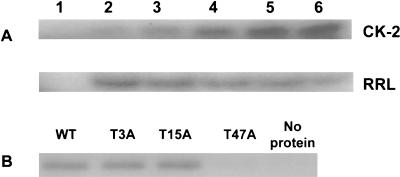
FIG. 1.
FIG. 1.
In vitro phosphorylation of the mengovirus leader protein by CK-2. (A) Time course of the phosphorylation of recombinant wild-type leader protein. Reactions were performed as described in Materials and Methods. Reactions were done in the absence of leader protein for 5 min (lane 1) or in the presence of 200 ng of leader protein for 1, 2, 3, 4, and 5 min (lanes 2, 3, 4, 5, and 6, respectively). Reactions were performed with CK-2 (upper panel) or in rabbit reticulocyte lysate (RRL) (lower panel). Reactions were analyzed by SDS-PAGE. (B) In vitro phosphorylation of recombinant leader proteins for 5 min by CK-2. Reactions were performed with 200 ng of recombinant wild-type (WT) leader protein or mutant (T3A, T15A, or T47A) leader protein or in the absence of leader protein. Reactions were analyzed by SDS-PAGE.
FIG. 2.
FIG. 2.
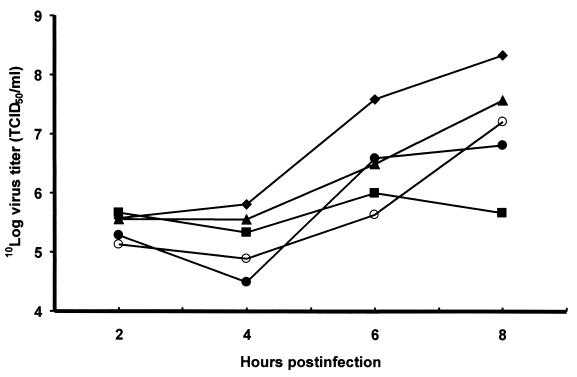
Single-cycle growth curves of wild-type virus vM16 (♦), vM16ΔL(12-64) (▪), vM16T47A (▴), vM16E50A (○), and vM16insG49 (•). L929 cells were infected at an MOI of 1 and harvested at 2, 4, 6, and 8 h postinfection. Virus titers were determined by titration (23).
FIG. 3.
FIG. 3.
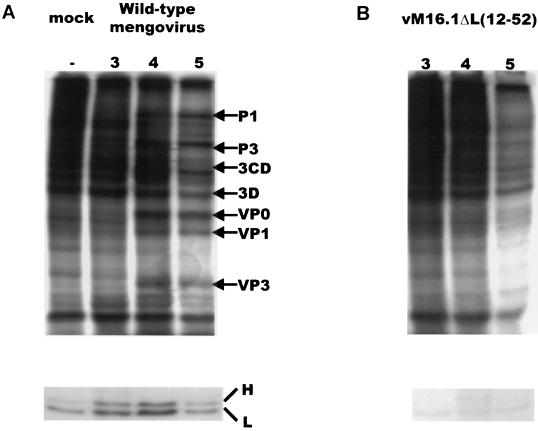
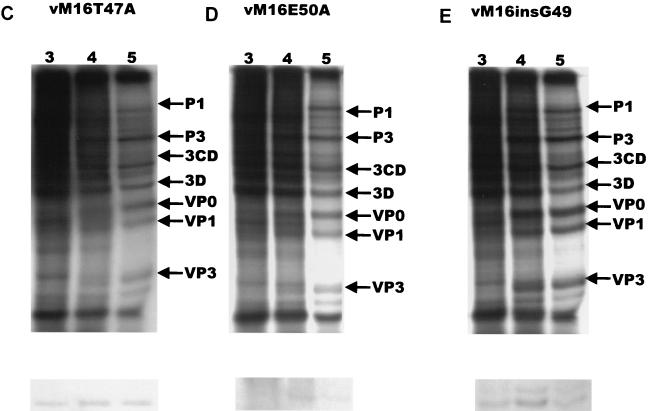
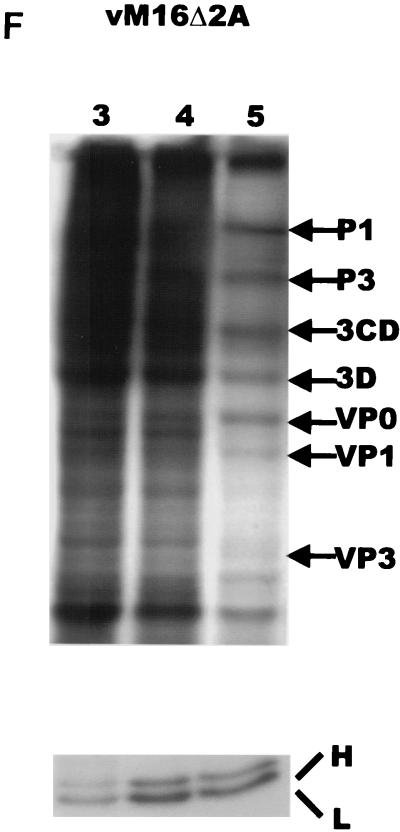
Protein synthesis in infected L929 cells. Cells were mock infected (A) or infected with wild-type mengovirus (A), vM16ΔL(12-52) (B), vM16T47A (C), vM16E50A (D), vM16insG49 (E), or vM16Δ2A (F) as indicated at an MOI of 50 TCID50/cell. At the time points indicated above the lanes (in hours postinfection), cells were pulse-labeled with [35S]methionine for 30 min. Cells were lysed and directly analyzed by SDS-PAGE on 12.5% polyacrylamide gels (upper panels) or used for immunoprecipitation of ferritin (lower panels). Viral proteins and heavy (H) and light (L) ferritin chains are indicated.
FIG. 3.
FIG. 3.
Protein synthesis in infected L929 cells. Cells were mock infected (A) or infected with wild-type mengovirus (A), vM16ΔL(12-52) (B), vM16T47A (C), vM16E50A (D), vM16insG49 (E), or vM16Δ2A (F) as indicated at an MOI of 50 TCID50/cell. At the time points indicated above the lanes (in hours postinfection), cells were pulse-labeled with [35S]methionine for 30 min. Cells were lysed and directly analyzed by SDS-PAGE on 12.5% polyacrylamide gels (upper panels) or used for immunoprecipitation of ferritin (lower panels). Viral proteins and heavy (H) and light (L) ferritin chains are indicated.
FIG. 3.
FIG. 3.
Protein synthesis in infected L929 cells. Cells were mock infected (A) or infected with wild-type mengovirus (A), vM16ΔL(12-52) (B), vM16T47A (C), vM16E50A (D), vM16insG49 (E), or vM16Δ2A (F) as indicated at an MOI of 50 TCID50/cell. At the time points indicated above the lanes (in hours postinfection), cells were pulse-labeled with [35S]methionine for 30 min. Cells were lysed and directly analyzed by SDS-PAGE on 12.5% polyacrylamide gels (upper panels) or used for immunoprecipitation of ferritin (lower panels). Viral proteins and heavy (H) and light (L) ferritin chains are indicated.
FIG. 4.
FIG. 4.
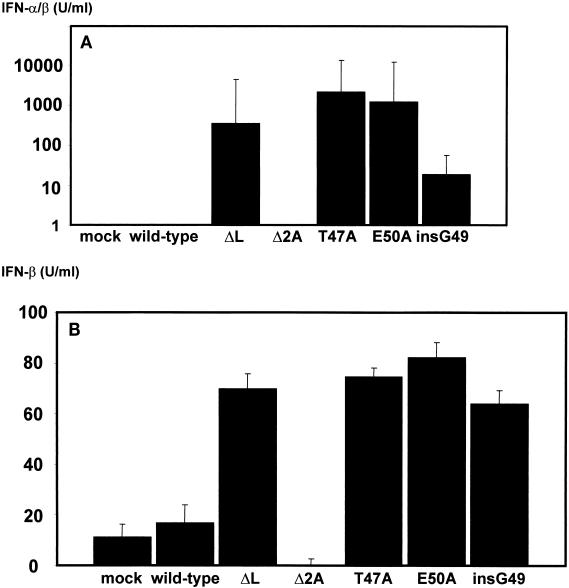
(A) Production of alpha/beta interferon in infected L929 cells. Cells were infected with the virus indicated at an MOI of 0.2 TCID50/ml for 48 h. Cell culture supernatants were treated for 24 h at pH 2, neutralized, and used for priming of fresh L929 cells. Interferon concentrations were calculated by using a standard curve of serial dilutions of alpha/beta interferon. (B) Production of beta interferon in infected HeLa cells. Cells were infected with the virus indicated at an MOI of 0.2 TCID50/ml for 48 h. Beta interferon production in cell culture supernatants was measured by enzyme-linked immunosorbent assay. Means and standard deviations from three independent experiments are indicated.
FIG. 5.
FIG. 5.
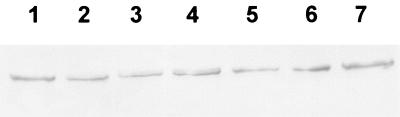
Synthesis of iNOS in infected L929 cells. Cells were mock infected (lane 1) or infected with wild-type mengovirus (lane 2), vM16ΔL(12-52) (lane 3), vM16T47A (lane 4), vM16E50A (lane 5), vM16insG49 (lane 6), or vM16Δ2A (lane 7) at an MOI of 50 TCID50/cell. At 5 h postinfection, cells were lysed and analyzed by Western blotting with antibodies against iNOS.
FIG. 6.
FIG. 6.
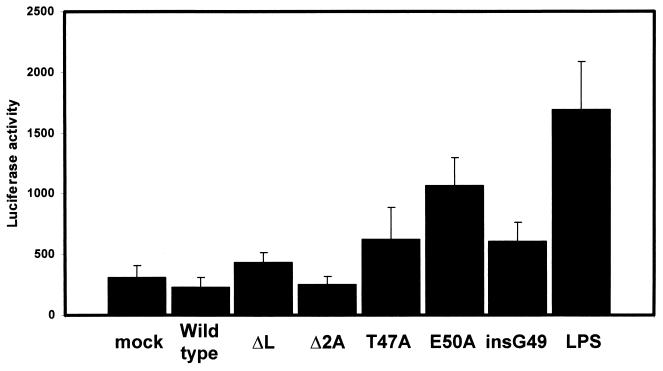
Activation of NF-κB in infected L929 cells. Cellular monolayers were transfected with an expression plasmid for luciferase under control of four repeats of the NF-κB binding site. At 48 h posttransfection, cells were mock infected or infected with wild-type mengovirus, vM16ΔL(12-52), vM16Δ2A, vM16T47A, vM16E50A, or vM16insG49 at an MOI of 10 TCID50/ml. As a control, cells were treated with 100 μg of lipopolysaccharide per ml. At 6 h postinfection, cellular lysates were tested for luciferase activity. Error bars indicate standard deviations.
FIG. 7.
FIG. 7.
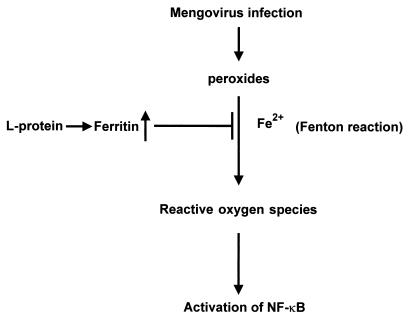
Role of ferritin and iron in the oxidative stress response. Various environmental factors, such as virus infections, cytokines, and UV radiation, enzymatically generate peroxides. Under the influence of iron ions, the peroxides are further reduced to hydroxyl radicals and other ROS that are capable of activating NF-κB. Ferritin forms an antioxidant system that traps free iron and thereby reduces the host cell response.

References

    1. Aisen, P., C. Enns, and M. Wessling-Resnick. 2001. Chemistry and biology of eukaryotic iron metabolism. Int. J. Biochem. Cell. Biol. 33:940-959. - PubMed
    1. Ausubel, F. M., R. Brent, R. E. Kingston, D. D. Moore, J. A. Smith, J. G. Seidman, and K. Struhl. 1995. Current protocols in molecular biology. John Wiley & Sons, New York, N.Y.
    1. Black, T. L., G. N. Barber, and M. G. Katze. 1993. Degradation of the interferon-induced 68,000-Mr protein kinase by poliovirus requires RNA. J. Virol. 67:791-800. - PMC - PubMed
    1. Boege, U., R. Hancharyk, and D. G. Scraba. 1987. The synthesis of a particle-forming cellular protein is enhanced by Mengo virus infection. Virology 159:358-367. - PubMed
    1. Cairo, G., L. Tacchini, G. Pogliaghi, E. Anzon, A. Tomasi, and A. Bernelli-Zazzera. 1995. Induction of ferritin synthesis by oxidative stress. Transcriptional and post-transcriptional regulation by expansion of the “free” iron pool. J. Biol. Chem. 270:700-703. - PubMed