. 2002 Sep;12(9):1386-400.
doi: 10.1101/gr.80202.

Temperature-regulated transcription in the pathogenic fungus Cryptococcus neoformans

Affiliations

Temperature-regulated transcription in the pathogenic fungus Cryptococcus neoformans

Barbara R Steen et al. Genome Res. 2002 Sep.

Abstract

The basidiomycete fungus Cryptococcus neoformans is an opportunistic pathogen of worldwide importance that causes meningitis, leading to death in immunocompromised individuals. Unlike many basidiomycete fungi, C. neoformans is thermotolerant, and its ability to grow at 37 degrees C is considered to be a virulence factor. We used serial analysis of gene expression (SAGE) to characterize the transcriptomes of C. neoformans strains that represent two varieties with different polysaccharide capsule serotypes. These include a serotype D strain of the C. neoformans variety neoformans and a serotype A strain of variety grubii. In this report, we describe the construction and characterization of SAGE libraries from each strain grown at 25 degrees C and 37 degrees C. The SAGE data reveal transcriptome differences between the two strains, even at this early stage of analysis, and identify sets of genes with higher transcript levels at 25 degrees C or 37 degrees C. Notably, growth at the lower temperature increased transcript levels for histone genes, indicating a general influence of temperature on chromatin structure. At 37 degrees C, we noted elevated transcript levels for several genes encoding heat shock proteins and translation machinery. Some of these genes may play a role in temperature-regulated phenotypes in C. neoformans, such as the adaptation of the fungus to growth in the host and the dimorphic transition between budding and filamentous growth. Overall, this work provides the most comprehensive gene expression data available for C. neoformans; this information will be a critical resource both for gene discovery and genome annotation in this pathogen.


Figures
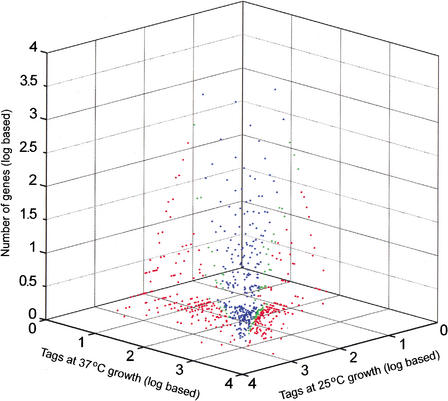
Figure 1
Figure 1
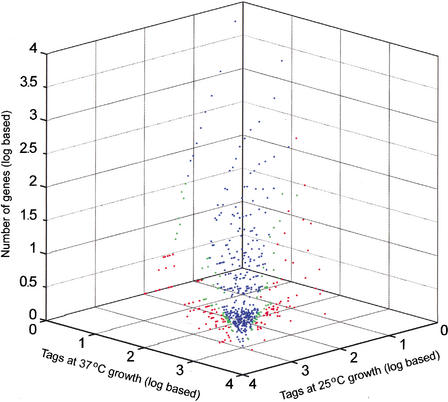
Expression profile comparing relative transcript levels at 25°C and 37°C in strain H99. Singleton tags were excluded. Blue dots indicate tags that do not show a significant expression difference; green dots, tags with a difference that is significant at 95% to 99% confidence; and red dots, tags with a significance of >99% confidence.
Figure 2
Figure 2
Expression profile comparing relative transcript levels at 25°C and 37°C in strain B3501. Singleton tags were excluded. Blue dots indicate tags that do not show a significant expression difference; green dots, tags with a difference that is significant at 95% to 99% confidence; and red dots, tags with a significance of >99% confidence.
Figure 3
Figure 3
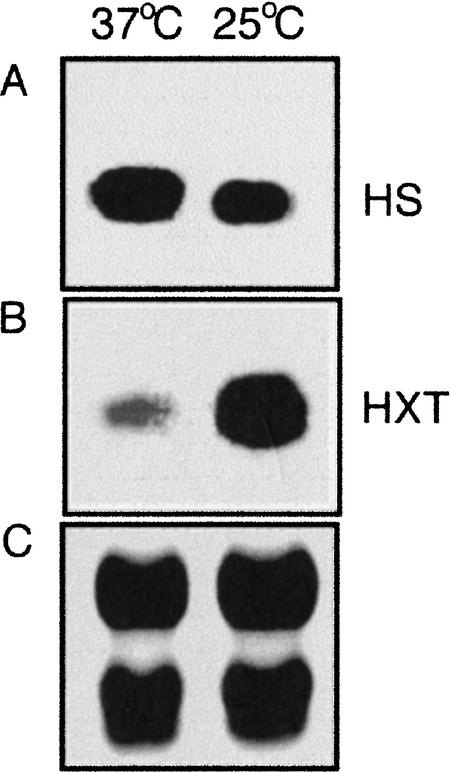
RNA blot analysis of two representative temperature-regulated genes in strain B3501. The RNA was isolated from cells grown at 25°C or 37°C. (A) Hybridization with a polymerase chain reaction (PCR) amplicon from a gene for a heat shock protein 70 (tag, CATAGTTGGT) with a higher transcript level at 37°C (HS). (B) Hybridization with a PCR amplicon from a gene for a high-affinity monosaccharide transporter (tag, GGCTTGACCA) with a higher transcript level at 25°C (HXT). (C) Ribosomal RNA (18S and 28S) bands as a loading control.

References

    1. Aguilar PS, Cronan JE, Jr, de Mendoza D. A Bacillus subtilisgene induced by cold shock encodes a membrane phospholipid desaturase. J Bacteriol. 1998;180:2194–2200. - PMC - PubMed
    1. Alspaugh JA, Perfect JR, Heitman J. Cryptococcus neoformansmating and virulence are regulated by the G-protein α subunit GPA1 and cAMP. Genes Dev. 1997;11:3206–3217. - PMC - PubMed
    1. Alspaugh AJ, Cavallo LM, Perfect JR, Heitman J. RAS1 regulates filamentation, mating and growth at high temperature of Cryptococcus neoformans. Mol Microbiol. 2000;36:352–365. - PubMed
    1. Alspaugh JA, Pukkila-Worley R, Harashima T, Cavallo LM, Funnell D, Cox GM, Perfect JR, Kronstad JW, Heitman J. Adenylyl cyclase functions downstream of the Gα protein GPA1 and controls mating and pathogenicity in Cryptococcus neoformans. Euk Cell. 2002;1:75–84. - PMC - PubMed
    1. Audic S, Claverie J-M. The significance of digital gene expression profiles. Genome Res. 1997;7:986–995. - PubMed

Publication types

MeSH terms