. 2002 Oct;184(19):5457-67.
doi: 10.1128/JB.184.19.5457-5467.2002.

sigmaB modulates virulence determinant expression and stress resistance: characterization of a functional rsbU strain derived from Staphylococcus aureus 8325-4

Affiliations

sigmaB modulates virulence determinant expression and stress resistance: characterization of a functional rsbU strain derived from Staphylococcus aureus 8325-4

Malcolm J Horsburgh et al. J Bacteriol. 2002 Oct.

Abstract

The accessory sigma factor sigmaB controls a general stress response that is thought to be important for Staphylococcus aureus survival and may contribute to virulence. The strain of choice for genetic studies, 8325-4, carries a small deletion in rsbU, which encodes a positive regulator of sigmaB activity. Consequently, to enable the role of sigmaB in virulence to be addressed, we constructed an rsbU(+) derivative, SH1000, using a method that does not leave behind an antibiotic resistance marker. The phenotypic properties of SH1000 (8325-4 rsbU(+)) were characterized and compared to those of 8325-4, the rsbU mutant, parent strain. A recognition site for sigmaB was located in the promoter region of katA, the gene encoding the sole catalase of S. aureus, by primer extension analysis. However, catalase expression and activity were similar in SH1000 (8325-4 rsbU(+)), suggesting that this promoter may have a minor role in catalase expression under normal conditions. Restoration of sigmaB activity in SH1000 (8325-4 rsbU(+)) resulted in a marked decrease in the levels of the exoproteins SspA and Hla, and this is likely to be mediated by reduced expression of agr in this strain. By using Western blotting and a sarA-lacZ reporter assay, the levels of SarA were found to be similar in strains 8325-4 and SH1000 (8325-4 rsbU(+)) and sigB mutant derivatives of these strains. This finding contrasts with previous reports that suggested that SarA expression levels are altered when they are measured transcriptionally. Inactivation of sarA in each of these strains resulted in an expected decrease in agr expression; however, the relative level of agr in SH1000 (8325-4 rsbU(+)) remained less than the relative levels in 8325-4 and the sigB mutant derivatives. We suggest that SarA is not likely to be the effector in the overall sigmaB-mediated effect on agr expression.


Figures
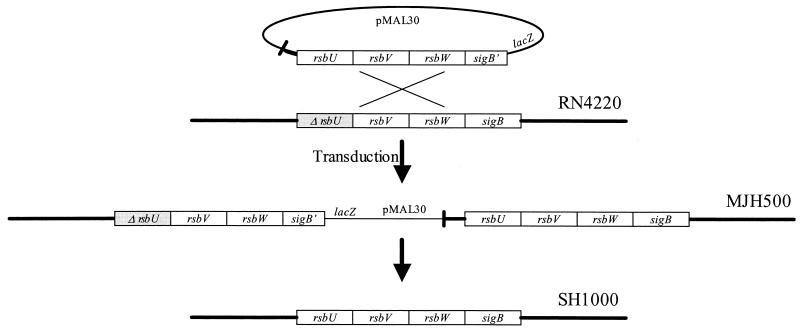
FIG. 1.
FIG. 1.
Schematic diagram illustrating the method used for construction of SH1000 (8325-4 rsbU+). A single crossover of pMAL30 into the chromosome of RN4220 produced a sigB-lacZ fusion, which was transferred to 8325-4 by transduction. The rsb-sigB locus was resolved by overnight growth in antibiotic-free medium followed by selection for white clones (loss of plasmid) and pigment formation (functional rsbU). ΔrsbU is the defective gene containing an 11-bp deletion.
FIG. 2.
FIG. 2.
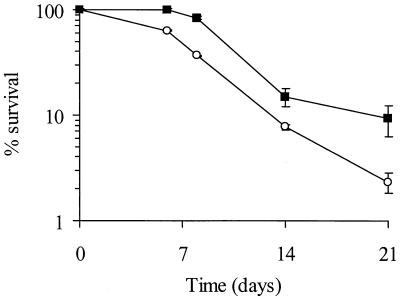
Starvation survival kinetics of SH1000 (8325-4 rsbU+) (▪) and 8325-4 (○) during prolonged incubation at 25°C in amino acid-limiting CDM medium. The values are representative of the results of three separate experiments, and the error bars indicate the mean errors.
FIG. 3.
FIG. 3.
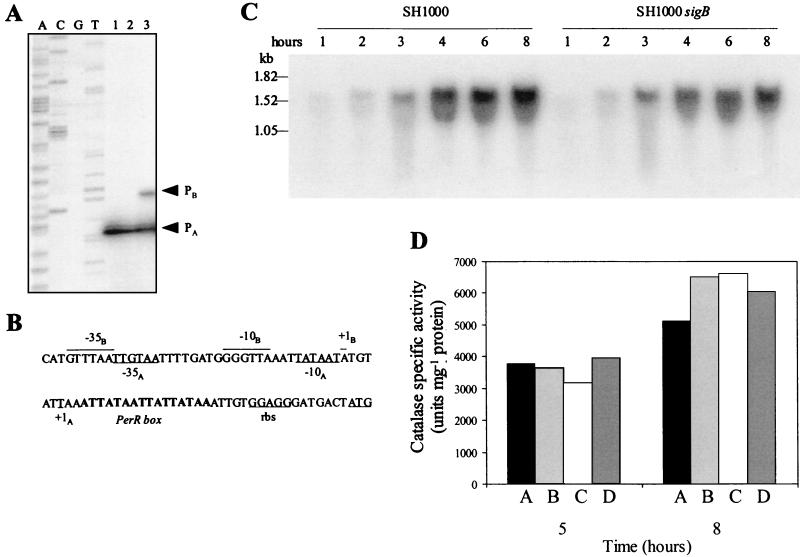
(A) Mapping of the 5′ ends of katA transcripts by primer extension analysis. One-hundred-microgram portions of RNA from post-exponential-phase cultures was used in reactions for 8325-4 (lane 1), PC400 (8325-4 sigB) (lane 2), and SH1000 (8325-4 rsbU+) (lane 3). Lanes A, C, G, and T show the dideoxy sequencing ladder obtained by using the same primer that was used for primer extension. (B) Potential −35 and −10 regions and transcriptional start sites (+1) for σA and σB are indicated by the subscripts A and B, respectively. The PerR box is indicated by boldface type, and rbs indicates the translational recognition sequence upstream of the translational start (underlined). (C) Transcript levels of katA during growth in 25 ml of BHI medium (medium/flask volume ratio, 1:10) at 37°C with shaking at 250 rpm. Samples were removed at the times indicated at the top, and the extracted RNA was probed by using a radiolabeled katA fragment. (D) Assay of catalase activity during growth in 25 ml of BHI medium (medium/flask volume ratio, 1:10) at 37°C with shaking at 250 rpm. Samples removed at different times were washed in PBS and then assayed. Bars A, SH1000 (8325-4 rsbU+); bars B, 8325-4; bars C, PC400 (8325-4 sigB); bars D, MJH502 (SH1000 rsbU+ sigB). Assays were performed in triplicate, and the means are shown. The results are representative of the results of two independent experiments.
FIG. 4.
FIG. 4.
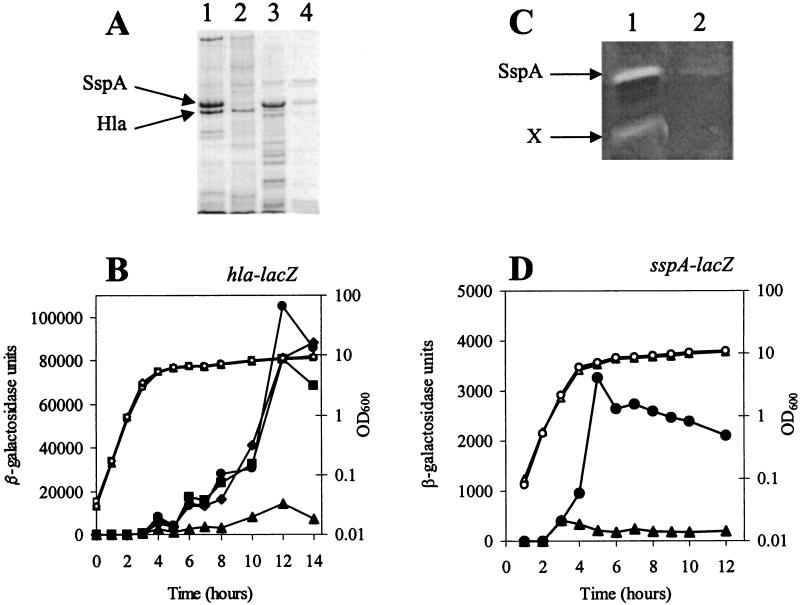
(A) Exoproteins of 8325-4 (lane 1), SH1000 (8325-4 rsbU+) (lane 2), PC1839 (8325-4 sarA) (lane 3), and SH1002 (SH1000 sarA) (lane 4) purified from culture supernatants after 15 h of growth. The arrows indicate the positions of serine protease (SspA) and alpha toxin (Hla), as verified by Western blotting (data not shown). In PC1839 (8325-4 sarA) there was increased proteolysis of Hla, as shown by the number of smaller fragments. (B) Assay of transcription from an hla-lacZ fusion during growth. Expression of the reporter fusion in PC322 (8325-4 hla-lacZ) (• and ○), JLA371 (SH1000 hla-lacZ) (▴ and ▵), PC4044 (8325-4 sigB hla-lacZ) (▪ and □), and JLA373 (SH1000 sigB hla-lacZ) (♦ and ⋄) was measured at different times. •, ▴, ▪, and ♦, β-galactosidase activity; ○, ▵, □, and ⋄, bacterial growth (OD600). The SH1000 sigB mutant derivatives were confirmed to be rsbU+ by using the PCR method of Kullik and Giachino (34). (C) Protease activities of 8325-4 (lane 1) and SH1000 (8325-4 rsbU+) (lane 2) visualized by using a gelatin-containing zymogram. The arrow labeled X indicates the position of unknown protease activity; the position of SspA was verified by comparison with the position of purified protein (V8 protease; Sigma) (data not shown). (D) Assay of transcription from an sspA-lacZ fusion during growth. Expression of the reporter fusion in LES07 (8325-4 sspA-lacZ) (• and ○) and LES08 (SH1000 sspA-lacZ) (▴ and ▵) was measured at different times. • and ▴, β-galactosidase activity; ○ and ▵, bacterial growth (OD600).
FIG. 5.
FIG. 5.
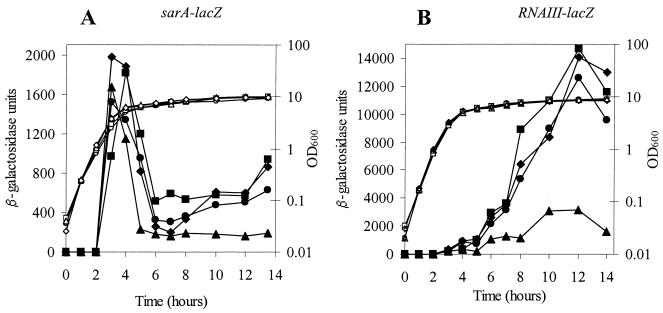
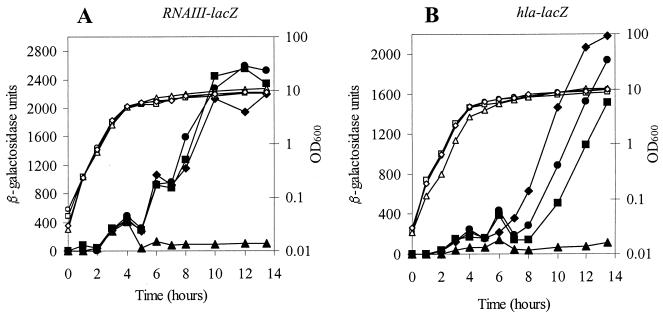
Assay of transcription from a sarA-lacZ fusion and an agr (RNA III)-lacZ fusion during growth. (A) Expression of the reporter fusion in PC161 (8325-4 sarA-lacZ) (• and ○), JLA311 (SH1000 sarA-lacZ) (▴ and ▵), PC4030 (8325-4 sigB sarA-lacZ) (▪ and □), and JLA313 (SH1000 sigB sarA-lacZ) (♦ and ⋄) at different times. (B) Expression of the reporter fusion in SH101F7 (8325-4 agr [RNA III]-lacZ) (• and ○), JLA341 (SH1000 agr [RNA III]-lacZ) (▴ and ▵), PC604 (8325-4 sigB agr [RNA III]-lacZ) (▪ and □), and JLA343 (SH1000 sigB agr [RNA III]-lacZ) (♦ and ⋄) at different times. •, ▴, and ▪, β-galactosidase activity; ○, ▵, and □, bacterial growth (OD600).
FIG. 6.
FIG. 6.
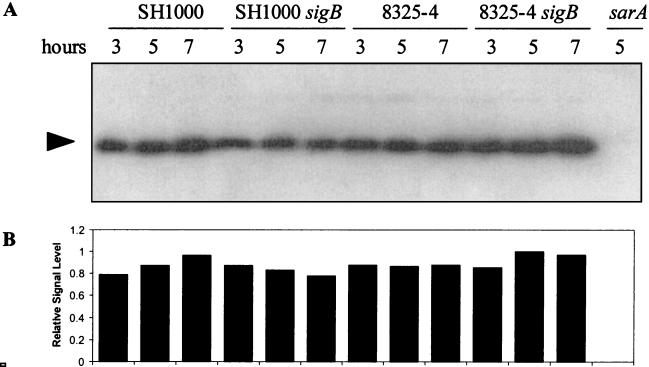
(A) Equivalent amounts of total cellular proteins (OD600 of culture, 0.1), isolated after lysostaphin digestion from cultures grown for 3, 5, and 7 h, were blotted and probed with purified immunoglobulin G antibodies raised against SarA (5). (B) SarA signals quantified on the blot by densitometry. The relative signal level for each lane was compared to the maximum signal level obtained. The results are representative of the results of three independent experiments.
FIG. 7.
FIG. 7.
Assay of an agr (RNA III)-lacZ fusion and an hla-lacZ fusion in a sarA mutant background during growth. (A) Expression of the reporter fusion in PC600 (8325-4 sarA agr [RNA III]-lacZ) (• and ○), JLA345 (SH1000 sarA agr [RNA III]-lacZ) (▴ and ▵), PC602 (8325-4 sarA sigB agr [RNA III]-lacZ) (▪ and □), and JLA347 (SH1000 sarA sigB agr [RNA III]-lacZ) (♦ and ⋄) at different times. (B) Expression of the reporter fusion in PC3221 (8325-4 sarA hla-lacZ) (• and ○), JLA375 (SH1000 sarA hla-lacZ) (▴ and ▵), JLA376 (8325-4 sarA sigB hla-lacZ) (▪ and □), and JLA377 (SH1000 sarA sigB hla-lacZ) (♦ and ⋄) at different times. •, ▴, and ▪, β-galactosidase activity; ○, ▵, and □, bacterial growth (OD600).
FIG. 8.
FIG. 8.
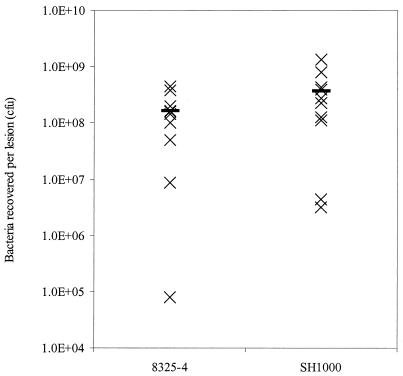
Virulence of S. aureus strains in a murine skin abscess model of infection. Approximately 108 CFU of each strain was inoculated subcutaneously into 6- to 8-week-old BALB/c mice. Seven days after infection mice were euthanatized, lesions were removed and homogenized, and viable bacteria were counted after dilution and growth on BHI agar plates. The bar indicates the mean recovery for each strain.

References

    1. Abdelnour, A., S. Arvidson, T. Bremell, C. Ryden, and A. Tarkowski. 1993. The accessory gene regulator (agr) controls Staphylococcus aureus virulence in a murine arthritis model. Infect. Immun. 61:3879-3885. - PMC - PubMed
    1. Bayer, M. G., J. H. Heinrichs, and A. L. Cheung. 1996. The molecular architecture of the sar locus in Staphylococcus aureus. J. Bacteriol. 178:4563-4570. - PMC - PubMed
    1. Beers, R. F., and I. W. Sizer. 1952. A spectrophotometric method for measuring the breakdown of hydrogen peroxide by catalase. J. Biol. Chem. 195:133-140. - PubMed
    1. Bischoff, M., J. M. Entenza, and P. Giachino. 2001. Influence of a functional sigB operon on the global regulators sar and agr in Staphylococcus aureus. J. Bacteriol. 183:5171-5179. - PMC - PubMed
    1. Blevins, J. S., A. F. Gillaspy, T. M. Rechtin, B. K. Hurlburt, and M. S. Smeltzer. 1999. The staphylococcal accessory regulator (sar) represses transcription of the Staphylococcus aureus collagen adhesin gene (cna) in an agr-independent manner. Mol. Microbiol. 33:317-326. - PubMed

Publication types

MeSH terms